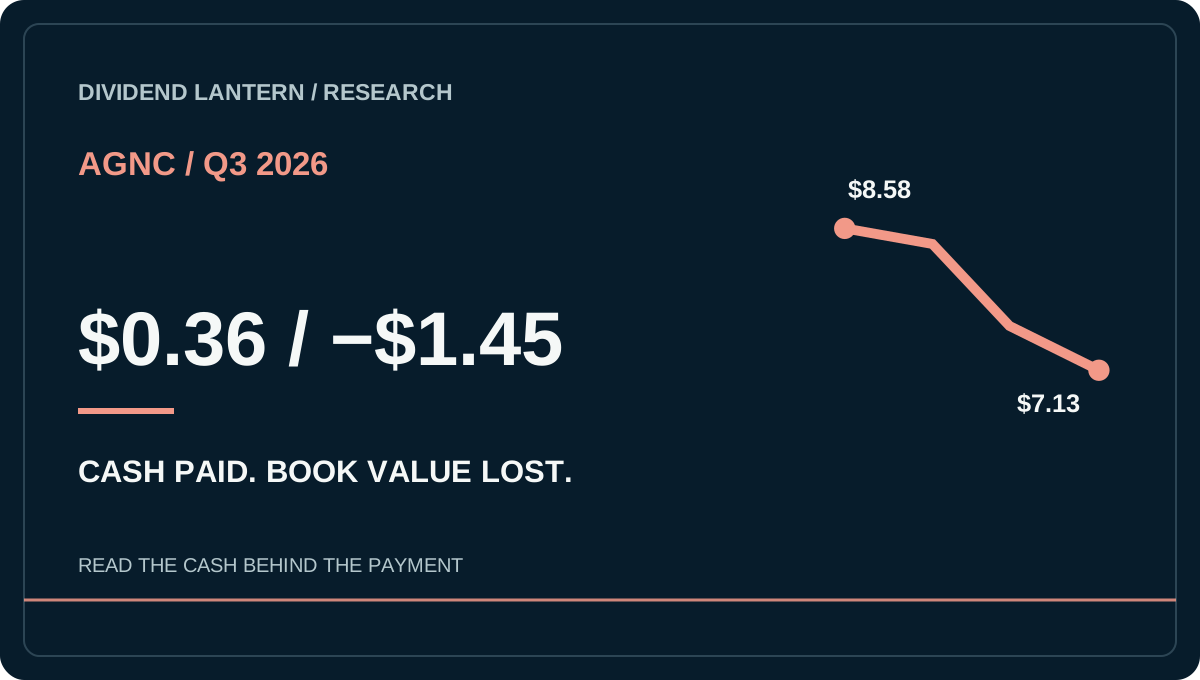
AGNC's third-quarter dividend was $0.36 per share. Tangible net book value fell $1.45 per share in the same quarter. Looking only at the monthly cash can make that a good quarter; looking only at the book-value loss can make the dividend seem irrelevant. Neither view is complete. AGNC itself reports negative 12.7% economic return on tangible common equity for Q3 2026, combining the $0.36 of dividends with the $1.45 book-value decline. The company released these results on October 19, 2026. AGNC Q3 results.

Two measures answer different questions
AGNC reported $0.37 per share of net spread and dollar roll income for the quarter, excluding a $0.05 estimated catch-up premium-amortization benefit. The $0.37 is a non-GAAP measure; it was only a cent above the $0.36 of dividends declared. A simple $0.37 ÷ $0.36 calculation gives roughly 1.03× on those specified measures. That is thin arithmetic coverage for one quarter, not a cash guarantee or a prediction of the next dividend. AGNC reconciles the non-GAAP measure with GAAP in its release and warns that its portfolio marks, financing and hedges must also be considered. AGNC Q3 results and reconciliation.
GAAP comprehensive loss was $1.28 per common share. That figure and the non-GAAP spread number are not interchangeable. The mortgage securities portfolio is marked to market; interest-rate movements, mortgage-bond spreads and hedge results can drive book value even when current carry produces distributable income. An investor who demands a single “payout ratio” analogous to a beverage company will miss this structure. The dividend is paid from the economic enterprise, but the portfolio's capital base and funding conditions influence what it can generate in the future.
Follow the capital behind the monthly cheque
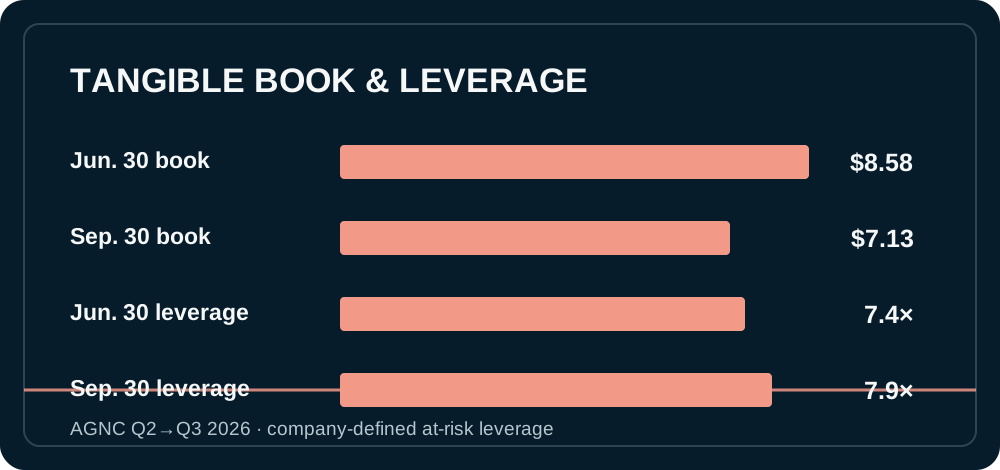
Tangible net book value declined from $8.58 per share at June 30 to $7.13 at September 30, a 16.9% drop. AGNC's tangible net book value at-risk leverage rose from 7.4× to 7.9× across those dates. The company disclosed $6.3 billion of unencumbered cash and Agency mortgage-backed securities at quarter-end. These are different kinds of information: book value per share describes a shrinking asset-value cushion; leverage shows sensitivity to portfolio movements; unencumbered assets provide liquidity. None alone answers whether the next $0.12 monthly dividend will be declared. AGNC Q3 release.
The financing detail is especially important for a leveraged mortgage REIT. AGNC reported a 3.95% weighted-average rate and 10-day weighted-average remaining maturity on its investment-security repurchase agreements at September 30, versus 3.75% and 13 days at June 30. Short-term financing can be rolled, but its cost and availability can change faster than a long-dated mortgage asset pays down. The firm uses hedges, so a simplistic “funding rate up equals dividend cut” conclusion would also be wrong. The task is to read the hedge and funding disclosures alongside book value. AGNC Q3 results.
Does share issuance solve the problem?
AGNC said it issued $992 million of common shares through an at-the-market program during the quarter at what it described as a significant premium to tangible book value. Issuing above book can be accretive to per-share book value at the time of issuance, but it also adds shares that may receive future dividends. Analyze per-share book value, per-share spread income and the total cash required for the dividend after issuance. Do not treat new equity as recurring operating earnings. AGNC Q3 release.
The common dividend declarations were $0.12 per share each for July, August and September, totaling $0.36 for Q3. They are dated board declarations, not a promise that every future month will pay $0.12. A monthly calendar is convenient for an investor, but a mortgage REIT's principal risk is the interaction of assets, leverage, financing and hedges.
A more honest AGNC dashboard
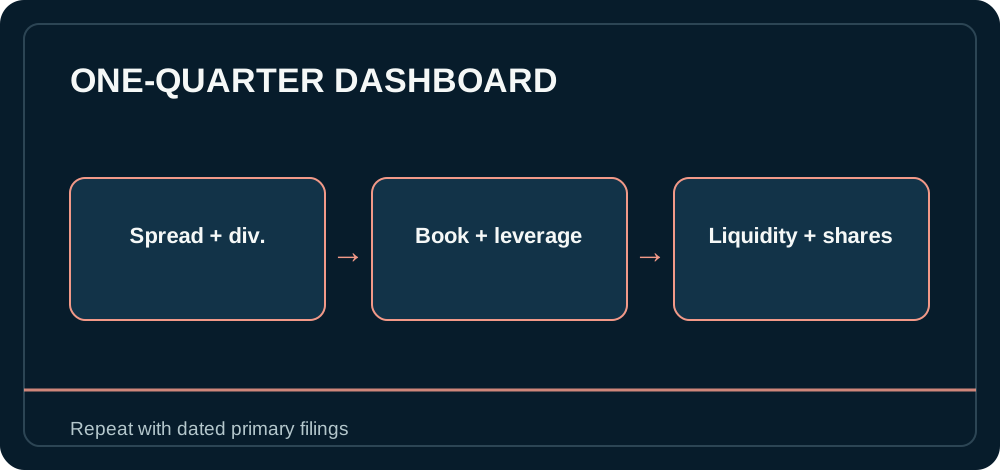
At each report, record (1) declared dividends; (2) net spread and dollar roll income with its reconciliation; (3) tangible book value per share; (4) economic return on tangible equity; (5) at-risk leverage and funding terms; (6) liquidity and new share issuance. Keep the dates aligned. If the spread number remains close to the dividend while book value erodes, a high market yield may be compensation for real risk rather than a free income opportunity.
This Q3 does not, by itself, prove an imminent cut. It does demonstrate why “the dividend was covered” cannot be the entire conclusion. Investors own the dividend and the remaining capital base.
The return bridge is the real headline
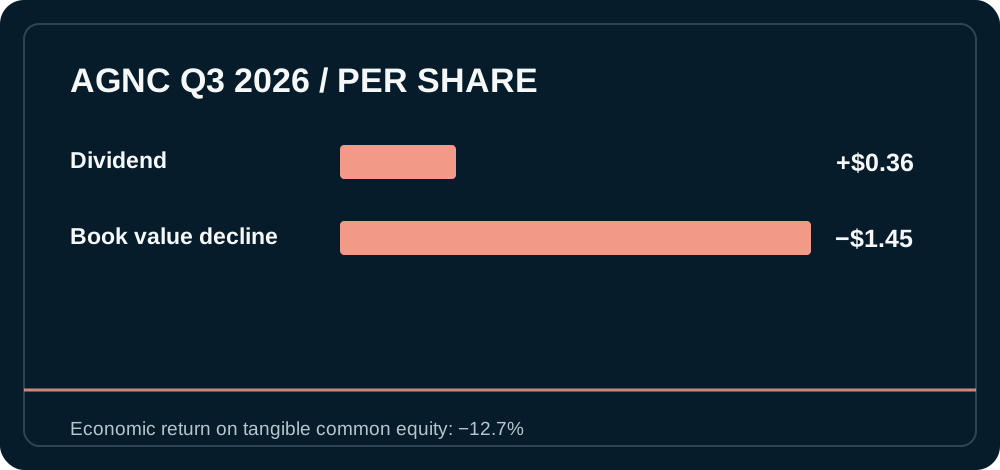
The $0.36 cash dividend and $1.45 fall in tangible book value refer to the same quarter and the same common share, which is why they belong on one graphic. Adding them with their signs gives negative $1.09 per share before considering where the shareholder bought or sold the stock. AGNC's company-defined economic return divides that combined change by starting tangible book value of $8.58, producing about negative 12.7% for Q3. This is an economic-book-value measure, not a market-price total return; a shareholder's quoted stock return can differ as the market premium or discount to book changes. AGNC Q3 results defines the metric and reports the components.
The bridge also clarifies what “covered” can and cannot mean. AGNC's $0.37 non-GAAP spread and dollar-roll measure, excluding the specified catch-up item, was slightly above $0.36 of dividends declared. That describes one kind of income capacity during the period. It does not erase the $1.45 change in the capital base. If mortgage spreads move adversely again, the starting asset cushion is lower; if conditions improve, the portfolio could recover. An investor needs both income and capital sensitivity, not a winner-take-all choice between them.
Stress the financing, not just the payout ratio
AGNC's at-risk leverage of 7.9× at September 30 means relatively small changes in portfolio asset values can have a larger effect on common equity, though the company uses hedges that modify exposures. A simple no-hedge leverage calculation should therefore be treated as a teaching scenario, not a prediction of AGNC's results. Its 10-day weighted-average remaining repo maturity also reminds investors that funding gets renegotiated far more frequently than the underlying agency mortgages pay off. The Q3 release reports these dated measures and the $6.3 billion of unencumbered cash and agency securities. AGNC Q3 release.
Run a qualitative stress case with three questions: what happens if mortgage securities fall relative to hedges; what happens if short-term financing becomes more expensive or less available; and what happens if the share price no longer supports issuance above tangible book? Each question affects a different part of the income engine. A liquidity buffer helps manage collateral and funding needs, but it is not distributable profit. Issuing new equity above book may support per-share value at issuance, but it does not make recurring income independent of market access.
For the next report, log the dividends actually declared after quarter-end, not merely the preceding monthly pattern. Recalculate non-GAAP coverage using the company's reconciliation and note any changed exclusions. Put tangible book value, at-risk leverage, repo terms, liquidity and new-share issuance in adjacent columns with exact period-end dates. If income coverage improves while the book-value decline reverses, the thesis strengthens. If a narrow income margin coexists with another large book loss, the market's high yield may be a warning about the capital needed to sustain future payments. Either outcome requires fresh evidence; Q3 alone cannot establish it.
Educational analysis of AGNC's published Q3 2026 results as of October 24, 2026. Company-defined non-GAAP measures are not GAAP cash flow. This is not a buy/sell recommendation or a forecast of board declarations.