

Alphabet grew revenue 25% in the third quarter of 2026, yet its free cash flow was negative $9.065 billion. That contrast, disclosed in the company's October 28 results filed with the SEC, is the useful story for a dividend investor. It is more informative than treating the following share-price decline as a verdict on the business. The stock was about 10% below its October 28 regular-session close in October 29 pre-market trading when this note was prepared; that was a moving market quote, not a completed regular-session return. GOOGL market quote.

The dividend did not disappear. Alphabet's board declared another $0.22 quarterly common dividend in October, with a December 14, 2026 payment date for holders of record on December 7. The question is whether the cash engine can support that payment, a much larger investment program and other claims on capital over time. A single negative quarter cannot answer it by itself. Alphabet Q3 2026 results.
The $9.1 billion cash-flow gap
The arithmetic is unusually stark. In Q3, Alphabet generated $42.290 billion of net cash from operating activities and spent $51.355 billion on property and equipment. Subtracting the latter from the former yields negative $9.065 billion of free cash flow, using the same definition Alphabet presents in its reconciliation. That is cash after this category of capital spending, not an accounting loss and not the company's cash balance. Q3 cash-flow statement and free-cash-flow reconciliation.
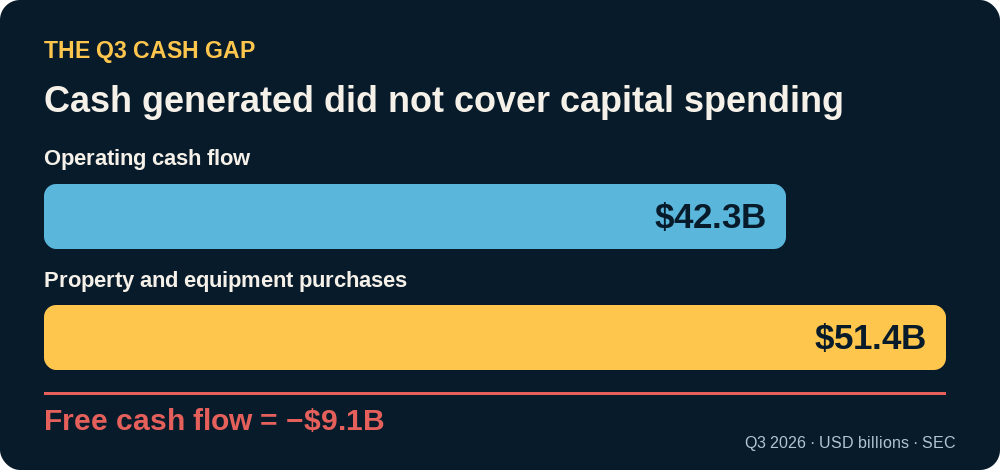
There is no need to pretend that the growth was weak. Revenue reached $127.577 billion, up 25% year over year, and operating income increased from $31.228 billion to $40.576 billion, about 30%. Google Cloud revenue rose from $15.157 billion to $30.709 billion. Those are powerful operating results. Cash available after the current investment cycle is a different measure, and it moved in the other direction. Alphabet Q3 highlights and segment results.
Reported earnings per diluted common share fell from $2.87 to $2.12. A reader should not call that entire change a collapse in operating performance: the filing shows an $8.664 billion loss on equity securities in Q3 2026 versus a $10.734 billion gain a year earlier. Alphabet says the current-quarter securities loss reduced diluted EPS by $0.55 after tax. Equity-investment marks can change reported profit without creating or consuming the same amount of operating cash. Income statement and other-income note.
The pattern matters more than one headline
The prior four quarters show why this is a real capital-allocation question, not just a one-day market reaction. Alphabet's own free-cash-flow reconciliation reports $24.551 billion in Q4 2025, $10.116 billion in Q1 2026, negative $5.855 billion in Q2, and negative $9.065 billion in Q3. Its trailing-twelve-month free cash flow was therefore still positive $19.747 billion at September 30, even after two negative quarters. Alphabet's quarterly and trailing-twelve-month reconciliation.
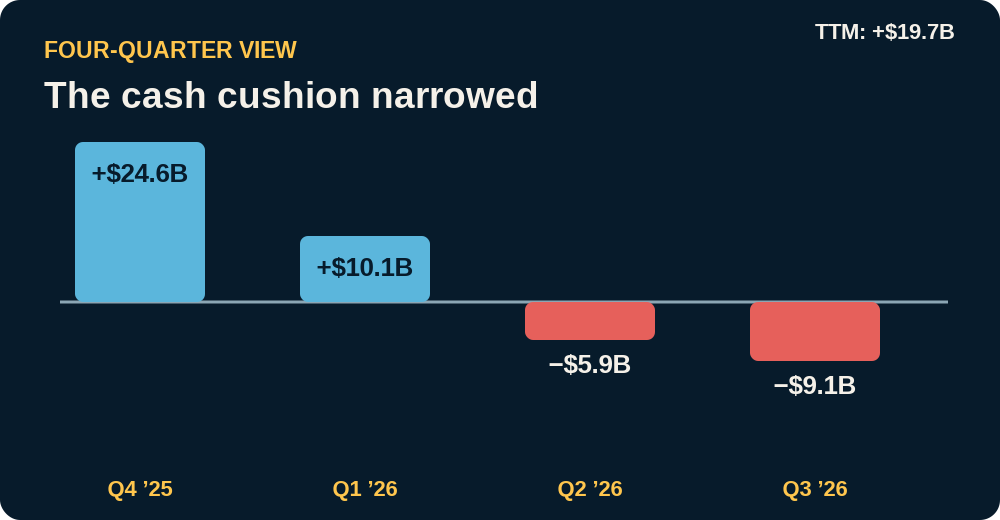
For the first nine months of 2026, operating cash flow of $127.149 billion was just below property and equipment purchases of $131.953 billion. Their difference was negative $4.804 billion. This nine-month period is not interchangeable with the positive twelve-month figure: the latter still includes the strong fourth quarter of 2025. A reader who reports only one of them misses the change in direction. Nine-month cash-flow statement.
Where the dividend fits
Alphabet's cash-flow statement records $2.936 billion of dividend payments on preferred and common stock combined in Q3, and $8.167 billion in the first nine months. Those cash totals are not solely the common dividend: the company has mandatory convertible preferred shares, and its filing separately reports preferred dividends. Nor should the newly declared $0.22 common payment be mistaken for cash already paid during Q3. Alphabet cash-flow statement and dividend declaration.
It would be mathematically wrong to divide a negative Q3 free-cash-flow figure into the cash dividend and announce that the payment must be cut. A company can draw on existing liquidity or finance investment while paying a dividend. At September 30, Alphabet reported $265.098 billion of cash, cash equivalents and marketable securities and $125.102 billion of long-term debt. Those are balance-sheet stocks measured on one date; neither proves that future data centers will earn a satisfactory return. September 30 balance sheet.
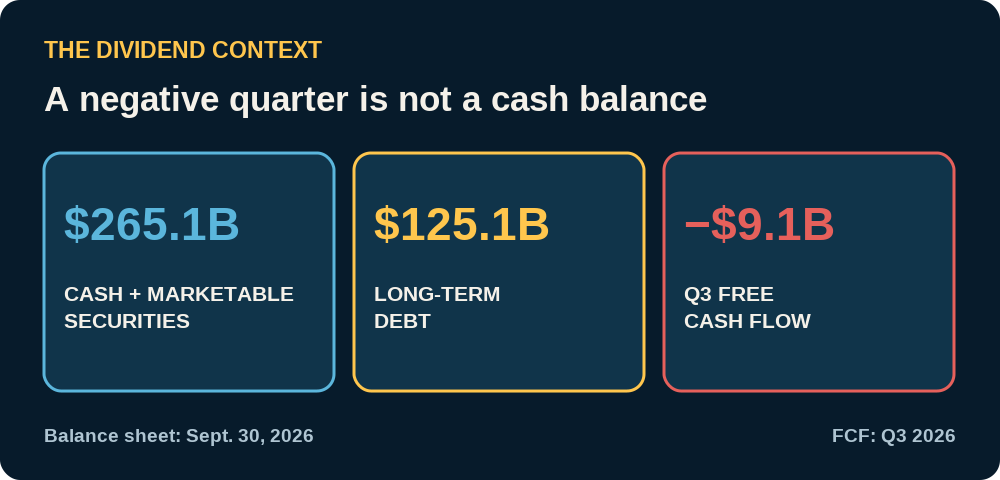
Financing also matters. In Q3, Alphabet reported $12.371 billion of net proceeds from common-stock issuance and $28.996 billion of debt proceeds, alongside zero stock repurchases in that quarter. These are financing cash flows, not sales or cash generated by the business. The company may rationally fund a long-lived build-out this way, but investors should not describe the dividend and infrastructure program as if both were paid from Q3 free cash flow. Q3 financing cash flows.
What to watch in the next report
The next useful test is whether incremental AI infrastructure spending turns into durable cash generation. Watch the same four lines in each report:
- Operating cash flow. Is growth in Search, Cloud and subscriptions translating into collected cash, or is working capital absorbing more of it?
- Property and equipment purchases. How quickly is the build-out rising, and when does spending stabilize relative to operating cash?
- Dividends and financing. Keep common and preferred distributions distinct; watch debt and equity issuance alongside repurchases.
- Rolling free cash flow. Recalculate a consistent trailing-twelve-month series, rather than extrapolating one quarter indefinitely.
Q3's cash-flow statement also shows $3.220 billion of cash used for inventory and $7.807 billion for other assets, so investment in equipment is not the only moving part of cash conversion. These working-capital lines deserve attention, but the filing alone cannot establish how much of each movement will repeat. Alphabet Q3 cash-flow statement.
A sharper conclusion than “dividend in danger”
Alphabet is growing rapidly and investing even faster. Q3's capital spending exceeded operating cash flow, and the current common dividend remained declared. The balance sheet and positive trailing-twelve-month free cash flow argue against treating one negative quarter as proof of an imminent cut. The consecutive negative quarters, increased financing and scale of capital spending argue for watching cash returns on those investments closely. That is the research question behind the share-price reaction—not a prediction that Alphabet will cut its dividend or a recommendation to buy the dip.
Educational analysis of Alphabet's October 28, 2026 Q3 release and SEC-filed statements, checked October 29, 2026. USD amounts are rounded where stated. Free cash flow is a non-GAAP measure defined by Alphabet as operating cash flow less capital expenditures. Market prices change; no personalized investment advice.

