
A dividend calendar is useful only if each date means what you think it means. Four dates often appear in a company's announcement: declaration, ex-dividend, record and payment. Two answer whether you qualify for the next payout; one answers when the cash should arrive.
The four dates in order
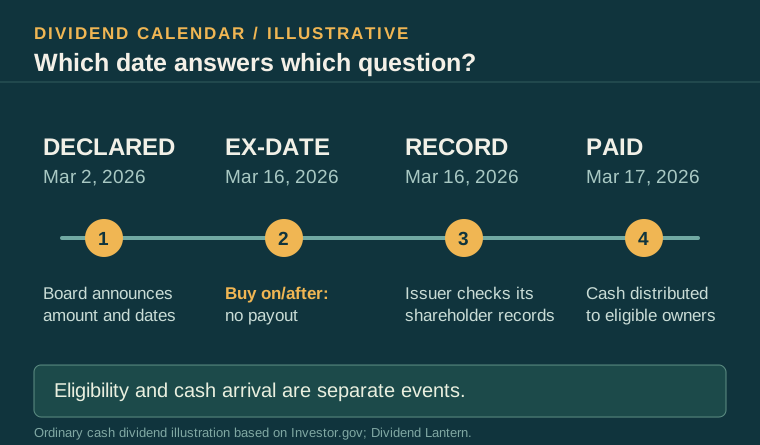
Declaration date: The company announces that its board has approved a dividend, usually with an amount per share and the remaining dates. Before a declaration, a future payment shown by a tracker is only a projection based on history.
Ex-dividend date: This is the first date on which a new buyer does not get the announced dividend. Buy before the ex-date to be eligible under the ordinary rule; buying on or after it is too late for that payment. The SEC's Investor.gov explanation gives the current U.S. rule and examples.
Record date: The company uses this date to establish its shareholder records for the distribution. Under current ordinary U.S. stock-dividend rules, the ex-date is usually the record date if it falls on a business day, or one business day before a record date that falls on a nonbusiness day. Special dividends and stock distributions can follow different rules, so verify the actual announced ex-date instead of calculating it yourself.
Payment date: The company distributes the cash to eligible shareholders. Your brokerage may show it after its own processing. This date is about when you get paid; it does not determine whether a new purchase qualifies.
A simple example
Suppose a company declares a $0.75-per-share cash dividend. Its announced ex-date and record date are Monday, March 16, and its payment date is Tuesday, March 17. If you own 100 qualifying shares before the ex-date and still hold the entitlement, the gross announced amount is 100 × $0.75 = $75. Buying the shares on March 16 does not qualify you for that specific payment.
The dates follow the SEC's published 2026 hypothetical illustration; the $0.75 dividend and 100-share position are our own illustrative additions. Always use the dates in the company's actual announcement for a real security.
What if you sell after the ex-date?
For an ordinary cash dividend, a shareholder who purchased before the ex-date generally keeps the entitlement even if the shares are sold on the ex-date. The new buyer does not receive that declared payment. That is why “hold until payment day” is usually the wrong rule for deciding eligibility. However, unusual distributions can have different exchange rules and broker processing can differ; verify a specific event instead of extrapolating from this basic case.
The ex-date is also not a guaranteed trading opportunity. A market price can adjust when an asset trades without the dividend entitlement, while many other factors move the price on the same day. Treat the dividend as one part of total return, not a free extra cash payment.
What a good calendar should label
A calendar should distinguish announced payments from estimated ones. If a company has paid a dividend every quarter for years, the next payment may seem predictable, but its board has not made a binding announcement for the next period until it declares one. Estimates should therefore carry a clear label and never silently become confirmed income.
For each event, look for the ticker, amount per share, currency, ex-date, payment date, declaration source and last update time. For portfolio planning, multiply the announced amount by the eligible share count, then account for any withholding or tax treatment relevant to your own circumstances. Stock splits and position changes can make an old estimate inaccurate.
| Calendar label | What it means | How to use it |
|---|---|---|
| Declared | The issuer announced an amount and dates | Check the company release or filing |
| Estimated | A future event inferred from past behavior | Plan loosely; do not count it as certain income |
| Paid | The payment date has passed | Reconcile with your broker's cash activity |
| Revised | A company changed a previously displayed detail | Check the new original announcement |
A tracker should not copy the last quarterly amount indefinitely and quietly present it as a future declaration. If the frequency changes, a special payment is made, or a dividend is suspended, that method can misstate both the next payment and the projected annual income. The calendar needs a source link and a visible last-checked time.
Build a personal cash-flow view without overstating certainty
Suppose the illustrative 100-share position above is one of several holdings. Put its gross $75 on the announced payment date, not on the ex-date. Add other announced payments separately. A second line can show estimates for later months, but make its color and label different. If a broker credits the account later than the issuer's payment date, keep the two dates distinct rather than rewriting the issuer event.
For international holdings, the cash received may differ from the simple share-count calculation because of currency conversion, withholding, fees or different market conventions. Even for U.S. holdings, the recorded share quantity can change after a purchase, sale or split. This is a reason to reconcile a calendar against actual broker cash activity rather than using it as an accounting ledger.
Dividend capture is not free money
Buying just before the ex-date and selling just after does not magically create return. A distribution transfers value from the company to shareholders, and market prices can adjust around the ex-date. The SEC also notes that very large special dividends can have different ex-date rules. Fees, taxes and market movement complicate any short holding period further.
Use the calendar to avoid surprises and plan cash flow. Use business fundamentals to decide whether the investment itself deserves a place in your portfolio.
For any real dividend, work from the issuer's release and the exchange or broker record. The SEC notes that a distribution of 25% or more of the stock's value can trigger special ex-date rules, and stock dividends can follow another timetable. A generic “one business day before record” shortcut is therefore unsafe for exceptional events. The SEC's ex-dividend guide is the right starting point, but the actual announcement controls the calendar entry.
This is general education. Confirm dates and eligibility with the issuer, exchange or your broker for a specific security.