

A dividend paid to a shareholder is cash, but buying a stock just before its ex-dividend date does not create free value. The new buyer on the ex-date no longer receives that payment, so the stock is trading with a different entitlement. Market prices also react to countless other forces. A profitable or unprofitable short trade is possible; the dividend alone cannot tell you which one it will be.

The strategy is often presented in four steps: buy before the ex-date, hold until the right to the payment is established, sell, and collect the cash later. This is usually called dividend capture. The critical missing step is to compare sale proceeds plus dividend with purchase cost and all trading and tax costs.
What the ex-date actually determines
For an ordinary U.S. cash dividend, the SEC's current explanation says that a purchase before the published ex-date generally qualifies for the next payment. A purchase on that date does not. With the current T+1 settlement cycle, the ordinary ex-date usually matches a business-day record date. Special distributions can follow different rules, so the exchange-published ex-date is the date to verify for a real security. The NYSE explains its current ex-date report.
Suppose a hypothetical company declares $0.50 per share and the stock closes at $50.00 on the trading day before the ex-date. A trader buys 100 shares for $5,000. If eligible, the trader will receive $50 gross cash, even if the share sale takes place on the ordinary ex-date. But the stock now trades without that $0.50 entitlement. A clean theoretical illustration is a $49.50 next-day price before unrelated market changes. In that case, the 100 shares sell for $4,950, and the $50 dividend brings gross proceeds back to $5,000. Gross return is zero before taxes and costs.
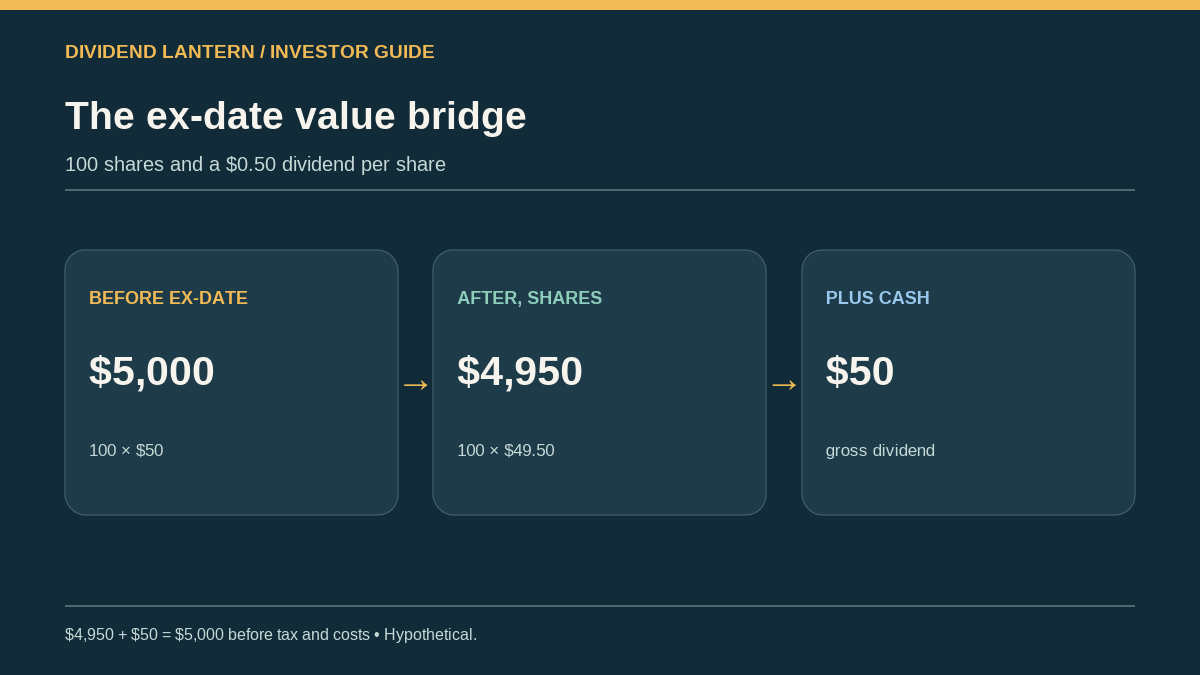
An exchange does not guarantee that the actual closing or opening trade will be exactly $49.50. Company news, the market, order flow and volatility can dominate the dividend-sized adjustment. The NYSE's ex-dividend trading explainer describes shares trading without the dividend value, while the SEC notes that the price may fall with a significant distribution. The illustration is a way to understand value transfer, not a price forecast.
Three price outcomes from the same $50 dividend
Keep the same 100-share purchase at $50 and $0.50 dividend. Now change only the hypothetical sale price:
| Ex-date sale price | Share proceeds | Dividend cash | Gross result before costs |
|---|---|---|---|
| $49.25 | $4,925 | $50 | −$25 |
| $49.50 | $4,950 | $50 | $0 |
| $49.75 | $4,975 | $50 | +$25 |
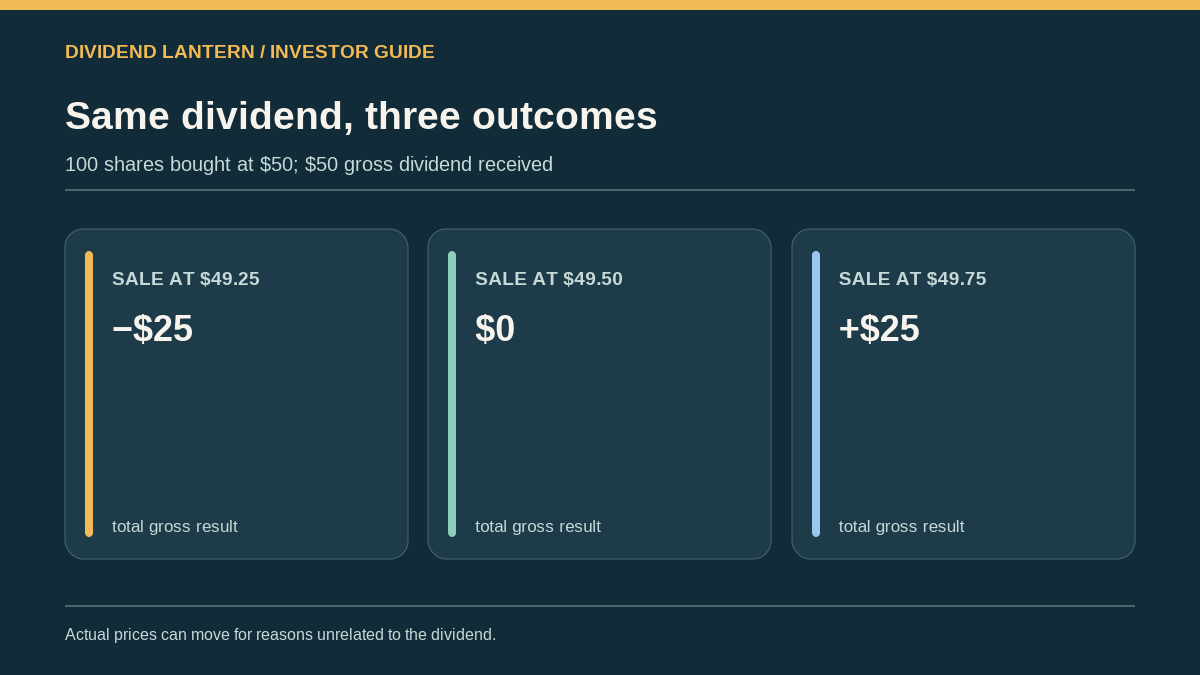
This is why a screenshot of a cash dividend deposit proves little about strategy performance. The trade has two legs. A dividend can arrive weeks after the stock sale, creating a psychological split between the visible sale and the later deposit. Combine them in a single ledger before deciding whether the transaction worked.
Taxes can change the after-tax result
In a U.S. taxable account, the distribution and the share sale may receive different tax treatment. The IRS says a common-stock dividend generally needs a holding period of more than 60 days during the 121-day period beginning 60 days before the ex-date to qualify for the lower qualified-dividend rates, along with other conditions. A one-day purchase-and-sale strategy ordinarily fails that holding-period test. See IRS Publication 550. A broker's preliminary label is not a substitute for checking the final Form 1099-DIV and your actual eligibility. Our qualified dividend guide explains the holding period in detail.
The share sale itself can create a short-term capital gain or loss. Transaction costs, bid–ask spreads and slippage can turn the zero-gross-return row above into a loss. A fund distribution may also include capital gains or return of capital, making its cash label different from a company's ordinary dividend. The SEC's fund distribution bulletin warns that distributions are not the same as performance.
Consider an entirely hypothetical illustration in which the investor has the $0 gross trading outcome above, pays a $4 round-trip spread and tax applies to the $50 cash. There is no positive economic return to tax away, yet the dividend still has a reporting character and the stock sale has its own basis calculation. The actual net tax effect could differ substantially by investor and account. That complexity is the opposite of a mechanical “collect and exit” shortcut.
Dates can be exceptional
Large special dividends deserve a separate check. The SEC states that when a distribution is 25% or more of the stock's value, special ex-date rules may defer the ex-date until after payment. Investors who use the ordinary record-date shortcut can be surprised by a due-bill obligation. Use the issuer's announcement and the exchange's actual corporate-action notice, especially for unusually large distributions. See our special dividend date guide.
Fund distributions also require more care than simply copying a stock's date logic. A fund can pay income, realized gains or return of capital; a high cash payout is not necessarily income generated in the current period. Consult the fund prospectus and distribution notices before designing a trade around a displayed payout rate.
A useful decision test
Ask these questions before any event-driven trade:
- Would the security be attractive to own without this one payment?
- Is the ex-date verified from the issuer, exchange or broker notice rather than guessed from the record date?
- What are the purchase and expected sale prices, spread, fees and tax assumptions?
- How much stock-price movement would eliminate the expected gross gain?
- Could the distribution be special, variable or partly return of capital?
The strategy can generate gains when the market moves favorably, just as any short stock trade can. The dividend is not an independent bonus layered on top of an unchanged asset. For a long-term dividend investor, the more durable questions are whether the business can fund future payments and whether the entry price compensates for its risk. Our cash-flow coverage guide addresses the first question.
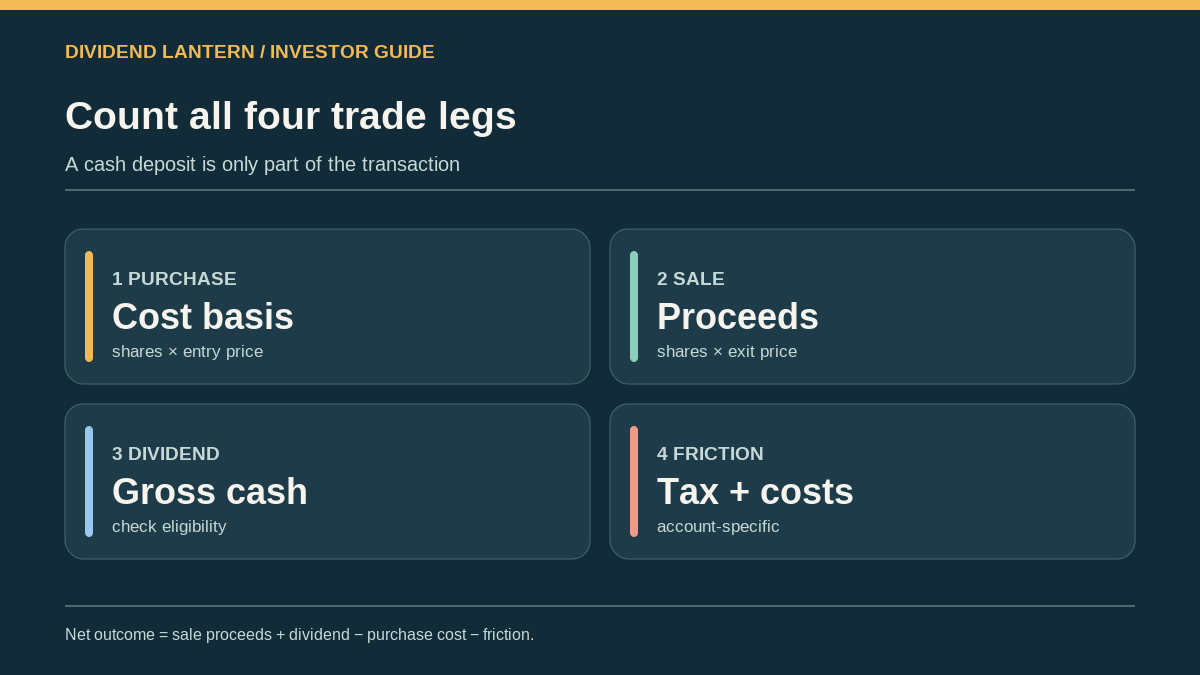
The practical takeaway: calculate total proceeds and after-tax consequences. Receiving a dividend is one transaction in that calculation, not the final answer.
Educational analysis as of October 28, 2026. Every price, share count, spread and return in the worked examples is hypothetical. Actual market prices, corporate actions and taxes may differ. This is not personalized trading or tax advice.

