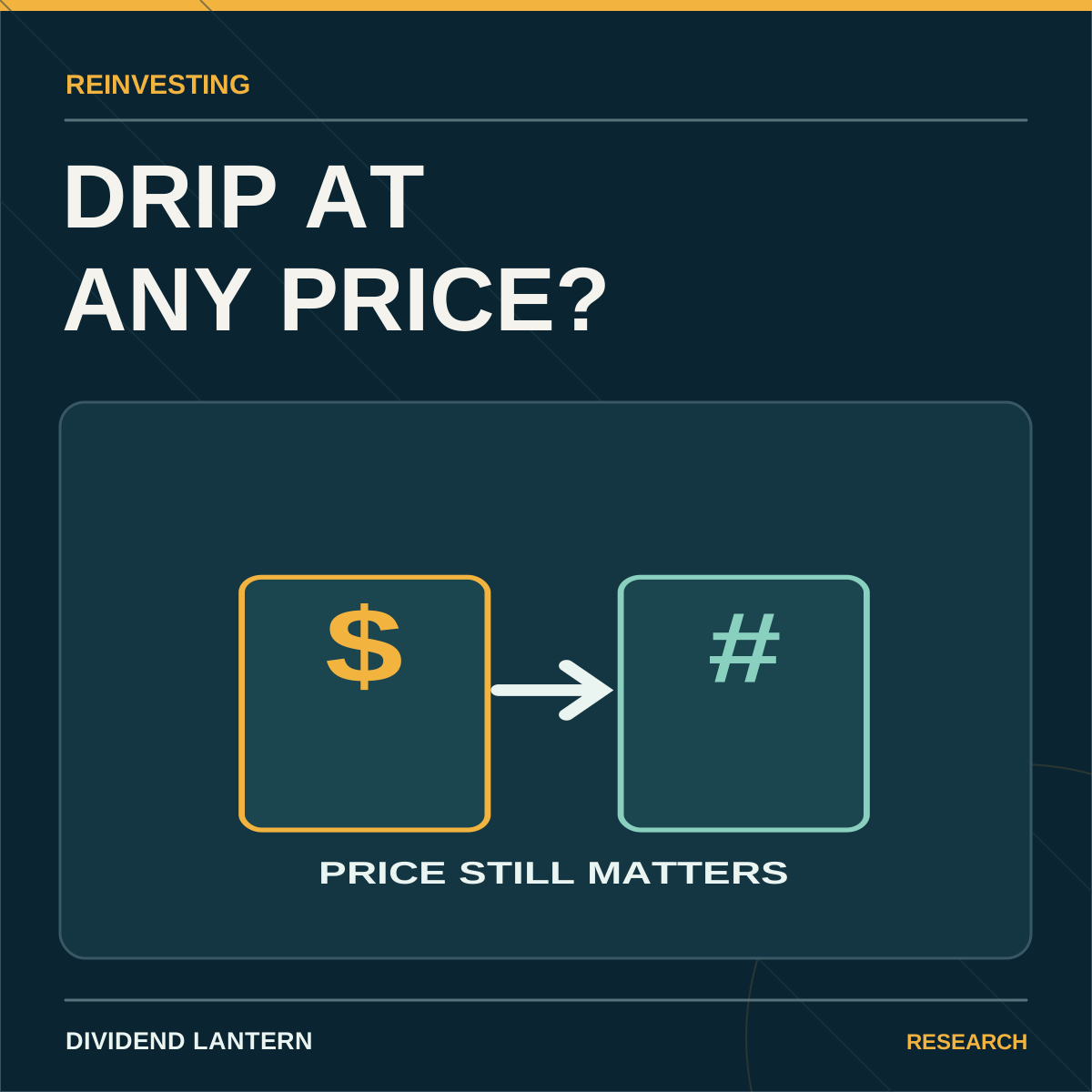
A dividend reinvestment plan turns an investing decision into a default setting. That can be excellent for discipline. It can also cause you to buy more of an expensive or deteriorating company because the cash happened to come from that company. The dividend is yours once paid; there is no rule that it must go back into the same stock.

The right question is not whether compounding works. Reinvesting a payment can buy more shares, and those shares may receive future payments. The question is whether this security, at this price, deserves the next dollar. That is the same question you would ask if the dividend arrived as cash from a paycheck. Automatic reinvestment answers it in advance, regardless of valuation, balance sheet, or your existing concentration.
The U.S. Securities and Exchange Commission explains that a dividend reinvestment plan, or DRIP, uses dividends to acquire additional shares. Company plans and brokerage plans can differ in fees, purchase timing and price determination. Read the actual plan terms before treating “automatic” as “free” or assuming you control the execution price.
One payment, three prices
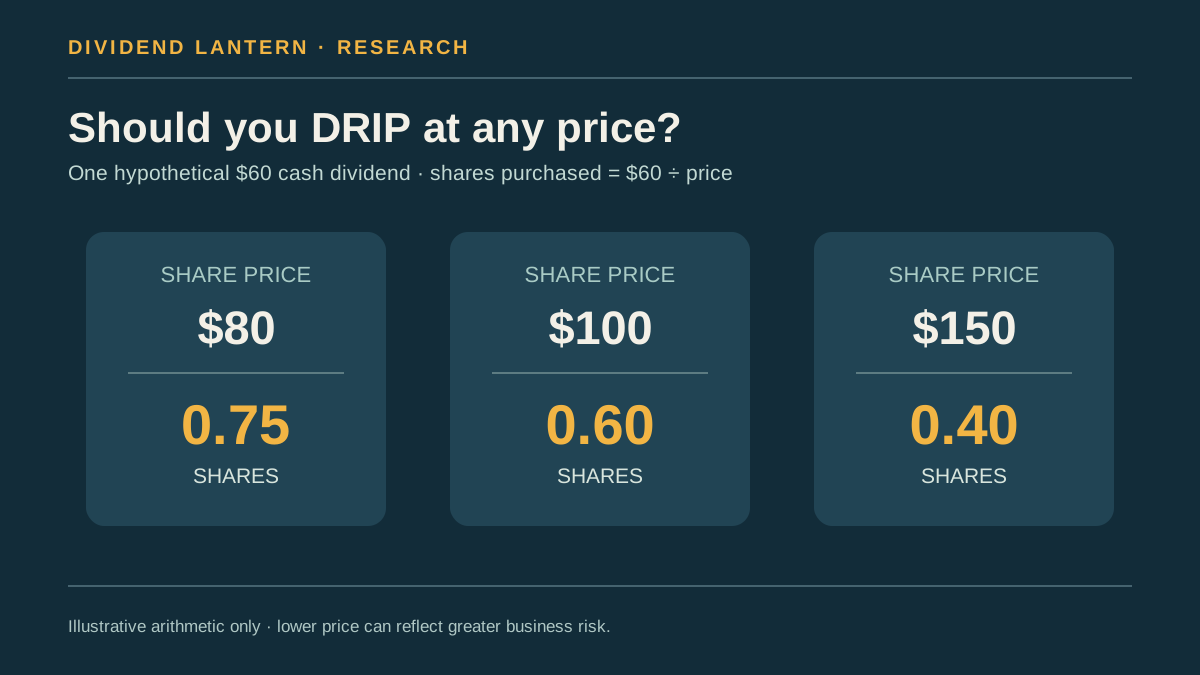
Imagine a hypothetical $60 dividend from a company. Ignore fees, taxes and fractional-share restrictions. If the reinvestment price is $80, the payment buys 0.75 share. At $100, it buys 0.60 share. At $150, it buys 0.40 share. The arithmetic is simply $60 divided by the purchase price. A lower price buys more shares, but it can also signal a worse business or a higher required return. More shares are not automatically more value.
This is similar to the logic behind regular dollar-cost averaging: a fixed amount buys more units when prices are lower. The SEC's definition of dollar-cost averaging describes equal investments at regular intervals. A dividend is not necessarily equal each period, and reinvesting it in the payer is more concentrated than spreading regular contributions across a diversified portfolio. The analogy helps with the math, not with an assessment of business quality.
Here is a second hypothetical comparison. A $100 dividend buys one new share at $100. If that share later falls to $60, the additional share is worth $60; retaining the dividend as cash would have preserved $100 before inflation and taxes. If the share instead rises to $140, reinvesting wins by $40 on that incremental payment. The previously owned shares change in value in both cases. This example isolates only the destination of the new $100 and does not predict returns.
The three gates before automatic reinvestment
First, look at cash coverage. Does the company generate enough operating cash after necessary reinvestment to support its dividend through a normal business cycle? If the headline payout ratio looks comfortable but working capital, capital spending or debt repayments absorb the cash, buying more because the yield rose may compound exposure to a problem. Our cash coverage guide provides a starting calculation. Banks and REITs require different measures; do not force a generic industrial free-cash-flow formula onto them.
Second, look at price. A sound company can be an unattractive incremental purchase if expectations embedded in its price are too optimistic. Decide what cash growth, payout growth and valuation would justify your return target. You do not need a single magical fair-value figure. A range of assumptions is more honest. A dividend yield that falls because the share price climbs may tell you less about the company's cash capacity than about the price new buyers now pay.
Third, look at portfolio weight. If one stock already represents 15% of a portfolio, reinvesting its payments keeps that cash exposed to the same issuer rather than making it available elsewhere. A DRIP does not necessarily increase the stock's weight after the normal ex-dividend price adjustment, but automatic reinvestment can preserve a concentration you meant to reduce. The SEC notes that even owning several funds does not guarantee diversification when their holdings overlap; the same principle applies to several dividend stocks in one industry. SEC diversification guide.
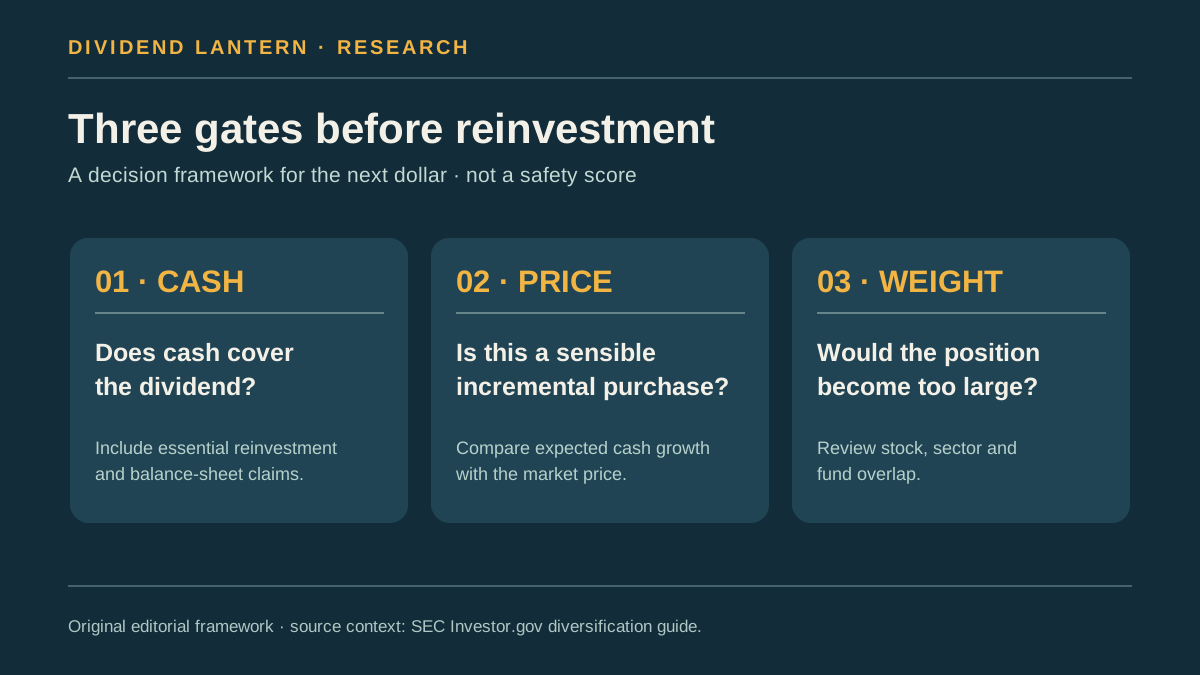
Passing all three gates need not mean the future dividend is guaranteed. It means you have made an explicit case for the next purchase instead of relying on a setting chosen months or years earlier. If a company fails one gate temporarily, you can receive cash and revisit the decision at the next payment. The dividend policy and the market price can both change in the meantime.
An example of what “set and forget” can hide
Suppose a hypothetical investor already has 15% of an equity portfolio in one company. A dividend from that holding is paid. Taking it in cash creates the option to diversify the payment; reinvesting it buys more of the same company instead. The dividend itself does not create extra portfolio wealth or necessarily raise that company's portfolio weight: the share price normally adjusts around an ex-dividend date, and ordinary market movement can overwhelm that adjustment. The concentration concern is the choice to keep directing new investable cash to one issuer, particularly if the investor also contributes additional money or the stock outperforms the rest of the portfolio.
Now suppose the investor instead puts the $300 into a diversified fund or another well-researched holding. That is not automatically superior: the alternative can be overpriced or risky too. The point is that dividends are portfolio cash, and the investor has more than one possible destination. A sensible policy might be to reinvest automatically into a diversified core fund while taking cash from concentrated single stocks. Another investor may keep a cash reserve and allocate once a quarter. Both require checking fees, taxes, and whether fractional purchases are supported.
The tax and recordkeeping detail people miss
In a U.S. taxable account, reinvestment generally does not make an otherwise taxable dividend disappear. The IRS says that dividends reinvested at fair market value must be reported as income along with other ordinary dividends. Shares bought through the plan acquire cost basis, so each reinvestment can create another acquisition lot to track. A plan that provides shares at a discount to fair market value has additional income and basis considerations. The exact treatment depends on the distribution and the account; tax-advantaged accounts are different. IRS DRIP tax and basis FAQ.
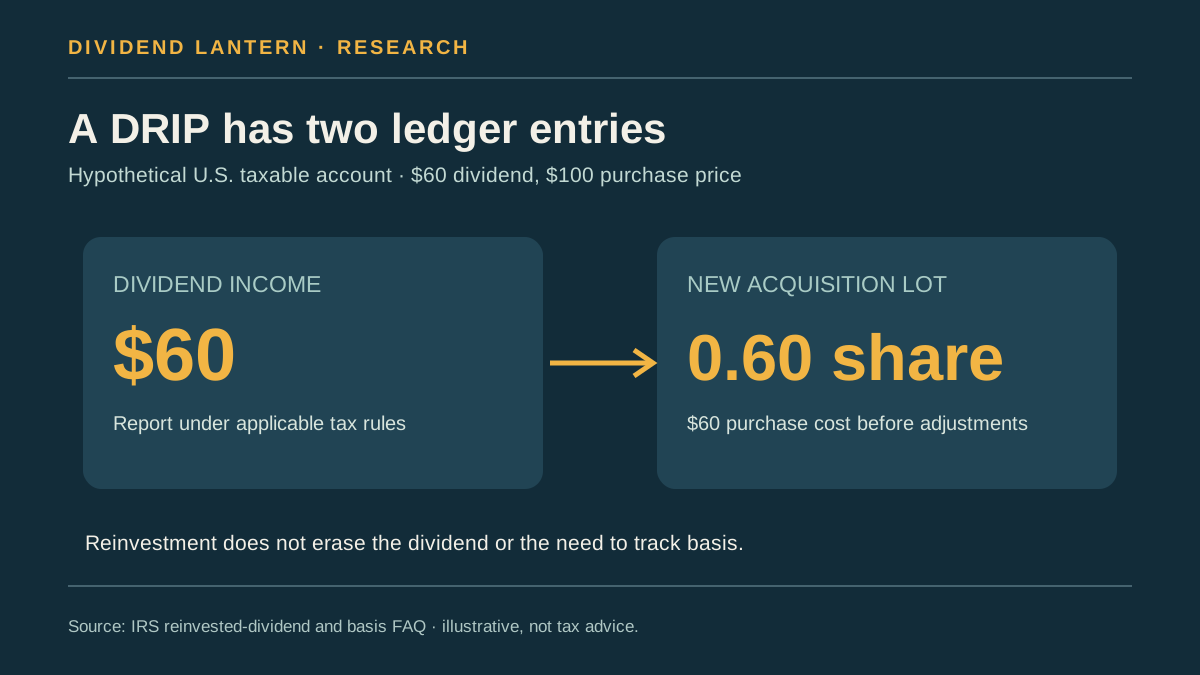
For a hypothetical $60 reinvested dividend at a $100 share price, the plan might record $60 of dividend income and a new 0.60-share lot with $60 of purchase cost, before any plan fees or tax adjustments. The dividend and the new basis are different entries; one does not cancel the other. Keep broker statements and review Form 1099-DIV rather than relying on memory. If you later sell, an incomplete lot history can turn a simple trade into a difficult basis reconstruction.
A practical policy rather than a permanent switch
Write a one-page rule for yourself. For example: Reinvest into a single stock only while its dividend is supported by appropriate cash measures, its weight remains below my chosen limit, and the purchase price still offers a reasonable return under conservative assumptions. The limit and return target should reflect your own situation; this sentence is a template for analysis, not a recommended threshold.
Review the rule after earnings, a dividend change, a large share-price move, a new debt issue, or an acquisition. These are moments when the same $60 may have a different opportunity cost. If you do not have time to review every position, a broad, low-cost fund for recurring reinvestment may be easier to monitor than automatic purchases into many single companies. Diversification still requires checking the fund's holdings and risks.
The conclusion: DRIP is an execution tool, not a valuation method. It can remove friction and support a long-term habit. Its weakness is that it faithfully buys the payer even when your best current use of cash is elsewhere. Keep the convenience when the investment case remains sound; turn the switch off when you need to make a fresh allocation decision.
This article is educational, not personalized investment or tax advice. All dollar and share examples are hypothetical unless labeled as a published source. Dividend declarations, prices, taxes and plan terms can change.