A monthly payment is a schedule, not a safety rating. Realty Income (O) and Agree Realty (ADC) both collect rent from long-term net leases and distribute a portion of it each month. It is tempting to choose between them by yield alone. That misses the real decision: would you rather own the much larger, more diversified landlord or the more focused retail specialist—and how much balance-sheet and issuance risk comes with either strategy?

This comparison uses the same full year, 2025, for the cleanest dividend-coverage baseline and the June 2026 quarter for matched company reporting. Agree Realty has since released its September quarter; Realty Income has scheduled its own Q3 release for November 2, 2026. We examine Agree's newer numbers separately below rather than comparing an available Q3 with an unreleased one. A current share price is deliberately absent: yield and valuation change daily. All AFFO figures below are company-defined, non-GAAP measures. Realty Income 2025 results · Agree Realty 2025 results · Realty Income Q3 schedule
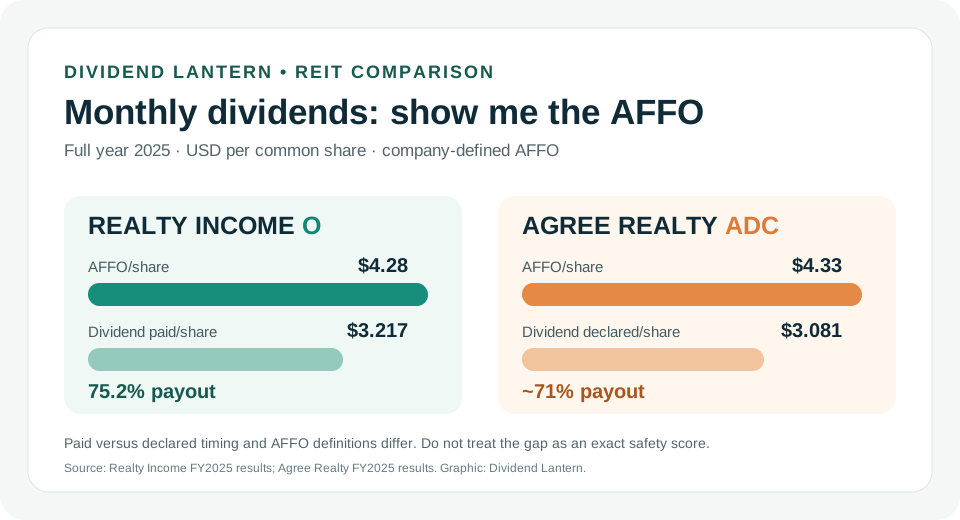
Chart: FY2025, USD per common share. Realty Income reports dividends paid; Agree Realty reports dividends declared. Those timing bases differ, and the two companies' AFFO definitions may differ. [O release](https://www.realtyincome.com/sites/realty-income/files/2026-02/02-24-26-realty-income-announces-operating-results-for-the-three-months-and-year-ended-december-31-2025.pdf) · [ADC release](https://investors.agreerealty.com/press-releases/press-releases-details/2026/Agree-Realty-Corporation-Reports-Fourth-Quarter-and-Full-Year-2025-Results/default.aspx).
Start with what the payout ratio actually says
Realty Income reported $4.28 of adjusted funds from operations per diluted share for 2025 and $3.217 of monthly common dividends paid per share. The company's reported AFFO payout ratio was 75.2%. Agree Realty reported $4.33 of AFFO per diluted share and $3.081 of dividends declared per share, an approximately 71% AFFO payout ratio. The apparent four-point difference is useful, but it is smaller than the uncertainty in long-run tenant performance, interest cost, new share issuance and AFFO definitions. A one-year percentage is a starting point, not a verdict. Realty Income 2025 results · Agree Realty 2025 results
For REITs, GAAP earnings are not usually the best single measure of recurring property cash generation because depreciation of buildings can materially reduce reported net income without matching current cash outflow. Funds from operations (FFO) adjusts for important real estate accounting items; AFFO makes further company-specific adjustments. That is why a REIT's GAAP earnings-per-share payout ratio can look alarming while its AFFO payout looks moderate. But the correction has limits: AFFO is not cash in a bank account, does not erase real maintenance or financing needs, and is not defined identically by every REIT. Agree Realty explicitly warns that its AFFO should not replace cash flow as a measure of liquidity or ability to pay distributions. Agree Realty Q2 2026 release and reconciliation · Realty Income Q2 2026 release
The first half of 2026 did not undo the coverage picture. Realty Income reported $2.22 of AFFO per diluted share for six months; Agree Realty reported $2.28. For the second quarter alone, Realty Income paid $0.812 per share against $1.09 of AFFO per share, or 74.5%. Agree Realty declared three monthly dividends of $0.267 each during the quarter—$0.801 total—against $1.14 of AFFO per share, about 70%. Again, paid versus declared timing and the different non-GAAP definitions prevent a perfectly matched contest. Realty Income Q2 2026 release · Agree Realty Q2 2026 release
A new Agree Realty check, not a matched comparison. Its October 20 report put Q3 AFFO at $1.15 per diluted share and the three July–September declared dividends at $0.801 per share: a company-reported AFFO payout ratio of about 69%. After the quarter, its board declared a higher $0.271 monthly dividend for October, payable in November. Annualizing that new declared rate gives $3.252, but it does not establish that every future month has already been declared. Agree's FY2026 AFFO-per-share guidance rose to $4.58–$4.59. Those are favorable coverage signals for Agree, yet they cannot establish a Q3 winner while Realty Income's Q3 AFFO is still unpublished. Agree Realty Q3 2026 release · Realty Income Q3 schedule
Similar lease structure, different concentration
Both are primarily net-lease landlords: tenants generally take on many property-level operating costs under long leases. That shifts some expense volatility away from the owner, but it does not transfer away tenant default, vacancy, re-leasing or financing risk. If a tenant fails, the landlord still needs another tenant, sometimes after spending money to adapt the building.
Realty Income's June 2026 portfolio contained interests in 15,588 properties leased to 1,798 clients across 92 industries, with a weighted average remaining lease term of about 8.6 years. Its stated property-level occupancy was 98.8%. The platform reaches beyond U.S. retail into industrial property, Europe, joint ventures and other financing structures. That spreads exposure but makes the enterprise more complex to analyze. The Q2 release also describes investment in a hyperscale data-center venture: a new growth channel with a different risk profile from a familiar drugstore or convenience store. Realty Income Q2 2026 release
Agree Realty is intentionally more concentrated in U.S. retail. At June 30, 2026 it reported 2,825 properties, approximately 99.8% leased by its definition, a 7.7-year weighted average lease term and 65.8% of annualized base rent from investment-grade retail tenants. It also reported that ground leases represented 10.2% of annualized base rent. Ground leases can have different economics from ownership of the whole building; the investor should read the lease and residual-value risks rather than treating every property count as identical. Agree Realty Q2 2026 release
By September 30, Agree reported 2,888 properties and 65.1% of annualized base rent from investment-grade retail tenants; its portfolio was still approximately 99.8% leased. This is a newer snapshot for Agree only. It should not be inserted into the June side-by-side chart and treated as a same-date comparison with Realty Income. Agree Realty Q3 2026 release
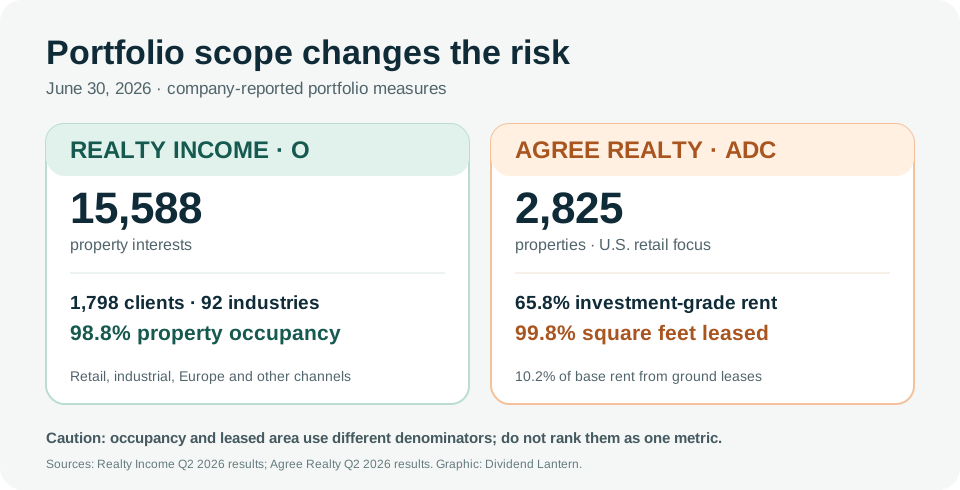
Graphic: June 30, 2026 company disclosures. Realty Income reports property-level occupancy while Agree Realty reports leased square footage; the two percentages are not directly comparable. [O Q2 release](https://www.realtyincome.com/sites/realty-income/files/realty-income/press-releases/08%2005%2026%20Realty%20Income%20Announces%20Operating%20Results%20for%20the%20Three%20and%20Six%20Months%20Ended%20June%2030,%202026.pdf) · [ADC Q2 release](https://investors.agreerealty.com/press-releases/press-releases-details/2026/Agree-Realty-Corporation-Reports-Second-Quarter-2026-Results/default.aspx).
The implication is more subtle than “diversification good, focus bad.” A broad platform can absorb a single troubled tenant more easily, but may enter unfamiliar asset classes. A retail specialist may be easier to understand, but the health of major tenants and categories matters more. For both companies, test the rent dollars exposed to stressed counterparties, not just the number of properties or the marketing description of tenant quality. An investment-grade rating is a useful credit signal, not a guarantee that a lease cannot fail.
Debt and equity are part of the dividend equation
At June 30, Realty Income reported 5.4× net debt to annualized pro forma adjusted EBITDAre. Agree Realty reported 5.2× net debt to recurring EBITDA on actual balances. Agree also showed 3.7× on a pro forma basis after deducting roughly $1.1 billion of anticipated proceeds from unsettled forward-equity transactions. The 3.7× figure describes what the balance sheet would look like after that funding step; it was not the leverage actually reported before settlement. Moreover, new equity can reduce debt while diluting the claim of each existing share on future AFFO. The leverage definitions also differ, so the bars are directional rather than an exact ranking. Realty Income Q2 2026 release · Agree Realty Q2 2026 release
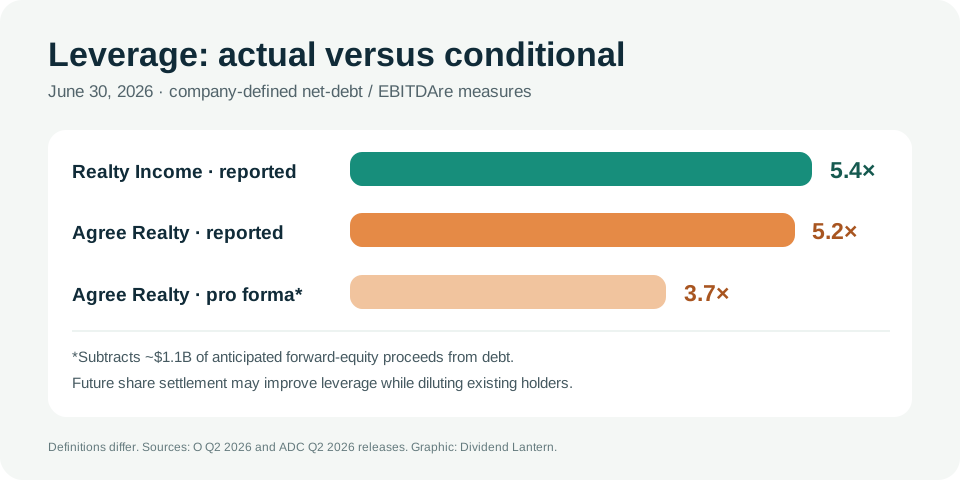
Chart: June 30, 2026, company-defined debt-to-EBITDAre measures. Agree Realty's 3.7× assumes receipt of future forward-equity proceeds; it is not the actual balance-sheet ratio. EBITDAre definitions vary. [O Q2 release](https://www.realtyincome.com/sites/realty-income/files/realty-income/press-releases/08%2005%2026%20Realty%20Income%20Announces%20Operating%20Results%20for%20the%20Three%20and%20Six%20Months%20Ended%20June%2030,%202026.pdf) · [ADC Q2 release](https://investors.agreerealty.com/press-releases/press-releases-details/2026/Agree-Realty-Corporation-Reports-Second-Quarter-2026-Results/default.aspx).
Realty Income had approximately $3.5 billion of available liquidity on its pro rata presentation at June quarter-end, a total that includes credit capacity and unsettled forward-share proceeds and subtracts commercial-paper borrowing. Agree Realty reported approximately $1.9 billion of liquidity including its own credit and forward-equity capacity. Neither number is simply cash sitting ready for dividends. Refinancing rates and the yield on newly purchased properties decide whether expansion raises or weakens AFFO per share. Realty Income Q2 2026 release · Agree Realty Q2 2026 release
Agree's September update reported 4.8× actual net debt to recurring EBITDA and 3.9× pro forma after assuming approximately $657 million of unsettled forward-equity proceeds are used to reduce debt. The difference is exactly why an investor should not read pro forma leverage as an accomplished refinancing. The company's approximately $2.0 billion of reported liquidity still includes facility availability and outstanding forward equity, not only cash. Agree Realty Q3 2026 release and reconciliation
What to watch before choosing either share
First, look at AFFO per share, not merely total AFFO. Both companies raise money by issuing stock and debt to acquire properties. Total cash generation can increase while each share's claim barely grows. Compare the investment yield on new assets with the all-in cost of capital, and check whether announced acquisitions are actually financed and occupied.
Second, examine tenant rent coverage and lease rollover. The headline occupancy number can stay high even as a small number of large tenants weaken. For Realty Income, its broader mix makes industry and geographic breakdowns important. For Agree Realty, look closely at retail tenant concentration, ground leases and re-leasing economics. The latest reported period is a snapshot, not a stress test.
Third, check debt maturity and dividend valuation at the date you might invest. A yield premium over Treasury bonds or another REIT only means something after allowing for growth prospects, refinancing costs, taxes and tenant risk. A share-price decline mechanically raises dividend yield; it does not raise the cash collected from tenants.
Our reading: Realty Income offers broader scale; Agree Realty offers a more concentrated and readily traceable retail-rent story. Both covered 2025 distributions by their reported AFFO and maintained similar coverage in the second quarter of 2026. Agree's Q3 report showed continued coverage and a newly declared monthly increase, while Realty Income's Q3 remains pending. None of these metrics alone settles which dividend is safer—or which stock is more attractive at a given price. The next useful evidence is sustained per-share AFFO growth after financing costs, not the fact that the dividend arrives monthly.
Educational analysis based on company disclosures available October 24, 2026, not personalized investment advice. AFFO and EBITDAre are non-GAAP and not standardized between companies. Future dividends require board approval and can change.