
An ordinary earnings payout ratio divides dividends by net income. Apply that formula mechanically to an equity REIT and you can get an alarming number, even when rental operations are healthy. The reason is not that accounting is broken. It is that property depreciation can make reported net income a poor stand-alone description of a REIT's ongoing operating performance.
That does not mean REIT dividends are automatically safe. It means the investigation needs better questions.
What FFO changes
Nareit developed funds from operations (FFO) as a supplemental measure for equity REITs. Starting with GAAP net income, its definition removes certain real-estate depreciation and amortization and adjusts for specified property-sale gains and losses, among other items. The reason is that straight-line accounting depreciation does not necessarily describe the economic change in a property's value in any one period.
FFO is not cash in the bank. Nor is it a replacement for GAAP statements. Nareit explicitly describes it as a supplemental performance measure. A REIT can report growing FFO while facing expensive property upkeep, weak tenants or rising refinancing costs.
Why AFFO may be closer—but harder to compare
Adjusted funds from operations (AFFO) often starts with FFO and subtracts recurring costs needed to sustain the properties and rent stream, such as leasing expenses or maintenance-related capital improvements. But Nareit warns that AFFO has no standardized definition. One company's reported AFFO may not be directly comparable with another's.
Imagine a hypothetical REIT with FFO of $1.70 per share, AFFO of $1.50 per share and dividends of $1.20 per share. Its FFO payout ratio is about 71%; its AFFO payout ratio is 80%. The second figure leaves $0.30 per share before other needs. Neither percentage alone tells you whether that cushion is enough. You need to inspect the AFFO reconciliation and the property's likely future costs.
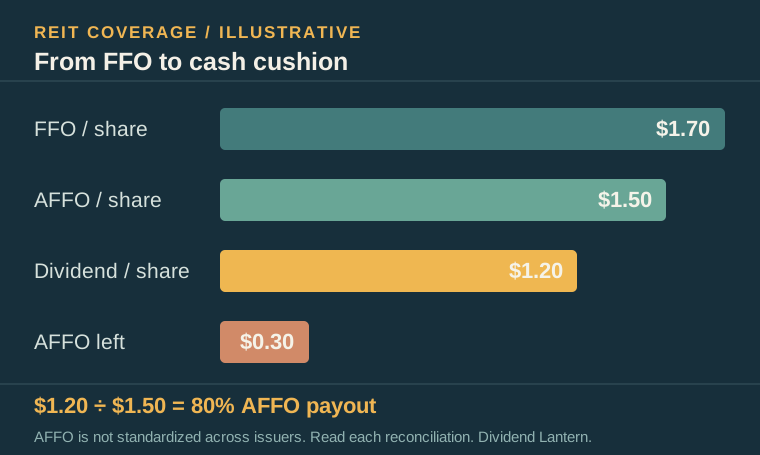
The adjustment from $1.70 to $1.50 is not a universal formula. It is an illustrative $0.20 difference. A real REIT might make several adjustments in both directions; some may be recurring costs with different labels from company to company. The Nareit definition of AFFO explicitly warns that the measure is not standardized. Recreate the bridge from each issuer's reconciliation before comparing payout ratios across two names.
Four tests beyond the ratio
1. Property cash flow. Are rents and occupancy stable? Are expiring leases likely to reset higher or lower? A new tenant may require incentives and capital spending before it contributes to cash flow.
2. Maintenance and development. Separate spending needed to keep existing assets competitive from growth projects. Both require financing, but maintenance cannot be postponed indefinitely without changing the business.
3. Debt and interest. Read the maturity ladder, fixed versus variable rate exposure, available liquidity and covenant disclosures. A REIT with comfortable payout coverage today can have less flexibility after a wave of refinancing.
4. Dividend history and policy. Past payments show what management has done, not what it must do next. Look for how management discusses distribution coverage, leverage targets and capital allocation in its latest filings and earnings materials.
Do not let a rising FFO figure hide dilution
If a REIT raises new equity, total FFO can rise because it owns more properties while FFO per share barely changes. For a shareholder, per-share growth and the cash available to support each share's dividend are the more useful comparisons. Look at the weighted average diluted share count alongside FFO and AFFO per share. A property acquisition can be sensible, but its financing cost must be part of the analysis.
Likewise, distinguish leases signed from cash collected. Contractual rent, occupancy and same-property results each tell a different part of the story. A tenant moving out can make the next period expensive even if last year's AFFO looked comfortable. Use the issuer's property schedule to check lease expirations, tenant concentration and whether planned work is maintenance or expansion.
Nareit's investing guide lists FFO payout ratios, underlying asset values, management quality and growth prospects among the factors used to assess REITs. Use them together, not as isolated green lights.
A practical reading order
Open the latest annual report and investor presentation. Find GAAP net income, FFO, the AFFO reconciliation, recurring capital spending, same-property operating results and the debt maturity schedule. Compare several years, then ask how the next two years could differ. If management's preferred non-GAAP metric improves while operating cash flow weakens, investigate the gap.
| Question | Useful primary-source location | Why it matters |
|---|---|---|
| How is AFFO defined here? | Issuer reconciliation in earnings release or filing | Adjustments vary across issuers |
| When does debt refinance? | 10-K debt note and maturity schedule | New borrowing costs can reduce the cash cushion |
| What keeps properties rentable? | Capital spending and leasing disclosures | Some spending is needed to preserve the rent stream |
| Is growth per share? | FFO/AFFO per share and diluted share count | Total growth can mask dilution |
One stress test is to hold the dividend at $1.20 but reduce hypothetical AFFO from $1.50 to $1.30. Coverage then moves from an 80% payout ratio to roughly 92%, leaving just $0.10 per share. That does not predict a cut. It demonstrates how quickly a seemingly comfortable ratio can narrow when rent collections weaken or expenses rise. Run the same test against disclosed debt maturities and expected maintenance work, not just a single quarter's AFFO.
A REIT is a property business with a financing structure. Its yield is the final number you inspect, not the first number you trust.
Remember that a REIT's distribution requirement relates to taxable income, which is different from GAAP net income, FFO and AFFO. The Nareit FAQ describes the REIT framework, but the tax rule is not proof that a particular cash dividend is sustainable. A mandatory minimum distribution and an affordable payout are two different questions.
The per-share example is hypothetical. This article is educational and does not assess any specific REIT.