

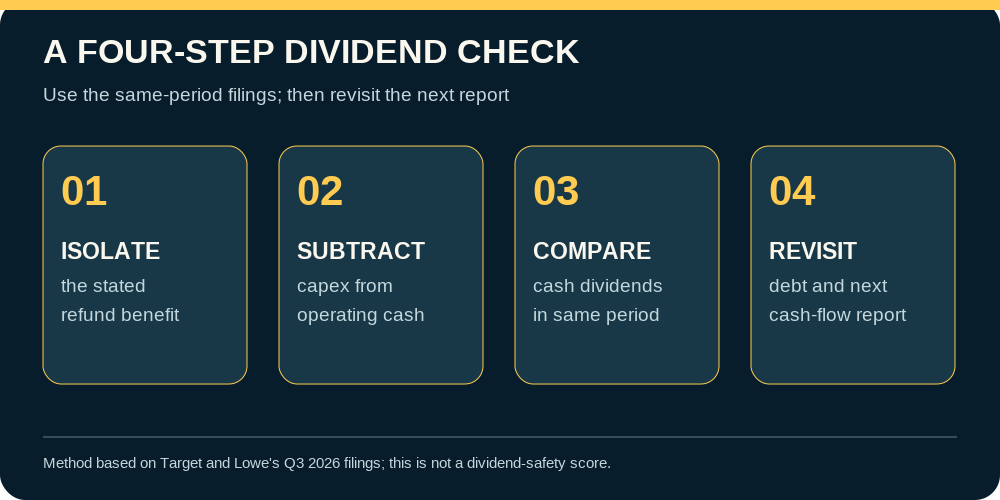
Target and Lowe's reported third-quarter 2026 results on November 18. Both results included cash benefits from refunds of tariffs paid earlier. The payments improved reported earnings, but an investor estimating future dividend funding should not assume a refund will recur every quarter. The useful test is to separate the stated refund contribution from earnings, then read cash from operations, capital spending and dividends for the same reporting period. Target's Q3 release · Lowe's Q3 release.

This is a comparison of two different businesses, not a dividend-safety ranking. Target's nine-month period ended October 31; Lowe's ended October 30. The cash figures below are historical, and the refund benefits affect the reported results.
The unusual item inside EPS
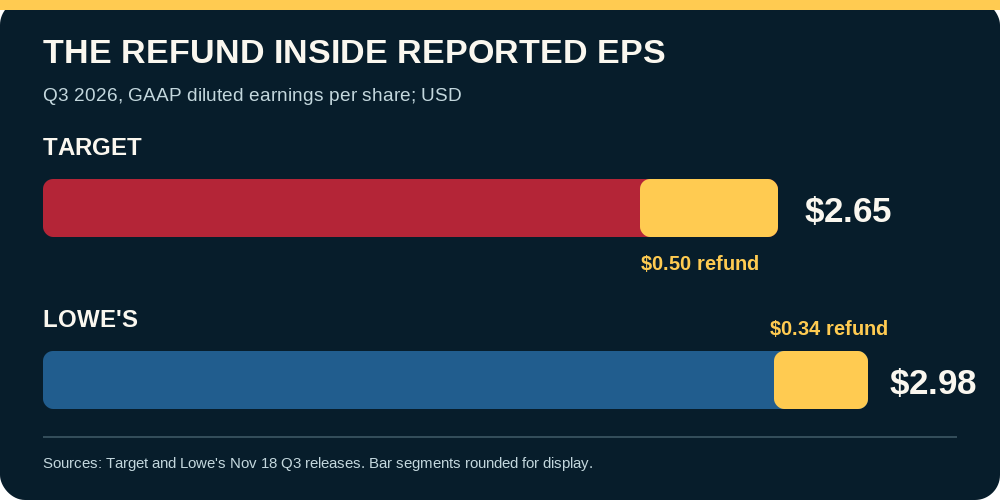
Target reported third-quarter diluted earnings per share of $2.65, both on a GAAP and company-adjusted basis. It says $0.50 per share came from $301 million of pretax tariff-refund benefits recognized in the quarter. Lowe's reported GAAP EPS of $2.98 and adjusted EPS of $3.10; both measures include $0.34 per share from approximately $250 million of pretax refunds. These contributions are part of the reported figures, including the headline adjusted figures. Target release · Lowe's release.
| Q3 2026, USD per diluted share | Target | Lowe's |
|---|---|---|
| Reported GAAP EPS | $2.65 | $2.98 |
| Stated tariff-refund contribution | $0.50 | $0.34 |
| GAAP EPS minus stated contribution | $2.15 | $2.64 |
The last row is simple subtraction by Dividend Lantern, not a company-published normalized EPS figure or a forecast. Other business changes remain in both results. Target's comparable sales rose 5.6%, while Lowe's rose 1.8%; the refund is not the whole earnings story. Lowe's adjusted EPS excludes certain acquisition-related amortization, so it must not be confused with the GAAP calculation in the table. Target release · Lowe's release and non-GAAP reconciliation.
Follow the cash through investment to dividends
Subtracting property and equipment spending from operating cash flow gives a simple free-cash-flow measure. It is a useful historical bridge, but it is not the same as cash that can be promised every future quarter. Retail inventory, payables and seasonal demand make nine-month cash flow especially dependent on timing. Target cash-flow statement · Lowe's nine-month financial statements.
| Nine months ended in October 2026, USD billions | Target | Lowe's |
|---|---|---|
| Cash from operations | $5.727 | $8.690 |
| Property and equipment spending | $3.762 | $1.664 |
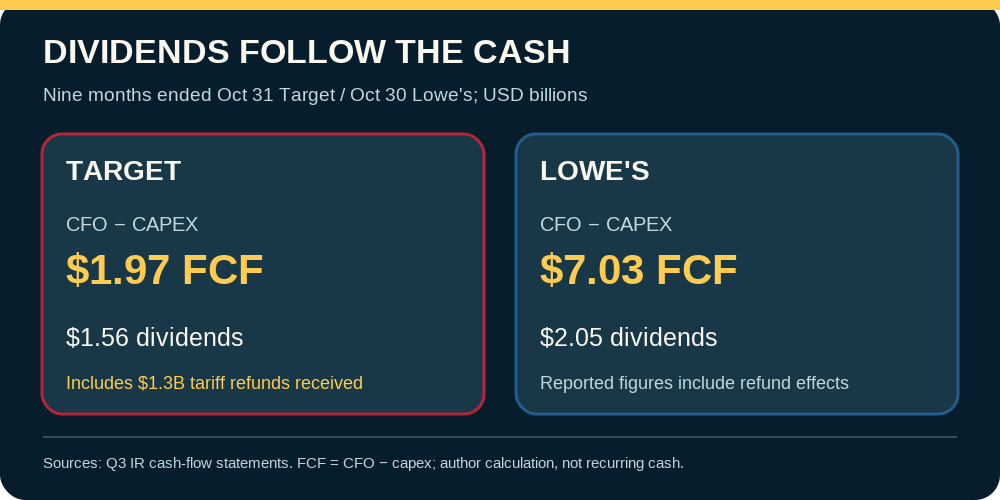
| Simple free cash flow, calculated | $1.965 | $7.026 |
| Cash dividends paid | $1.561 | $2.048 |
On these reported numbers, simple free cash flow was about 1.26 times dividends for Target and 3.43 times for Lowe's. These are author calculations for different companies, and neither ratio alone establishes dividend safety. They omit future operating changes, planned investments, debt maturities and each board's future decisions. Target release · Lowe's financial statements.
The distinction is particularly important at Target. It says the first nine months included $1.3 billion of tariff refunds received during 2026, recorded as a reduction of cost of sales. Therefore its $1.965 billion of reported simple free cash flow should not be labeled repeatable cash generation. Mechanically subtracting $1.3 billion from that figure would not yield a reliable future run rate either: tax effects and working-capital timing also matter. Lowe's disclosed a third-quarter refund benefit as well. Target release, cash-flow statement and operating-metrics note · Lowe's release.
What to watch after the refund
Target paid $527 million in dividends in its third quarter, while Lowe's paid $701 million. These are actual cash distributions, not implied annual yields. Target's full-year 2026 EPS outlook of $10.65–$11.40 already includes approximately $2.14 per share of tariff-refund benefits recognized to date; its guidance excludes potential future refunds. It also plans $5–6 billion of capital expenditures in 2027, versus approximately $5 billion expected in 2026. These investment plans make future cash generation more relevant than a one-quarter EPS headline. Target release · Lowe's release.
Lowe's expects up to $2.5 billion of capital expenditures in fiscal 2026 and forecasts adjusted EPS of approximately $12.25. That forecast and Target's 2027 plan refer to different fiscal years, so they are not a like-for-like spending comparison. Lowe's acquisitions also affect how its investment, amortization and debt should be read. Its October 30 financial statements showed about $37.5 billion of debt including current maturities; Target reported about $15.3 billion at October 31. Absolute debt balances across different-size businesses do not settle a dividend comparison. Lowe's release · Lowe's financial statements · Target release.
Before carrying either company's payout into a long-term income plan, check the next cash-flow statement, its investment spending, the actual dividend declaration and any remaining refund effects. The November results do not by themselves show that either dividend is at risk. They show why reported earnings and repeatable dividend funding are different questions.
Educational analysis of company-reported third-quarter 2026 results and nine-month cash-flow statements, checked November 18, 2026. Free cash flow and coverage multiples are simple Dividend Lantern calculations. No purchase, sale or personal income recommendation is implied. The cover scene is AI-generated editorial illustration; it is not a photograph of either company's records.

