

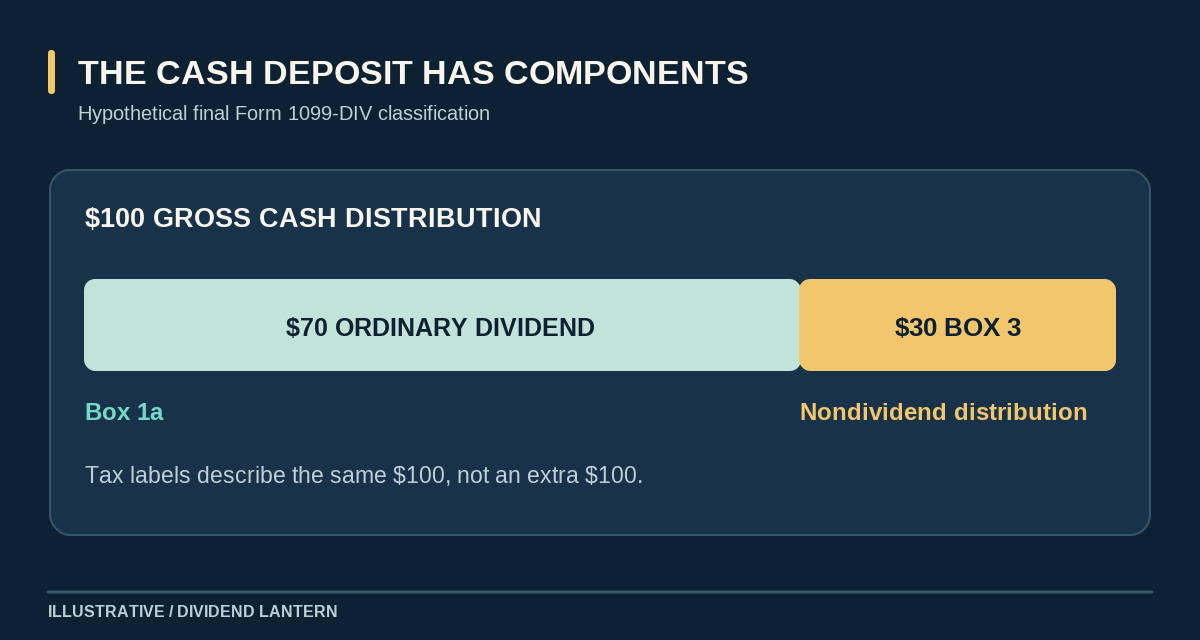
A brokerage account may show a $100 cash distribution, but the tax form may call some of it a return of capital. That classification changes the investor's cost basis and often the timing of tax. It does not by itself reveal whether the underlying business created or destroyed economic value. To understand the payment, read both the tax label and the issuer's financial statements.

For U.S. federal tax purposes, the IRS calls a return of capital a nondividend distribution: it returns some of the shareholder's investment and generally reduces the adjusted basis of the stock. The amount is shown in box 3 of Form 1099-DIV when reported as a nondividend distribution. Ordinary dividends appear in box 1a; qualified dividends, when applicable, are the subset in box 1b. The boxes describe different tax characteristics of cash received. The brokerage app's generic word “dividend” may not.
Follow the money on a simple tax lot
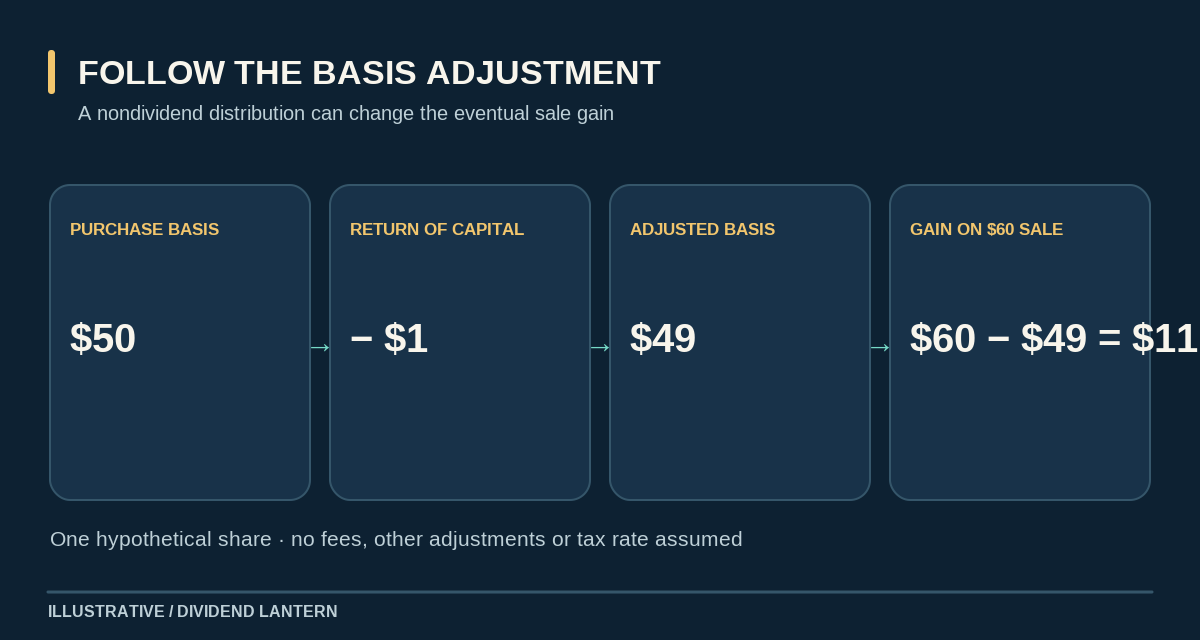
Assume a person buys one share for $50 in a taxable account. The issuer later pays a hypothetical $4 cash distribution, of which the final tax reporting classifies $3 as an ordinary dividend and $1 as a nondividend distribution. The $1 return of capital generally reduces the share's adjusted basis from $50 to $49. The investor still received $4 in cash, but the whole $4 is not taxed under the same heading in that year. IRS Publication 550 explains the basis reduction.
If the shareholder later sells the share for a hypothetical $60, ignoring fees and other adjustments, the gain calculation is $60 sale proceeds minus $49 adjusted basis = $11. Had the $1 basis reduction been forgotten, a simplistic $60 − $50 calculation would show $10 and understate the gain. The return of capital generally shifts some tax consequence to a later disposition. It is not a permanent tax exemption. Once adjusted basis reaches zero, later nondividend distributions are generally reported as capital gain, according to IRS Topic 404.
This illustration assumes a single share and a finalized classification. Real accounts may hold multiple lots purchased on different dates, dividend reinvestments, stock splits, corrected forms and sales. The basis adjustment is tracked per share. IRS Form 8949 instructions describe the treatment when basis has already been fully recovered. For an actual return, use the issuer and broker's final information and a tax professional when necessary.
Why the classification can surprise an income investor
An issuer may communicate a cash distribution throughout the year without knowing every final tax category until year-end calculations are complete. The amount transferred to a shareholder can be easy to see, while its character under U.S. tax rules requires a separate determination. An income calendar may project a future gross cash payment; it cannot guarantee the final 1099-DIV boxes. The IRS instructions for Form 1099-DIV direct issuers to report box 3 nondividend distributions when determinable.
Different structures can complicate the picture. A publicly traded business development company can distribute investment income, capital gains and return of capital. The SEC's BDC investor bulletin explicitly tells investors to examine the distribution's components. Funds and real-estate vehicles may also have tax accounting that does not match a simple “cash earned this quarter equals cash paid this quarter” narrative. The tax label belongs in the research file, while business cash generation needs its own test.
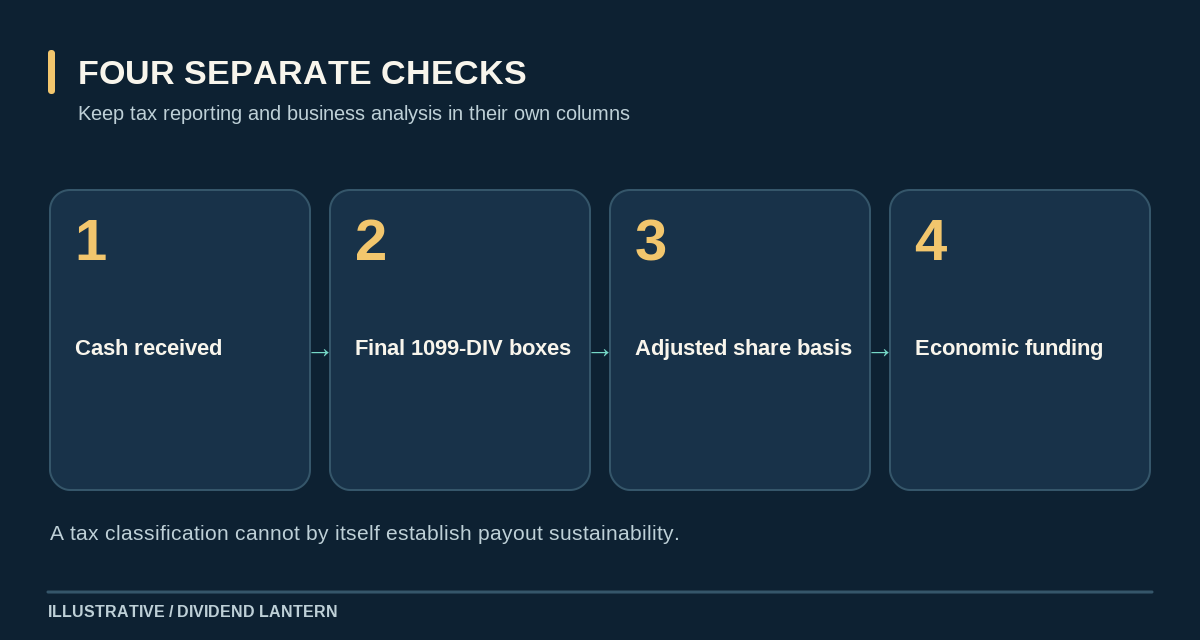
Avoid two equally easy conclusions. “Box 3 is tax-deferred, so this is free income” ignores the reduction in basis and potential later gain. “Box 3 appears, so the investment is automatically failing” ignores that tax classification and economic cash flow answer different questions. A distribution funded repeatedly by new borrowing or asset sales deserves scrutiny; a tax classification alone does not establish the funding source. To evaluate the economic side, inspect the issuer's cash-flow statement, payout policy, debt, asset values and the trend in per-share results.
Read Form 1099-DIV in the right order
Start with the total cash received in account records. Then read the year's final Form 1099-DIV. Box 1a shows total ordinary dividends and box 1b shows the qualified portion within box 1a; do not add box 1b again. Box 2a may show capital-gain distributions. Box 3 reports nondividend distributions. Adding every box indiscriminately can double-count an amount. The IRS's recipient guidance explains that the form breaks distributions into categories, and the Form 1099-DIV instructions define those boxes.
Next, reconcile the amount with each tax lot's adjusted basis. If the broker provides basis records, inspect whether the nondividend distribution has been reflected, particularly for older holdings or transferred accounts. Preserve the final 1099-DIV and any corrected version. A preliminary website notice is useful context but should not silently replace a corrected tax form. If the issuer's distribution characterization looks materially different from the broker's, investigate before filing.
The business test still matters
Suppose two funds each distribute a hypothetical $1 per share. One earns cash returns on its portfolio that support the payment; the other repeatedly sells assets to sustain the same visible payout while net asset value erodes. The brokerage screen can display the same $1 deposit. To distinguish the stories, read the fund's reports and compare changes in net asset value, realized gains, expenses, financing and the long-term total return. For an operating company, compare recurring operating cash with capital needs, interest and distributions. These are illustrative possibilities, not descriptions of any named investment.
The SEC notes in its BDC bulletin that a return of capital may mean the investor is receiving back part of their principal and can reduce assets available for future investment. That risk deserves attention. It does not authorize a blanket judgment about every entity whose Form 1099-DIV reports box 3. Investigate what generated the cash, whether per-share assets and earnings are stable, and how much of the payout might reasonably repeat.
Our qualified-dividend guide addresses a different Form 1099-DIV question: whether a payment in box 1a can receive the tax treatment associated with box 1b for an investor's specific share lot. A return of capital is another category and requires a basis record. When building an income forecast, show gross cash, expected tax character if known, and economic sustainability as three separate fields. That separation keeps a projected payment from being mistaken for spendable, permanent, tax-free income.
U.S. federal-tax education as of October 28, 2026. The examples are hypothetical and omit state rules, fees and other basis adjustments. This is not individualized tax or investment advice.

