

Walmart raised its fiscal 2027 outlook on November 19, 2026, while reporting less free cash flow through October than it did a year earlier. Both facts can be true. Sales and operating cash improved, but investment in property and equipment rose faster. For a dividend investor, the question is how much cash remains after that spending, and how the company chooses to divide it between dividends, repurchases and other obligations. Walmart's Q3 FY27 release furnished to the SEC.

The latest reported quarter ended October 31, 2026. The cash-flow comparison below covers the nine months ended on that date and the comparable nine months ended October 31, 2025. It is not a single-quarter cash-flow result or a forecast of the holiday quarter.
The stronger operating story
Third-quarter revenue reached $188.8 billion, up 5.2% from a year earlier, and Walmart said global eCommerce sales rose 17%. It lifted its full-year constant-currency net-sales growth outlook to 4.9%–5.2%, from 4.0%–5.0% in its previous outlook, and adjusted EPS guidance to $2.84–$2.89, from $2.80–$2.87. Those are management forecasts; they are not cash already collected. Q3 release and guidance table.
The gap appears in the cash statement. Operating cash flow for the first nine months rose by $1.984 billion year over year. Payments for property and equipment rose by $3.994 billion. Subtracting the latter from the former leaves Walmart-defined free cash flow $2.010 billion lower. Walmart attributes the higher spending to its omnichannel growth strategy. Cash-flow statement and non-GAAP reconciliation.
| Nine months ended October 31, USD billions | 2025 | 2026 | Change |
|---|---|---|---|
| Cash from operations | $27.452 | $29.436 | +$1.984 |
| Property and equipment payments | $18.627 | $22.621 | +$3.994 |
| Free cash flow, Walmart definition | $8.825 | $6.815 | −$2.010 |
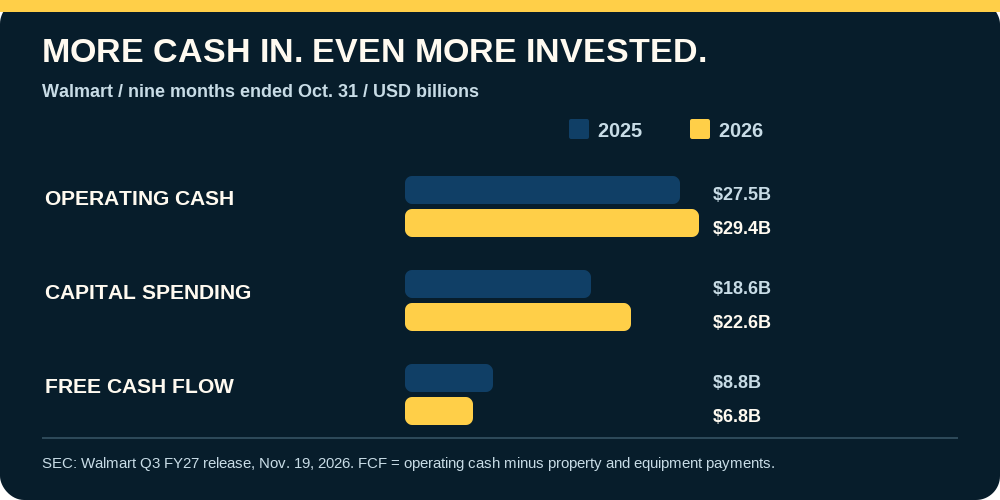
This is a capital-spending story, not evidence that operating cash collapsed. The company expects full-year capital spending of approximately 4% of net sales; that forecast was unchanged in the November guidance table. The amount and return from future investment remain uncertain. Q3 release.
The dividend is covered in this period, with less room left over
Walmart paid $5.913 billion in dividends during the reported nine months, versus $5.630 billion a year earlier. Against the company's free-cash-flow measure, that is about 1.15 times coverage in 2026 versus 1.57 times in 2025. These ratios are Dividend Lantern calculations, and the nine-month snapshot should not be annualized mechanically: retail cash flow changes with inventory, supplier payments and the holiday season. Walmart's consolidated cash-flow statement.
| Nine months ended October 31, USD billions | 2025 | 2026 |
|---|---|---|
| Free cash flow, Walmart definition | $8.825 | $6.815 |
| Dividends paid | $5.630 | $5.913 |
| Free cash flow less dividends, simple arithmetic | $3.195 | $0.902 |
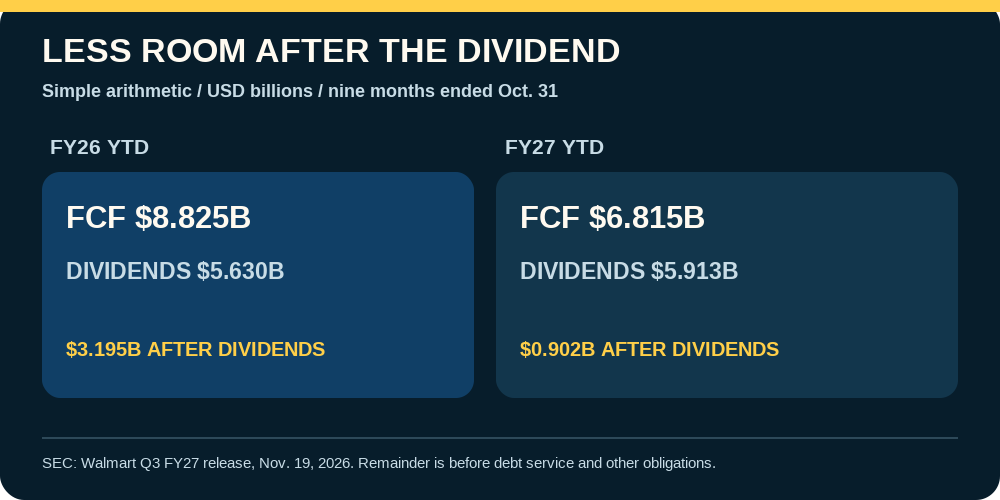
The $0.902 billion difference is not a safety reserve or a promise of future dividend growth. Walmart explicitly cautions that its free-cash-flow definition does not deduct debt service, other contractual commitments or acquisitions. A single coverage ratio cannot establish the safety of a dividend set by future board decisions. Walmart's free-cash-flow definition and limitations.
Buybacks are the second cash-allocation question
Walmart also spent $7.830 billion buying its own shares in the first nine months of 2026, up from $7.008 billion a year earlier. That is more than the period's $6.815 billion free cash flow. It would be wrong to conclude from those two lines alone that Walmart borrowed specifically to fund repurchases: corporate cash is fungible, and its cash-flow statement includes financing, acquisitions, working-capital changes and balances carried into the period. The defensible observation is narrower: dividends and buybacks together exceeded this period's free cash flow. Walmart cash-flow statement.
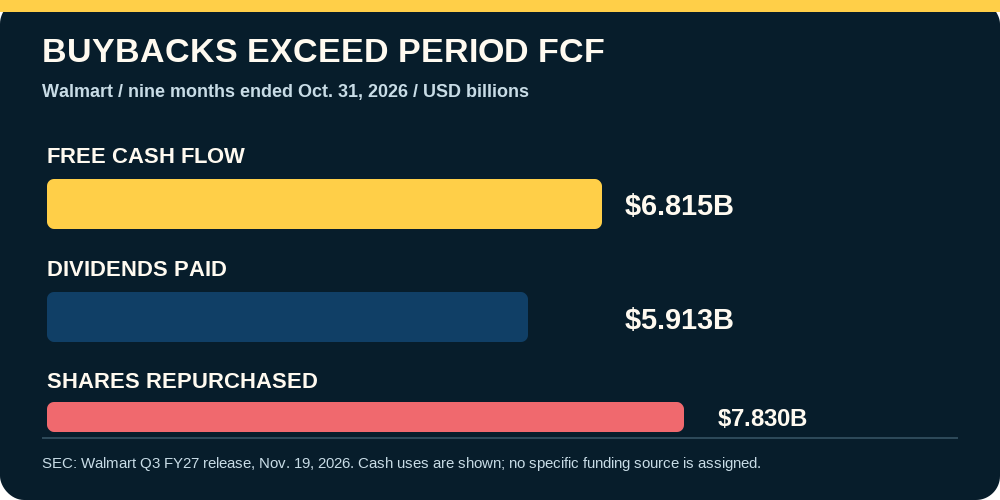
Repurchases can be adjusted independently of a regular dividend. That flexibility matters when investment spending is elevated, but it does not make the dividend risk-free. The next useful check is whether the new capital spending produces lasting operating cash, while funding the declared dividend and other obligations without excessive balance-sheet pressure.
What to check next
Read the next full cash-flow statement after the holiday quarter before treating this nine-month dip as a lasting trend. Compare operating cash, property and equipment payments, dividends paid, repurchases and debt movements over matching periods. Separate changes caused by working-capital timing from a sustained rise in investment. Walmart's raised sales outlook supports the operating thesis; its reported cash bridge shows the cost of building it. Neither observation alone settles whether the shares are attractively valued or whether future dividend increases are assured.
Educational analysis of Walmart's fiscal Q3 2027 release, checked November 19, 2026. Coverage multiples and cash differences are Dividend Lantern calculations using Walmart-reported figures. Walmart's free cash flow is a non-GAAP measure with the limitations stated above. This article is not a buy, sell or personal income recommendation.

