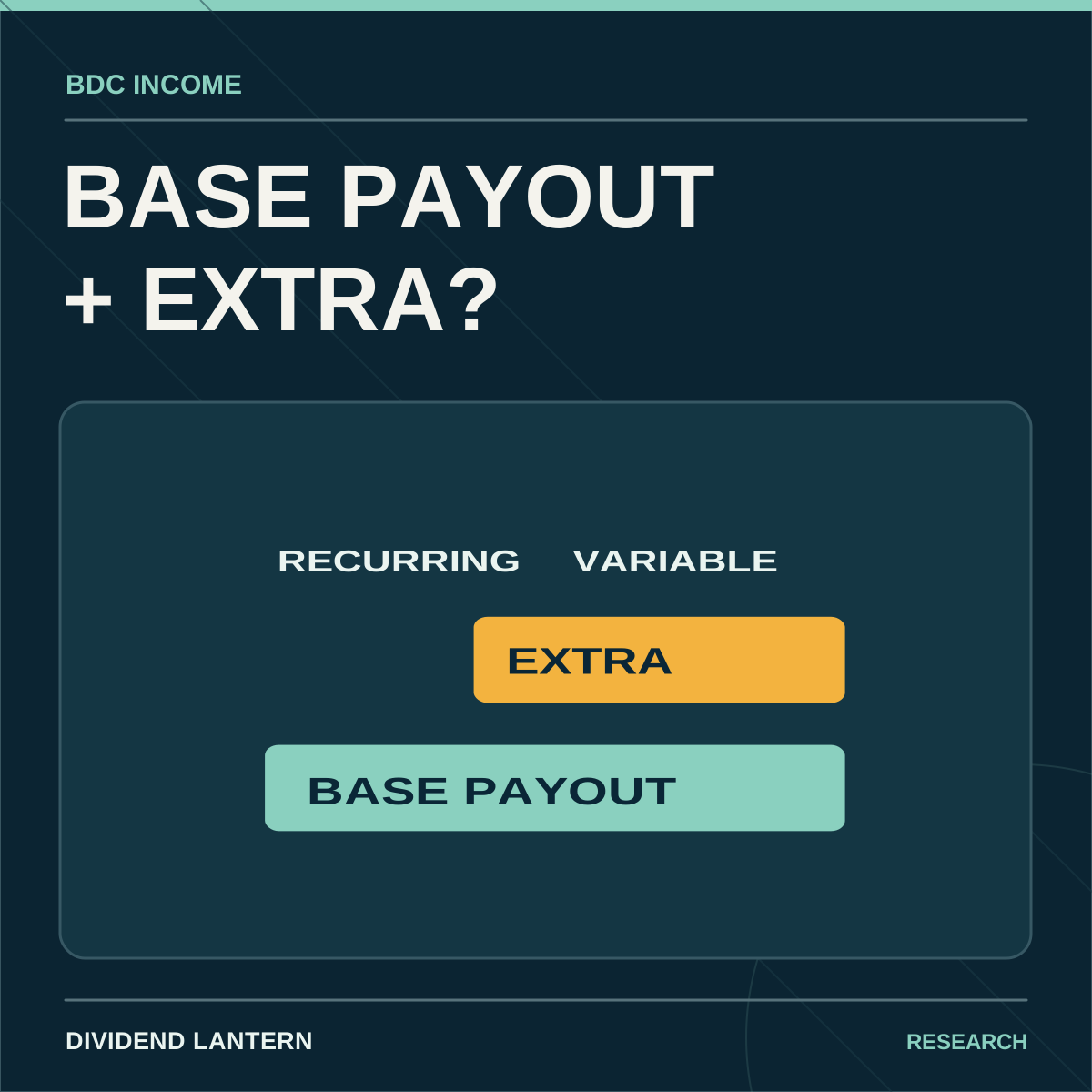
The headline payout can look wonderfully predictable—until a supplemental dividend quietly disappears. Business development companies, or BDCs, finance businesses that many retail investors cannot lend to directly. Their share prices and distributions often attract income seekers. Yet the payment shown by a yield screen may combine a recurring base dividend with an extra payment tied to accumulated income or unusual gains. Treating both as equally durable can overstate the income available for next year's budget.

Main Street Capital (MAIN) and Ares Capital (ARCC) make the distinction concrete. This is not a claim that one is safer, cheaper or a better purchase. It is a framework for reading the cash and credit behind a BDC distribution. The information cutoff is October 24, 2026. All company examples below are dated declarations or reported periods, not promises of future payments. MAIN published a preliminary estimate for Q3 on October 15, but its complete Q3 results are scheduled for November 5; preliminary figures must not be treated as a completed filing. MAIN August 2026 dividend release · ARCC July 2026 release · MAIN preliminary Q3 and release schedule
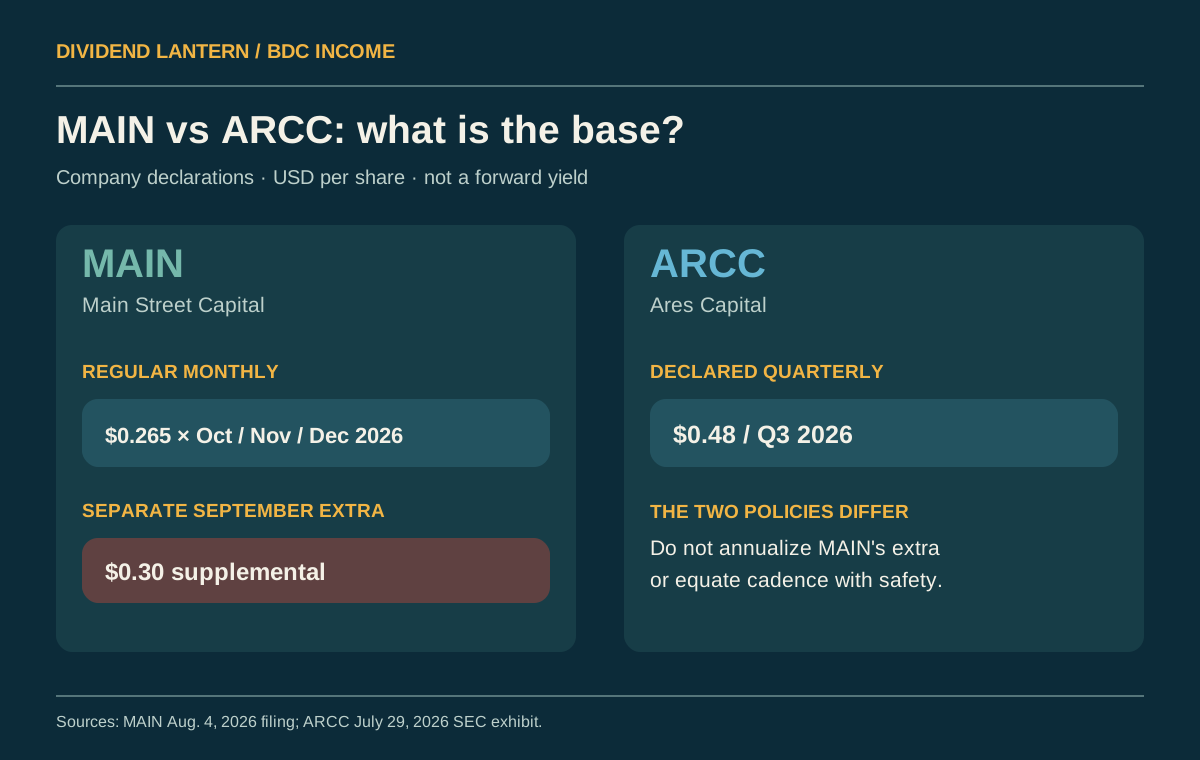
Graphic: company-declared 2026 payments, USD per share. MAIN's $0.30 September supplemental was a specific declared payment, not a fourth monthly base payment or a forward commitment. Sources: [MAIN filing](https://www.mainstcapital.com/investors/sec-filings/all-sec-filings/content/0001396440-26-000088/main-q22026xdividendprxexx.htm), [ARCC filing](https://www.sec.gov/Archives/edgar/data/1287750/000162828026050303/arccq2-2026exhibit991.htm).
What a BDC actually owns
ARCC describes itself in its 2025 Form 10-K as a specialty finance company that elected to be regulated as a BDC under the Investment Company Act of 1940. It invests primarily in debt and equity of middle-market businesses. The manager earns interest, fees and potentially capital gains, but borrowers can miss payments and the fair value of loans can fall. That makes a BDC very different from a consumer company selling products to households. Its reported income is produced by a loan and investment portfolio, supported by the BDC's own borrowing and equity capital. ARCC 2025 Form 10-K
MAIN also combines debt and equity investments. Its 2025 Form 10-K reported $352.7 million of net investment income (NII), or $3.95 per share. NII measures investment income after relevant expenses, but it is not a bank balance reserved for dividends. A reader must check what portion is cash received, whether income includes payment-in-kind (PIK) accruals, and whether realized gains supplement the ordinary lending result. MAIN separately reports measures it calls distributable NII; those are company-defined and should be reconciled back to GAAP rather than substituted for it. MAIN 2025 Form 10-K
The base and the extra are different commitments
In August 2026, MAIN's board declared $0.265 per share for each of October, November and December 2026. The same announcement referred to a $0.30 supplemental dividend payable in September 2026, sourced from undistributed taxable income as of June 30. The $0.265 payments form the declared fourth-quarter regular monthly stream. The September $0.30 is an additional, dated distribution; putting it into every future quarter of a personal cash-flow plan would assume a new board declaration not yet made. MAIN August 2026 dividend release
ARCC follows a different cadence. Its board declared a $0.48 per-share third-quarter 2026 dividend in July. The reported Q2 2026 NII was $0.50 per share. Dividing the latest reported quarterly NII by the next quarter's declared dividend gives approximately 1.04 times as a run-rate illustration. It is not realized Q3 coverage: the numerator and denominator belong to different periods. The small arithmetic cushion still calls for testing cash collection and credit quality. It is not a forecast or a like-for-like comparison with MAIN's separate monthly and supplemental structure. The dates and denominators matter. ARCC Q2 2026 results and dividend
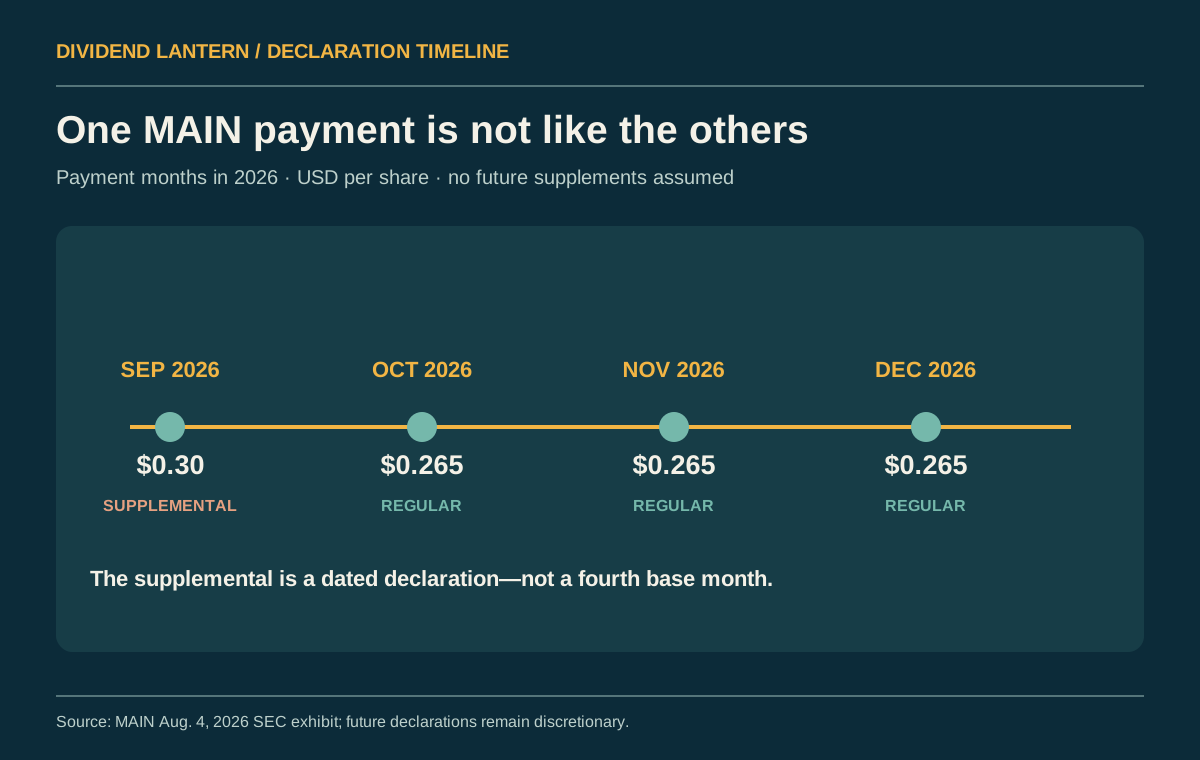
Timeline: 2026 declaration announced in August; dollars per share on the scheduled payment months. This is a historical illustration, not a forecast of later supplements. [MAIN filing](https://www.mainstcapital.com/investors/sec-filings/all-sec-filings/content/0001396440-26-000088/main-q22026xdividendprxexx.htm).
Some yield services annualize the most recent distribution, even if it includes a special payment. A better presentation has two lines: base income from declared regular payments and potential extras with no assumed recurrence. If a payment is truly designated supplemental or special, describe it that way in a tracker, budget or video. Do not turn an extra distribution into a new base rate simply because it appeared on a chart.
Four checks beneath the payout
1. Earnings quality. Compare NII per share with the regular dividend per share over several quarters, not just one. Then inspect PIK interest and dividend income—amounts that may be accrued before cash is received—and realized gains. A single large repayment or gain can support an extra distribution without establishing a repeatable lending yield. SEC filings contain the income statements and investment schedules; company presentations may add useful reconciliations, but the 10-K and 10-Q anchor the analysis. ARCC 2025 Form 10-K · MAIN 2025 Form 10-K
2. Credit migration. A BDC can report current interest income while the risk in its portfolio grows. Follow non-accrual investments, loan grades, defaults, restructurings and fair-value marks. Non-accruals may reduce future interest receipts; fair-value changes affect net asset value (NAV), which influences financing flexibility and the ability to issue equity without diluting existing shareholders. A rising dividend alongside persistent NAV erosion requires a better explanation than “the yield is high.”
3. Liability structure. BDCs borrow to invest. Compare fixed and floating borrowing costs, maturities, secured borrowing, asset coverage and access to credit. A falling lending yield or higher financing cost can compress the spread that supports distributions. This is why the same portfolio may look comfortable at one interest-rate level and strained at another. ARCC 2025 Form 10-K · MAIN 2025 Form 10-K
4. Per-share economics. Total NII can grow while NII per share stalls if the share count rises. Conversely, issuing equity above NAV can bring capital for attractive loans. A diversified manager with a strong historical record does not get a permanent exemption from this arithmetic. Follow NII per share, NAV per share and the cost of external funding together.
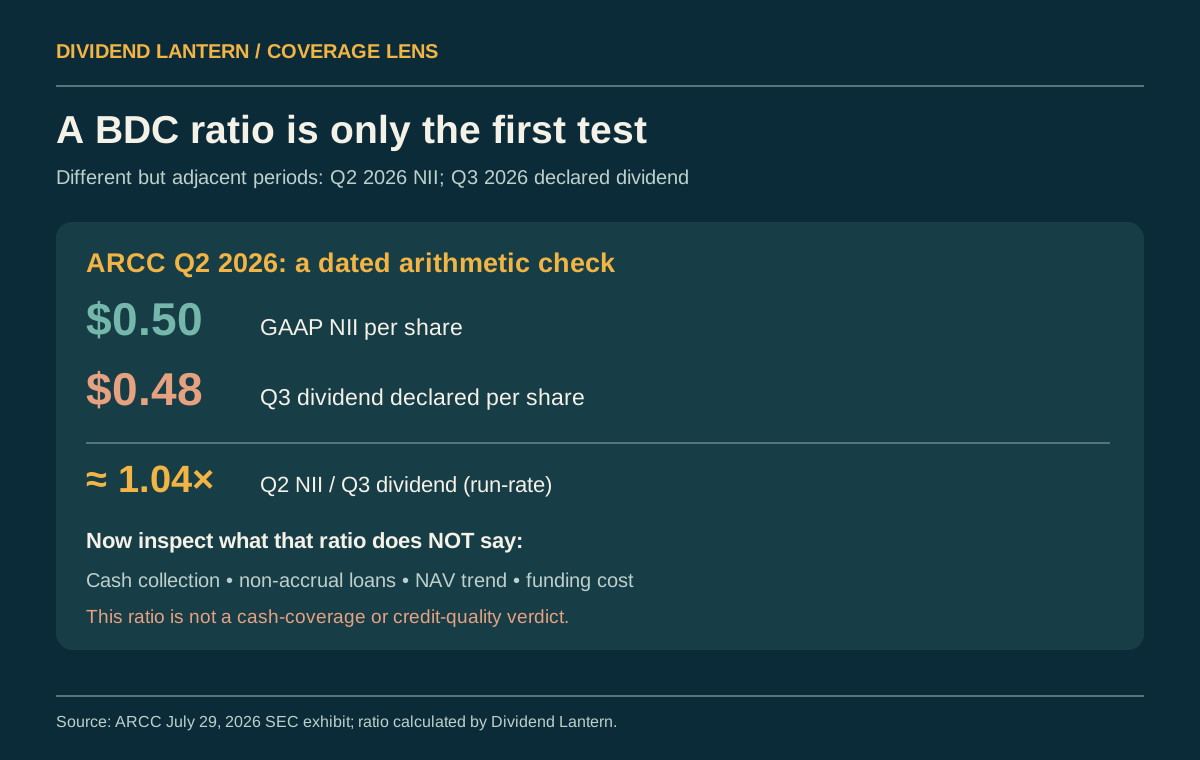
Graphic: four checks, with ARCC Q2 2026 reported NII and Q3 declared dividend used solely as a dated run-rate illustration. The 1.04× figure compares different quarters; it is not realized Q3 cash coverage or a credit rating. [ARCC Q2 filing](https://www.sec.gov/Archives/edgar/data/1287750/000162828026050303/arccq2-2026exhibit991.htm).
How to compare MAIN and ARCC fairly
Start with the payment you can actually identify as regular. For MAIN's declared fourth-quarter 2026 schedule, that was $0.265 per month, or $0.795 over the three specified months. The September supplement belongs in a separate historical column. For ARCC, the July declaration named a $0.48 quarterly payment. Dividing either figure by a current share price produces a dated yield that moves with the price; this article deliberately avoids presenting one as permanent. MAIN declaration · ARCC declaration
Next, put each company's same-period NII, cash collection, credit losses, NAV trend and financing cost beside its regular distribution. If an extra payment follows, ask whether it came from recurring income, retained taxable income or gains. There may be sound reasons for different policies: a manager can retain flexibility with a lower base plus supplements, while another may prefer a steadier quarterly figure. The policy alone does not rank underwriting quality.
Finally, challenge the assumption that a past pattern is guaranteed. MAIN has declared many supplemental payments, but a board can change the extra without cutting the regular amount. ARCC's reported Q2 2026 coverage says something about that quarter, but credit and rate conditions can change after the report. Recheck the next filings before extrapolating either payment schedule.
The take: Budget from the regular, declared stream and treat supplemental money as an upside scenario. A reliable BDC income thesis requires more than an attractive distribution history: it needs earnings that convert to cash, loans that keep paying, and financing that does not consume the spread.
Educational analysis of public filings, not personalized investment or tax advice. Any future distribution is subject to board declaration. NII, distributable NII, taxable income and cash received are different measures.