
A dividend can look comfortably covered in an ordinary year and still be the first major cash commitment a board reconsiders when orders, collections or financing conditions change. A payout ratio describes what happened in one accounting period. A stress test asks what the company would have to fund if its next year is materially worse.
The exercise does not predict a recession or calculate a precise probability of a cut. It makes the cash obligations visible, forces conservative assumptions into the open and identifies the single missing fact you should investigate in the filing. It is most useful for a cyclical company, a business with a debt maturity ahead, or a stock whose yield rose rapidly after a price decline.
Why a long dividend history is not enough
Ford paid a regular $0.15 per share dividend in each quarter of 2019 and in the first quarter of 2020. It paid $0.00 in each of the remaining three quarters of 2020, according to its 2020 Form 10-K. The company announced the suspension on March 19, 2020, explaining that it wanted to preserve cash and flexibility during the coronavirus disruption. It also drew $15.4 billion from two credit lines and withdrew guidance. The point is not that the pandemic can be forecast by a spreadsheet. It is that a board can decide that liquidity and continued business investment take priority over maintaining a familiar payment.
Ford's decision was company-specific and made in an exceptional period. It is a historical demonstration of the decision a stress test is trying to anticipate: what happens when cash from normal operations cannot be trusted, and the company wants more room to maneuver? A dividend history is evidence of past choices, not a binding promise about the next declaration.
Start with the cash obligations, not the yield
Open the issuer's latest annual report. Locate operating cash flow, property and equipment purchases, cash dividends, debt maturities and the balance of cash that can actually be used by the parent company. Do the same for several years to spot the normal range and any seasonal pattern. For a bank, insurer or REIT, the relevant cash and payout measures differ; see our REIT coverage guide for why an ordinary industrial calculation should not be pasted onto property companies.
Separate expenses into three groups. First are operating and maintenance needs: the spending required to keep customers served and assets usable. Second are contractual or near-term financial claims such as interest and maturities. Third are more discretionary uses such as acquisitions and repurchases. The dividend is also a board decision, but many investors and managers treat a reduction as significant; that does not make it untouchable.
Do not assume every dollar of reported cash is available. Restricted cash, regulated subsidiaries, foreign operations, pension commitments or working-capital needs may limit how readily funds can reach the parent. Likewise, an undrawn credit line has conditions and an expiry. Check the liquidity discussion, not just the balance-sheet headline.
Run three scenarios with one transparent model
Consider a hypothetical nonfinancial company. In a normal year it produces $120 million of operating cash flow, spends $35 million on necessary capital work, faces $20 million of debt principal that it chooses to repay, and pays $50 million in dividends. Assume no acquisitions, share repurchases or new financing. Its cash after those four items is $15 million.
Now model a weaker year in which customer collections slow and operating cash falls to $100 million. Keep capital work, debt repayment and the dividend at the same amounts. The resulting cash gap is $5 million. A more severe case uses $75 million of operating cash, $40 million of necessary capital spending, $25 million of debt principal and the same $50 million dividend. The gap becomes $40 million.
| Hypothetical annual cash, $m | Normal | Weaker | Severe |
|---|---|---|---|
| Cash from operations | 120 | 100 | 75 |
| Necessary capital spending | (35) | (35) | (40) |
| Debt principal repaid | (20) | (20) | (25) |
| Dividend at current cash amount | (50) | (50) | (50) |
| Cash remaining / funding gap | 15 | (5) | (40) |
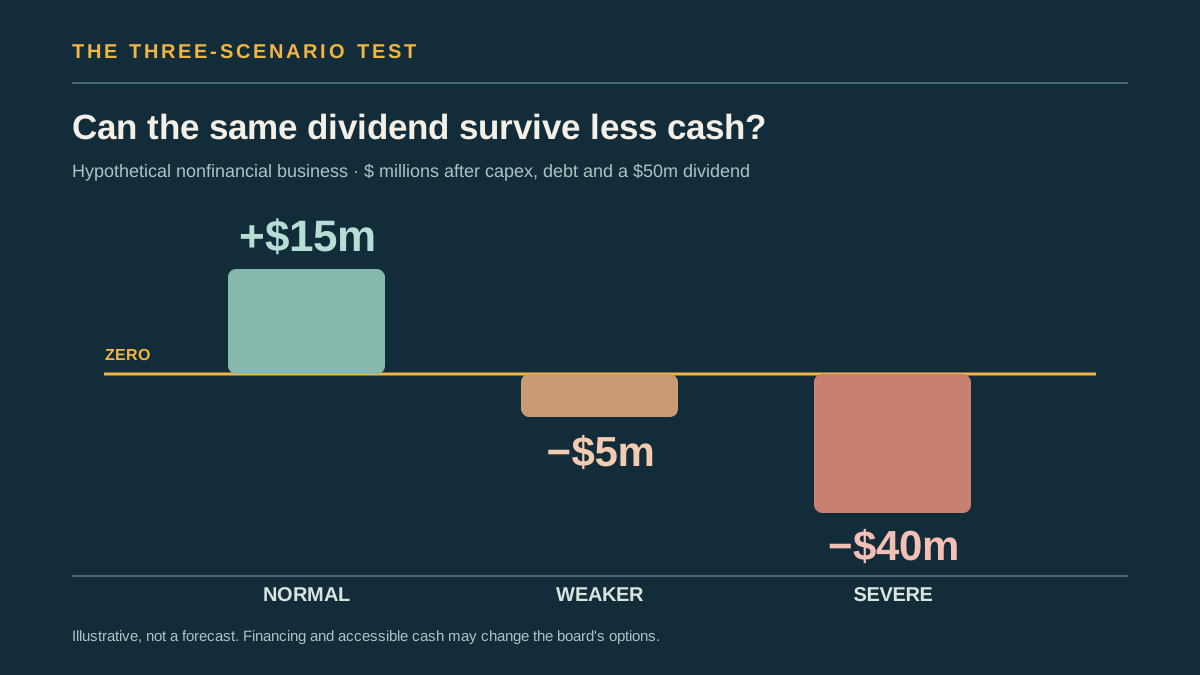
This model sets a simple threshold. In the normal assumptions, cash from operations must be at least $105 million to cover $35 million of necessary capital spending, $20 million of debt principal and $50 million of dividends without drawing on existing cash or obtaining financing. That is not a universal safety line. Debt may be refinanceable; capital spending may include growth projects; working-capital cash may reverse. The point is to expose the assumptions behind a comforting payout ratio.
Change what actually moves in a downturn
A common shortcut is to take last year's operating cash and reduce it by the same percentage as revenue. That is usually too neat. A distributor may sell less and release inventory cash; or it may collect more slowly and absorb cash. A manufacturer may have fixed costs that make profit fall faster than sales. A regulated utility may keep relatively stable demand while facing capital projects and high interest costs. Model the cash drivers that fit the company.
Build at least one second-order shock. Suppose sales decline and a major customer extends payment terms. That is a cash-collection problem even if booked revenue has not collapsed. Suppose a debt maturity lands in the same year that lenders demand a higher interest rate. Refinancing may still be possible, but the dividend's future cash cushion shrinks. Suppose maintenance spending cannot be deferred without harming service quality. The cash gap can widen as management tries to protect the franchise.
For a cyclical business, look at the company's last weak period. Use its actual revenue, margin, cash conversion and capital spending to set the range rather than selecting a dramatic percentage for clicks. Historical episodes are imperfect; business mix, share count and debt may have changed. They remain useful to test whether today's payout depends on unusually favorable conditions.
Ask how the gap could be closed
In the $5 million shortfall case, management might draw on unrestricted cash, delay a truly optional project, stop repurchases, refinance debt, sell an asset or leave the dividend unchanged while accepting a temporary cash reduction. Any one of those may be sensible depending on the balance sheet. In the $40 million case, the solutions become more consequential. A company with $100 million of accessible cash and no near-term debt wall faces a different decision from one with $10 million of accessible cash and an expiring credit line.
Do not count a halted buyback twice. If the scenario table already excludes repurchases, cancelling a repurchase program cannot improve the table again. Similarly, if the debt principal is assumed to be refinanced, remove the repayment from the cash bridge but add the likely new interest cost and refinancing risk. A stress test should be conservative without becoming internally inconsistent.
Write down the board's realistic options in order: stop optional buybacks; protect operating and maintenance spending; manage debt maturities; then consider whether the regular dividend can remain. This is a framework for questions, not a forecast of what a board will choose. Dividend policy also depends on covenants, legal limits, regulatory requirements and management's stated priorities.
Red flags and evidence that the model is too pessimistic
The model needs another look if dividends plus necessary investment repeatedly exceed operating cash, if debt maturities bunch up, if the cash balance is largely unavailable, or if management's optimistic adjusted metric improves while operating cash lags. A rising indicated yield after a price drop is a prompt to run the test, not proof of danger. Our high-yield checklist helps organize that first investigation.
It may be too pessimistic if a temporary working-capital build reverses, planned capital spending is genuinely optional, near-term debt is already refinanced on manageable terms, or the business has contracted revenue that holds up through weak demand. Document those reasons with primary filings and management's actual guidance. Do not silently assume them because the dividend has never been cut before.
The final output can be one sentence: Under a 20% drop in operating cash and current planned spending, the company would need $X from cash reserves or financing to maintain its dividend. Then list the source and date for every input. Update the model after earnings, debt refinancing and dividend announcements. A stress test is valuable because it changes when the business changes; a fixed “safe” badge does not.
Ford's 2020 decision is historical context, not a statement about its current dividend. All scenario amounts are illustrative. This article is educational and is not personalized investment advice.