
Two headlines can sound almost interchangeable: the board raised its dividend and the board authorized another $100 billion in repurchases. Both concern cash returned to shareholders. For an investor trying to build a dependable stream of spendable income, they answer different questions. A dividend puts cash in the account when the payment is made. A repurchase may increase the ownership claim of shares that remain outstanding, but it creates no scheduled cash payment for an investor who keeps every share.
Apple made this distinction unusually visible in May 2025. Its board declared a quarterly dividend of $0.26 per share, up 4%, and authorized an additional program to repurchase up to $100 billion. Those were two separate capital-allocation decisions. The authorization was a ceiling, not a promise to spend the whole amount. The dividend declaration established one payment, not a legally guaranteed stream of future increases.
First, follow what happens to one shareholder
Suppose you own 100 shares. A declared $1-per-share dividend gives you $100 in cash on the payment date, before tax. If the company instead buys shares from other owners, you still own 100 shares and receive no cash directly. You may own a larger percentage of the company if the share count actually falls, but you need either a later dividend or a share sale to turn that ownership into personal cash flow.
This is why comparing only the dollar value of a company's dividend and repurchase program does not answer an income question. Repurchases can support future per-share growth by dividing the same total earnings or distributable cash among fewer shares. They can also offset dilution from stock compensation and have little effect on the net count. An authorization can remain partly unused. A dividend can grow while buybacks shrink, or vice versa.
The mechanisms are related, but neither one turns a weak business into a safe income investment. Both compete with reinvestment, debt reduction and the cash reserve the business needs through downturns.
A $200 million allocation example
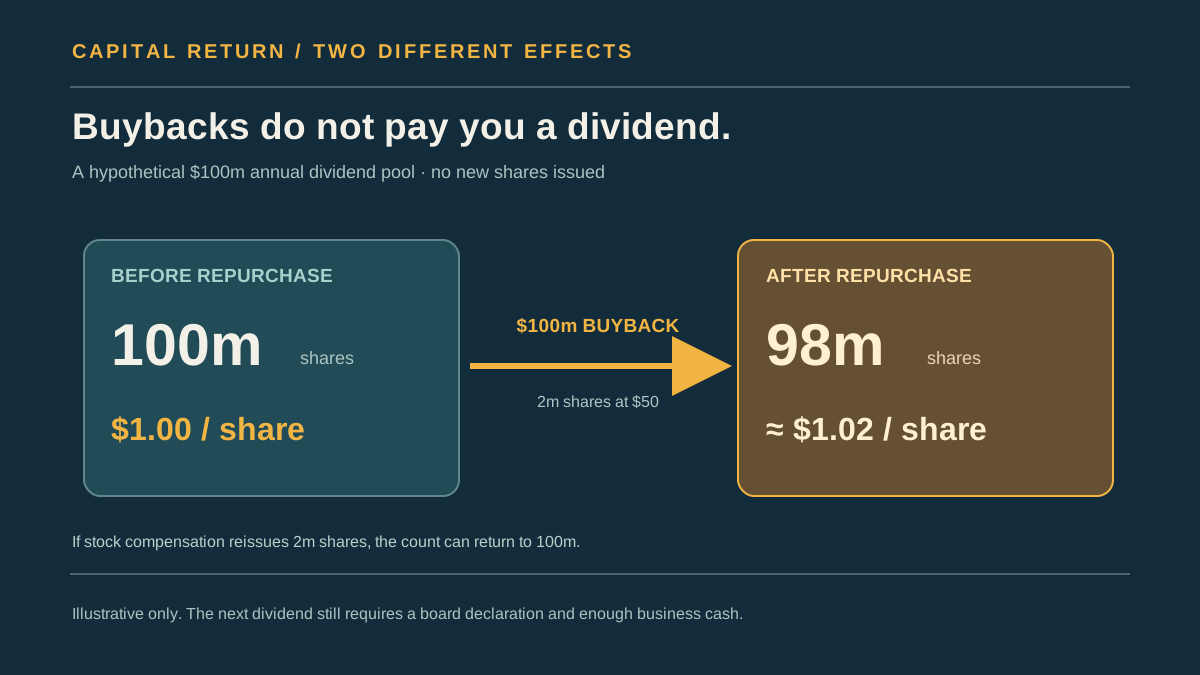
Consider a purely hypothetical company with 100 million shares outstanding and $200 million of cash available after operations, necessary capital spending and near-term obligations. The board decides to spend $100 million on dividends and $100 million on repurchases. A $100 million dividend pool equals $1 per share. At a $50 repurchase price, the other $100 million would buy 2 million shares. If no shares are issued and all purchased shares are retired, 98 million shares would remain.
Next year, if the company can again afford a $100 million dividend pool, it could pay about $1.0204 per remaining share instead of $1.00. That roughly 2.04% rise comes from the lower share count alone. It does not mean the business earned more cash. It assumes the purchase price, available cash and share count behave exactly as modeled. If the company issues 2 million shares for compensation, the net count could return to 100 million and this mechanical benefit disappears.
The alternative matters too. If that entire $200 million had been available and paid out instead, the same 100 million shares could receive $2 each that year. That would leave no cash from that budget for the repurchase. But a board might reasonably prefer an uneven, flexible repurchase program over a dividend so high that it would be hard to repeat. The point is to make the trade-off explicit, not to assume a particular split is best.
What Apple's filing shows—and does not show
Apple's fiscal 2025 Form 10-K says it repurchased $89.3 billion of common stock during the year and paid $15.4 billion in dividends and dividend equivalents. Its common shares outstanding fell from approximately 15.117 billion at the start of that fiscal year to 14.773 billion at the end. The filing also shows approximately 402 million shares repurchased and 58 million net shares issued, mainly illustrating why the gross repurchase count and the net reduction are not equal.
Those historical figures do not tell us whether Apple bought shares at an attractive price. They do not establish what its future dividend will be, or whether its next year of cash generation will match its last. They show the evidence to collect when a company makes a large capital-return announcement: cash actually spent, net shares outstanding, per-share dividends and the business cash flows that paid for everything.
Apple explicitly says its programs do not obligate it to acquire a minimum number of shares. It also says future dividends depend on board declaration. That distinction between board authority and shareholder cash received is essential whenever a headline uses the word authorized.
Five questions to ask before cheering a buyback
1. Did shares outstanding fall? Compare the beginning and ending common share count, rather than treating gross purchases as a net reduction. Compensation and acquisitions can add shares. A large buyback budget can act mainly as an antidote to dilution.
2. What price was paid? Repurchasing at an inflated valuation can destroy value even if reported earnings per share rises. The same cash would buy more shares after a price decline. A falling share count is useful data, but it is not proof of a good purchase.
3. Was the business funded first? Check operating cash flow, necessary capital spending, inventories and working capital. Maintenance cannot be postponed forever to produce a smoother dividend story. Use the cash-flow statement and balance-sheet explanations in the SEC's financial-statement guide as the starting map.
4. Was the return funded by borrowing? Debt may make sense in a broader capital plan, but new interest and refinancing obligations reduce future flexibility. Read the debt note and maturity schedule alongside the capital-return slide.
5. What does the per-share dividend require next year? Multiply the proposed or indicated per-share annual payment by the current share count, then compare that cash requirement with a conservative cash-flow scenario. A lower share count can reduce the total cash cost of a dividend, but it cannot protect a payment if operating cash collapses.
An earnings-per-share increase after repurchases should be split conceptually into business improvement and denominator improvement. If the earnings numerator is flat but shares shrink, EPS rises without a stronger operating engine. If both improve, the dividend might have more room, subject to investment and debt needs. The research checklist for a dividend watchlist is a place to record this distinction after each filing.
The investor's own cash-flow plan is separate
Some investors prefer cash dividends because they can use the payment without selling shares. Others prefer a company to repurchase shares when management believes the price is attractive, leaving investors free to decide when to sell. Those preferences interact with tax treatment, account type, transaction costs and the investor's need for near-term income. This article cannot decide that trade-off for an individual.
A useful personal plan can show two lines: cash the company has declared and possible value from per-share ownership growth. Only the first is a scheduled cash payment. Even it remains subject to future board decisions beyond the current declaration. For a deeper discussion of how a modest starting yield can grow over time, read Dividend Growth vs. Starting Yield; that growth math is a scenario, not a guarantee.
Watch for the tempting but incomplete statement, “They returned $100 billion to shareholders.” How much was a direct dividend? How much was spent repurchasing shares? Did the net share count fall? Were business investment and debt handled sensibly? If you need recurring income, the answers matter more than the headline total.
The strongest capital-return policy is not always the one with the biggest authorization or fastest dividend increase. It is the policy the business can fund without starving its future. Ask what cash remains after maintaining the company, then inspect how the board chose to divide that cash—and whether its choices improved the position of the shareholders who stayed.
Figures from Apple refer to its fiscal 2025 filing, not a current valuation assessment. The numerical company example is hypothetical, pretax and rounded. This is educational research, not personalized investment advice.