
An earnings headline can move a stock in seconds. It cannot tell you, by itself, whether next year's dividend is more secure. Sales, adjusted earnings, operating cash, investment spending and debt can all point in different directions. The useful investor habit is to read the latest earnings release as a sequence of questions rather than a verdict.
Two reports from October 2026 make the problem concrete. Fastenal reported 15.5% year-over-year daily-sales growth in its September quarter, while UnitedHealth raised its 2026 adjusted-earnings outlook to at least $20.50 per share. Those are real, company-reported facts, but neither number is a dividend-coverage calculation. The filings answer different questions, and the industries require different follow-up work.
Here is a ten-minute first pass. It is a triage method: it tells you what deserves a deeper read, not whether to buy or sell a security.
Minute 1: Date the claim and name the period
Write down when the report was issued and whether each number covers a quarter, the first nine months or a full year. Fastenal's third-quarter release dated October 14, 2026 includes both the three-month and nine-month cash-flow columns. UnitedHealth's October 13 release reports quarterly operating cash flow of $5.1 billion, while its SEC-filed supplementary statements show cash flows for nine months.
Do not divide a single quarter's cash generation by nine months of dividends and call the result a coverage ratio. Equally, do not annualize an unusually strong quarter without examining seasonality and working capital. Period matching is the fastest way to prevent a plausible-looking but meaningless chart.
Minutes 2–3: Start with business momentum, then interrogate it
For Fastenal, ask what produced the 15.5% daily-sales gain. Its release attributes the increase to larger-customer share gains, pricing actions and demand across core markets. The same filing says operating margin reached 21.5%, up from 20.7% a year earlier. That is encouraging business context. But industrial distribution often needs more receivables and inventory as it grows. Cash can be absorbed before customers pay.
For UnitedHealth, the relevant operating questions are different. The company reported third-quarter revenue of $112.7 billion, lower than $113.2 billion in the year-earlier quarter, and a medical care ratio of 88.4%, down from 89.9%. The change in the medical ratio is material context for an insurer, but it is not a cash-dividend figure. Read it alongside claims reserves, benefit pricing, membership and regulatory exposure rather than borrowing the same rubric used for a parts distributor. Its raised adjusted EPS outlook is a management estimate for 2026, not cash in the bank.
The rule is to explain why the headline moved. Revenue growth with weakening margins may bring less dividend capacity than slower sales with stronger cash conversion. An adjusted earnings figure may exclude costs that still require cash. Management's reconciliation and the actual cash-flow statement belong next to the headline.
Minutes 4–6: Build a small, period-matched cash bridge
For most operating companies, start with reported cash from operations. Subtract purchases of property and equipment as a simple capital-spending proxy. Then subtract cash dividends paid in the same period. This gives a rough residual before debt repayment, acquisitions, buybacks and other demands. It is not a universal definition of free cash flow or an assurance that every dollar can be distributed.
Fastenal's September 2026 filing reports the following, in millions of dollars:
| Period | Operating cash flow | Gross purchases of property and equipment | Cash dividends paid | Simple residual |
|---|---|---|---|---|
| Q3 2026 | $421.6 | $74.0 | $298.2 | $49.4 |
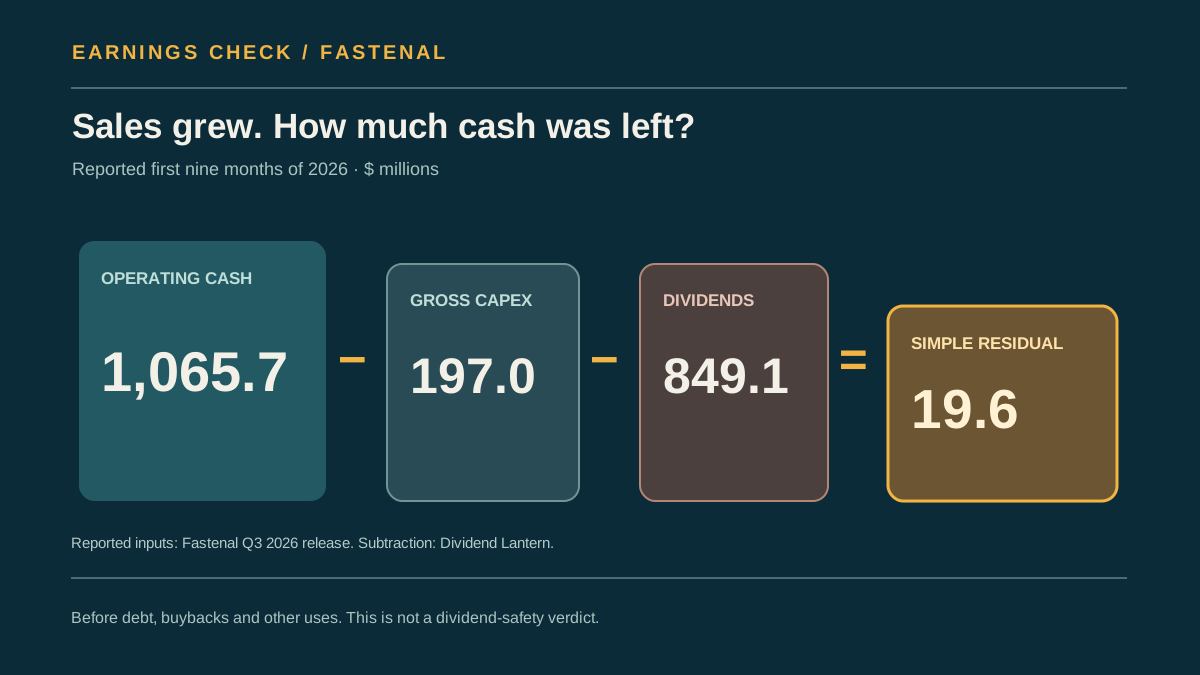
| First nine months of 2026 | $1,065.7 | $197.0 | $849.1 | $19.6 |
The nine-month result is more revealing than the sales headline. The simple residual is positive but narrow compared with the dividend outlay. It was not necessarily an emergency: the company also reported just $100.0 million of total debt at September 30, and a cash balance of $211.9 million. The same release describes operating cash flow affected by receivables and inventory associated with rapid growth. It also expects net property-and-equipment investment of $310 million to $330 million for full-year 2026, above 2025. These facts create a follow-up question about the fourth quarter and the next capital-spending cycle, not a prediction of a cut.
Now try the same period-matching discipline for UnitedHealth. Its SEC-filed nine-month 2026 cash-flow statement reports $25.087 billion of operating cash flow, $2.421 billion of purchases of property, equipment and capitalized software, and $6.170 billion of dividends paid. The mechanical difference is $16.496 billion. That figure should not be compared directly with Fastenal's residual: UnitedHealth's insurer cash flows include claim timing, investment assets and regulated subsidiaries. The release reports $5.031 billion of share repurchases and $3.075 billion of net debt reduction in the nine-month financing section, and its risk disclosures discuss the ability to obtain funds from regulated subsidiaries. A cash bridge helps frame the investigation; it does not finish it.
Minute 7: Look for the gap between profit and cash
Fastenal says third-quarter operating cash flow was 105.0% of net income, down from 115.3% a year earlier. That ratio alone does not mean cash collection deteriorated permanently. The company links the difference to more cash tied up in receivables and inventory as sales grew, partly offset by payables. An analyst should ask whether those working-capital balances normalize, worsen or become a durable requirement of the larger business.
At UnitedHealth, the quarterly $5.1 billion operating-cash figure was 1.2 times net income, according to the company. The nine-month cash statement shows a different period and a much larger total. Those figures can both be correct. The analyst's task is to use the same dates and the company's business-specific explanation, then test whether favorable claims developments or timing effects may reverse.
If adjusted EPS improves but operating cash weakens repeatedly, don't stop at management's adjective adjusted. Locate the reconciliation, the items removed, the operating cash line and changes in receivables, inventories or reserves. One quarter can contain ordinary timing noise; a repeated gap needs an explanation.
Minutes 8–9: Find the claims ahead of the dividend
Scan the balance sheet and notes for maturities, floating-rate borrowing, restricted cash, regulatory capital, committed capital projects and acquisition payments. A payout can be covered by this year's operating cash while the next two years require refinancing or a major rebuild. A company with little debt may have more choices than one that must fund its dividend and a debt wall at the same time.
Then ask whether the board has actually declared the next dividend. An earnings release may discuss a policy but leave the next payment undeclared. A calendar should identify future undeclared payments as estimates. Our dividend-date explainer separates declaration, record and payment dates; use it before entering a future cash amount into an income plan.
If the share price fell sharply on earnings day, recalculate the indicated yield with a dated quote and a genuinely declared or clearly annualized payout. A higher yield caused by a lower price tells you market expectations changed. It does not reveal whether those expectations are correct. The high-yield research checklist is the next step when the price move makes a dividend look unusually large.
Minute 10: Write one question, not a verdict
Finish with a short note: What would change my view after the next report? For Fastenal, a useful question is whether operating cash after higher capital spending still covers dividends with room for the company's other needs. For UnitedHealth, ask whether medical-cost trends, cash conversion, regulated cash availability and leverage develop in line with management's outlook. Neither example here is a buy or sell recommendation.
Set an alert for the next earnings release, dividend declaration or material debt event. Save the period, source URL and the calculation used. The point of a ten-minute review is to direct attention efficiently; the full 10-Q or 10-K, notes and management call are where a position-sized decision should be tested. The watchlist research template helps keep those questions visible rather than losing them beneath daily price moves.
A strong dividend headline should survive three questions: Did the business generate enough cash over a comparable period? What else competes for that cash? What could change before the next declaration? Asking them consistently is more useful than reacting to an adjusted earnings surprise alone.
Reported Fastenal values are in millions and UnitedHealth values in billions, for the periods indicated. Simple cash residuals are arithmetic by Dividend Lantern, not company guidance or a standardized accounting measure. Educational only; not personalized investment advice.
Sources
- Fastenal, third-quarter 2026 earnings release and cash-flow statement, October 14, 2026
- UnitedHealth Group, third-quarter 2026 press release, October 13, 2026
- UnitedHealth Group, third-quarter 2026 supplementary statements filed with the SEC, October 13, 2026
- SEC, Beginner's Guide to Financial Statements