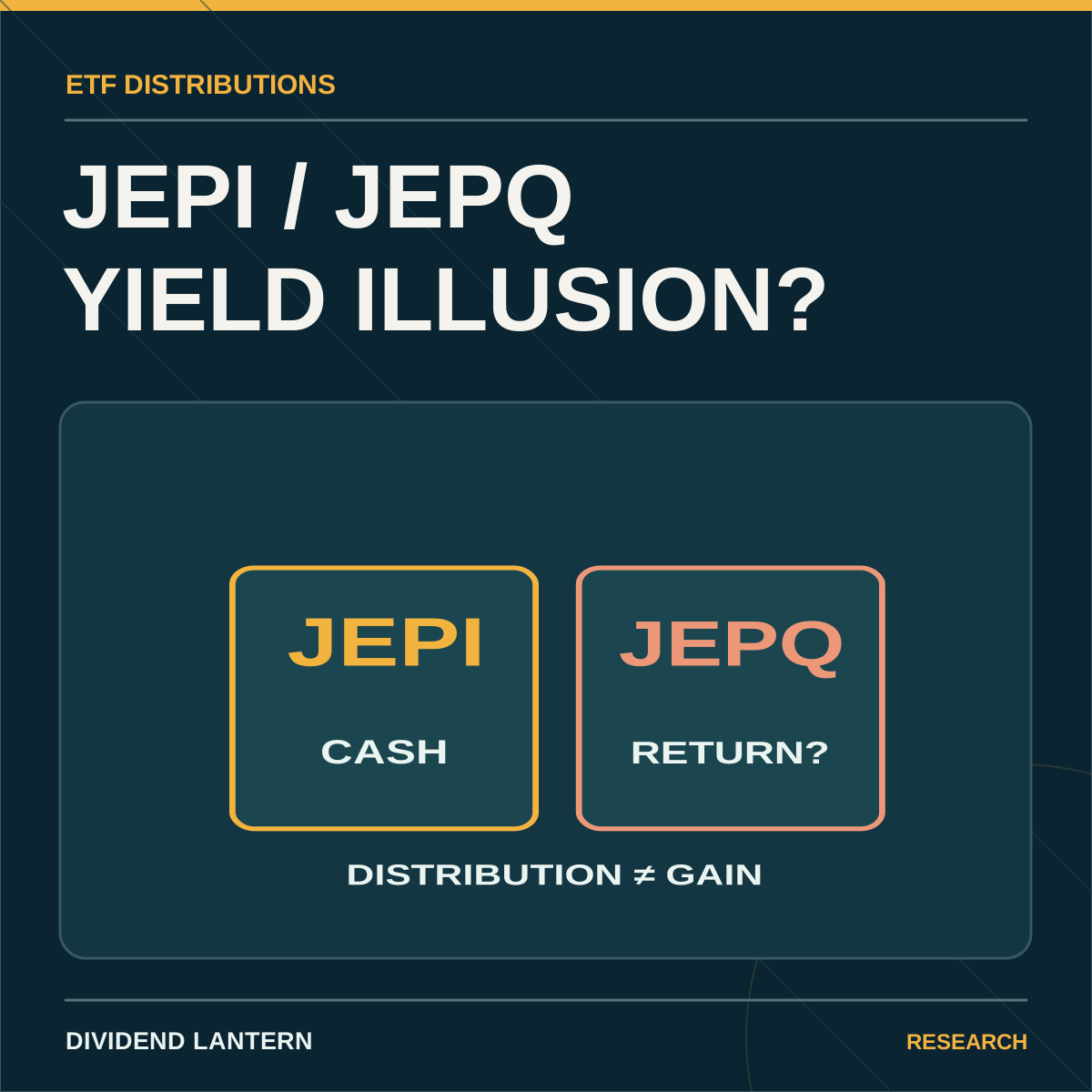
A monthly ETF payment is not automatically a dividend earned by the companies it owns. The distinction matters when investors compare JEPI or JEPQ with a dividend-growth stock. An operating company can raise its dividend because its business generates more cash per share. A covered-call income fund can distribute cash from a combination of the stocks it holds and an option-linked strategy. Both put money into a shareholder's account, but they rely on different engines and surrender different opportunities.

J.P. Morgan describes JEPI as holding a defensive portfolio of U.S. stocks and using an options overlay to seek monthly distributable income. JEPQ pursues a similar income objective with Nasdaq-100 exposure. The prospectus says the funds use equity-linked notes (ELNs) for their options exposure; the economic payoff resembles written call options, but the notes also introduce counterparty and valuation considerations. This article examines the mechanism using fund documents reviewed by October 24, 2026, rather than recommending either fund or forecasting a later distribution. J.P. Morgan JEPI product page · JEPI/JEPQ prospectus filed with the SEC
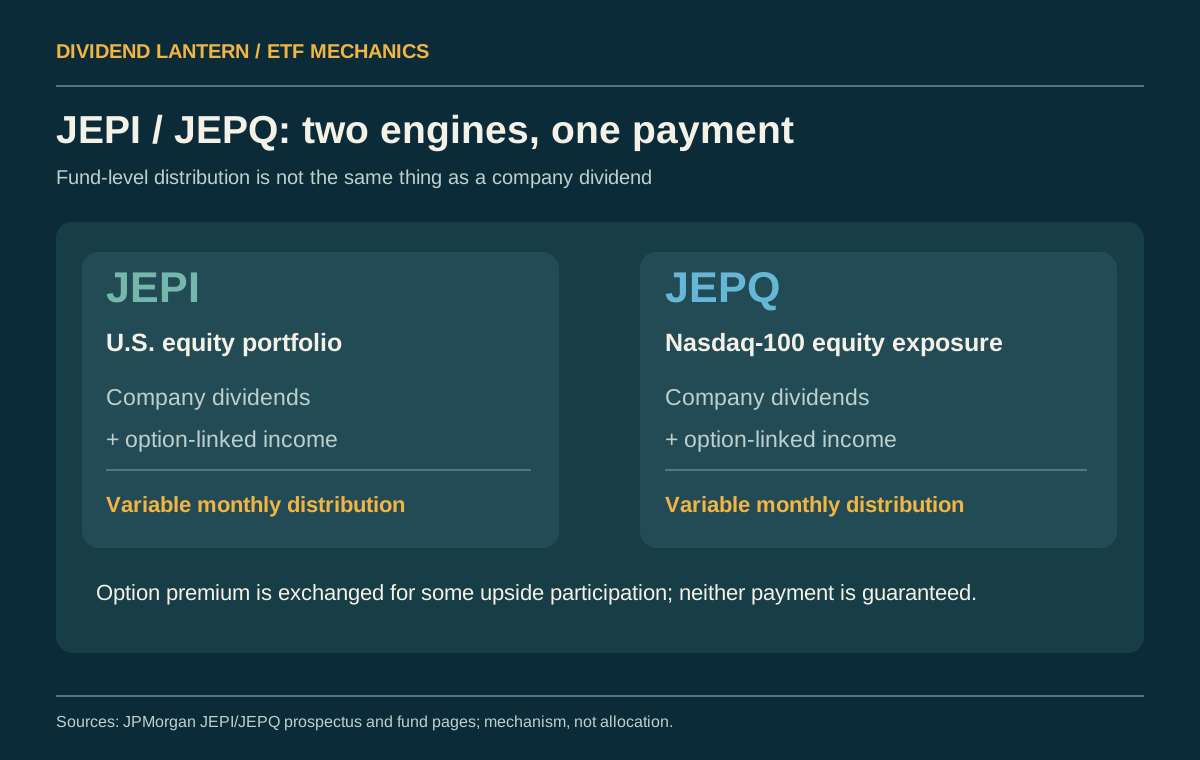
Diagram: conceptual mechanism, no claimed fund allocation. JEPI and JEPQ holdings, option-linked ELNs and distribution policies are described in the [SEC prospectus](https://www.sec.gov/Archives/edgar/data/1485894/000119312525246367/d870279d485bpos.htm) and [J.P. Morgan materials](https://am.jpmorgan.com/us/en/asset-management/adv/products/jpmorgan-equity-premium-income-etf-46641q332).
What is being exchanged for the option-linked income?
Imagine a stock portfolio that might rise or fall. Selling a call option—or arranging the equivalent exposure through an ELN—can bring in premium or coupon income. In exchange, some gains beyond the option's strike can be given up. If markets rise sharply, the portfolio may lag a comparable uncapped equity portfolio despite paying more cash along the way. If markets are flat or choppy, the extra income may help total return; it does not remove the risk of a falling share price. Option terms, volatility and execution all matter. JEPI fund story · SEC prospectus
That trade is frequently invisible in a screenshot of monthly payments. Cash arrived, so the income strategy can feel successful. But wealth depends on distribution plus change in the share price or net asset value (NAV), after expenses and taxes. An investor who receives $1 while a fund's value falls $2 has not earned a $1 total return. Equally, a fund that lags a soaring index may still suit an investor who values a different return pattern. The point is to measure the objective honestly.
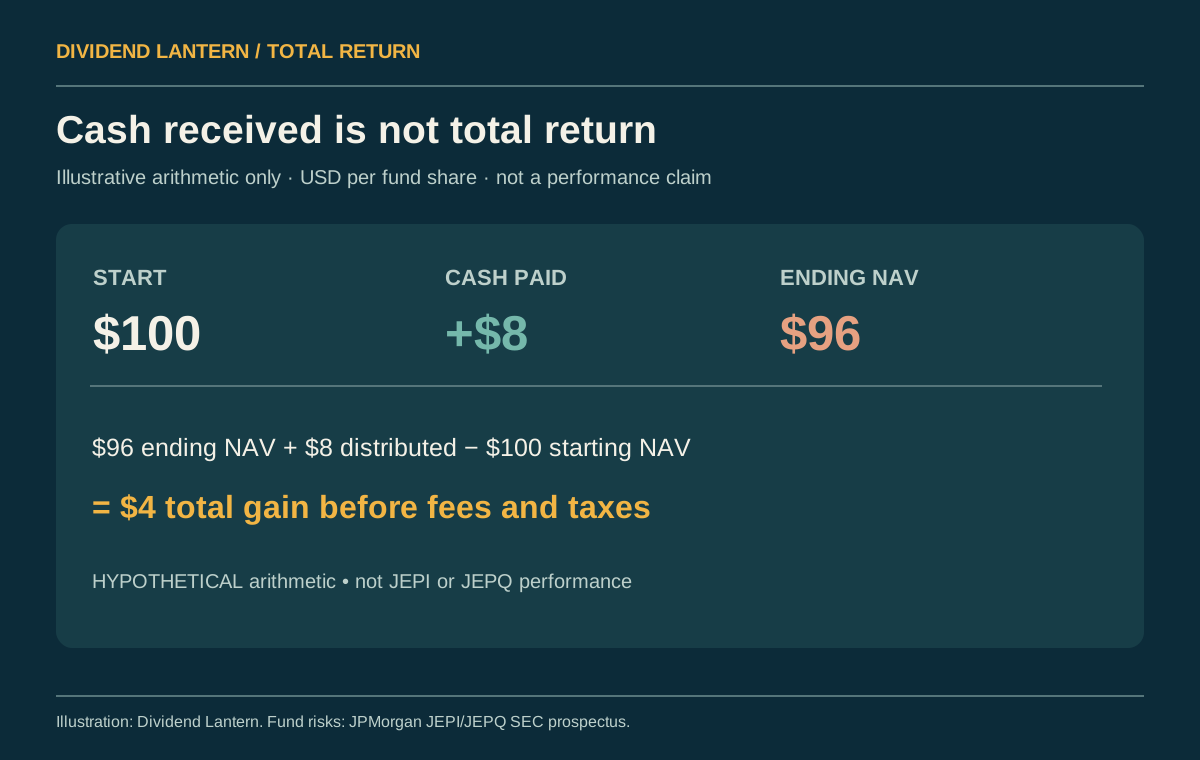
Graphic: hypothetical arithmetic, not JEPI or JEPQ performance. Beginning NAV $100, cash distributed $8, ending NAV $96 implies a $4 gain before fees and taxes: ($96 + $8 − $100). The example teaches that a distribution is not the same as total return. See the [SEC prospectus](https://www.sec.gov/Archives/edgar/data/1485894/000119312525246367/d870279d485bpos.htm) for actual fund risks.
Why the word “yield” can mislead
On JEPI's product page, several yield measures appear: a 30-day SEC yield, a 12-month rolling dividend yield, and recent individual distributions. They answer different questions. The 30-day SEC yield is a standardized calculation of recent net investment income, not a promise of next month's payment. The 12-month figure summarizes a trailing set of distributions relative to fund values; it is backward-looking. The most recent monthly amount is one observation. Annualizing that single payment would presume eleven more identical months. J.P. Morgan's own payment table shows that the monthly per-share amounts change. JEPI product page, definitions and dividend schedule
The name of a website's yield field is not an analysis of source. A company dividend from an underlying stock, an ELN coupon or option-linked payoff, a realized capital gain and a return-of-capital tax classification have different meanings. The final tax character may differ from early distribution estimates; it should be read from fund notices and year-end tax information for the relevant year. A high payout alone does not prove a fund is “earning” it in the ordinary operating-company sense, and it also does not by itself prove destructive return of capital. SEC prospectus · JEPI product page
JEPI and JEPQ are not interchangeable monthly checks
JEPI and JEPQ use related equity-premium ideas but start with different stock exposures. JEPI's benchmark context is the S&P 500; JEPQ is designed around the Nasdaq-100. The latter has a different sector and company mix, so the fund's underlying equity risk and potential upside trade-offs are not the same. J.P. Morgan's JEPQ literature describes its objective as current income with prospects for capital appreciation, not a contractual fixed coupon to shareholders. Both products are actively managed; holdings and option exposures can change. JEPI/JEPQ SEC prospectus · JEPQ fund story
The ELN detail deserves more attention than it usually gets. In an exchange-traded call option, exposure and counterparties can differ from those of a structured note. An ELN is a debt obligation of its issuer with a payoff tied to the option strategy. The prospectus discusses the possibility that a counterparty may not perform and that note values may not move exactly like the reference assets. An investor should check the current holdings report and prospectus rather than assuming every dollar of the overlay is a simple option on the fund's own stock basket. SEC prospectus
A three-column dashboard for an income ETF
To judge a covered-call fund over a meaningful period, record three separate columns: cash paid per share, NAV or price change, and the total return with distributions reinvested. The first helps with near-term spending. The second shows how much claim on future assets remains. The third allows a comparison with a plain equity fund or Treasury instrument over the same dates. None can replace the others. When possible, use NAV total return, since market price may temporarily differ from NAV; if using market price, label it.
Next ask what economic environment produced the result. Option premiums can change with volatility, and covered-call strategies may participate less in a strong rally. A modestly declining market may leave an option-income fund with a different loss profile than its reference index, but the overlay is not a guaranteed downside hedge. Compare both the distribution amount and the opportunity cost of capped upside. The fund's expense ratio and tax treatment can further change what the investor keeps. JEPI fund story · SEC prospectus
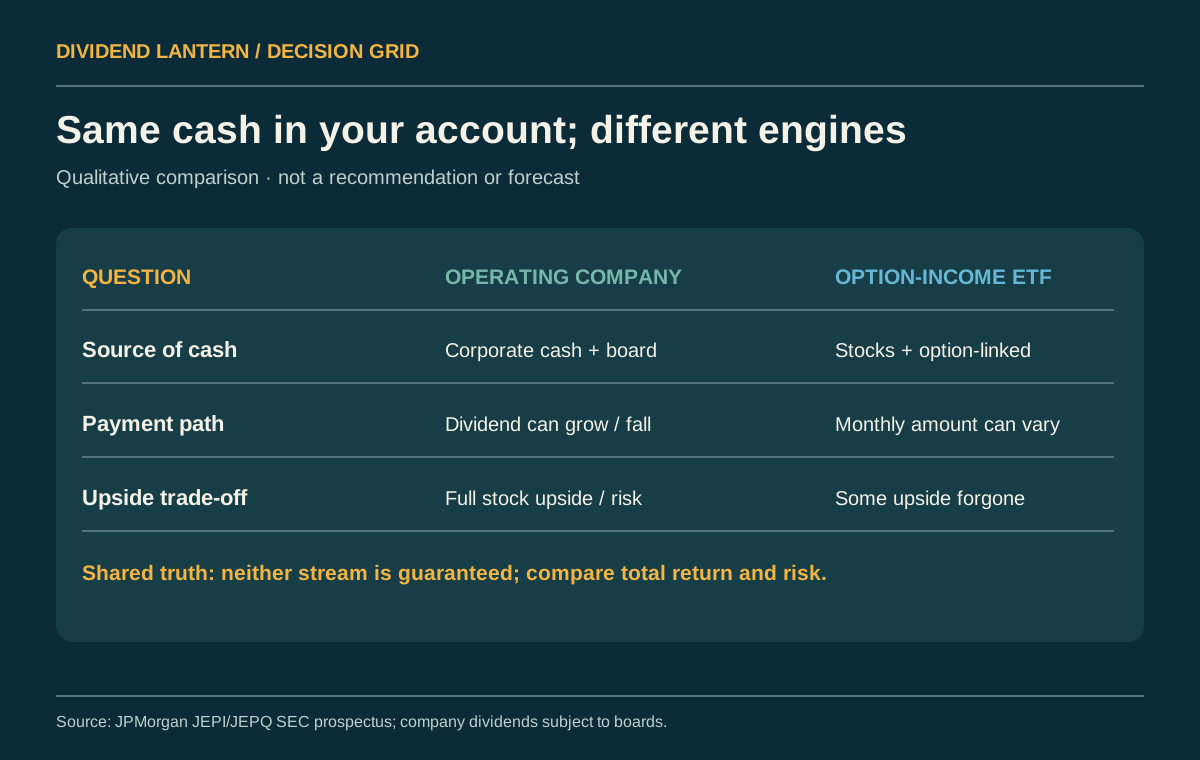
Graphic: qualitative comparison, not a forecast. Source and risk descriptions from the [JEPI/JEPQ prospectus](https://www.sec.gov/Archives/edgar/data/1485894/000119312525246367/d870279d485bpos.htm). A company dividend can also be reduced or eliminated; neither cash stream is guaranteed.
A fair conclusion for dividend investors
An income ETF can be a deliberate way to exchange some potential equity upside for current cash. That is a legitimate portfolio objective. It is different from owning a company because its board has raised a dividend out of growing operating cash flow for many years. Comparing the two solely by the number in a yield box erases the trade-off that created the ETF payment.
Before extrapolating a monthly amount, inspect the current fund documents, distribution history, total return, option and ELN exposures, expenses and the tax information relevant to your account. Recheck after market conditions change. The practical distinction: a distribution tells you how much cash left the fund; total return and NAV tell you what happened to the investment while it did so.
Educational analysis, not personalized investment or tax advice. Hypothetical figures are labeled. ETF distributions, their tax character and market returns can vary; neither JEPI nor JEPQ guarantees a payment.