A pipeline partnership may send a large cash payment every quarter and still need to borrow billions to build the next project. That is not automatically unsustainable, but neither is the quoted distribution yield a safety certificate. Enterprise Products Partners (EPD) and Energy Transfer (ET) are publicly traded partnerships with energy-infrastructure businesses. They pay cash distributions per common unit, not conventional corporate dividends per share. For a U.S. income investor, the analysis starts with cash generated by existing assets, then follows maintenance spending, expansion spending, debt and the partnership's own definition of “available” cash.
This is an educational comparison using reported 2025 results and distributions disclosed by October 24, 2026. It does not equate a company-defined cash metric with GAAP cash flow or offer individualized tax guidance. Partnership investors should inspect the actual filing and tax documents before assuming an MLP is a direct substitute for a dividend stock. EPD 2025 results · ET 2025 Form 10-K
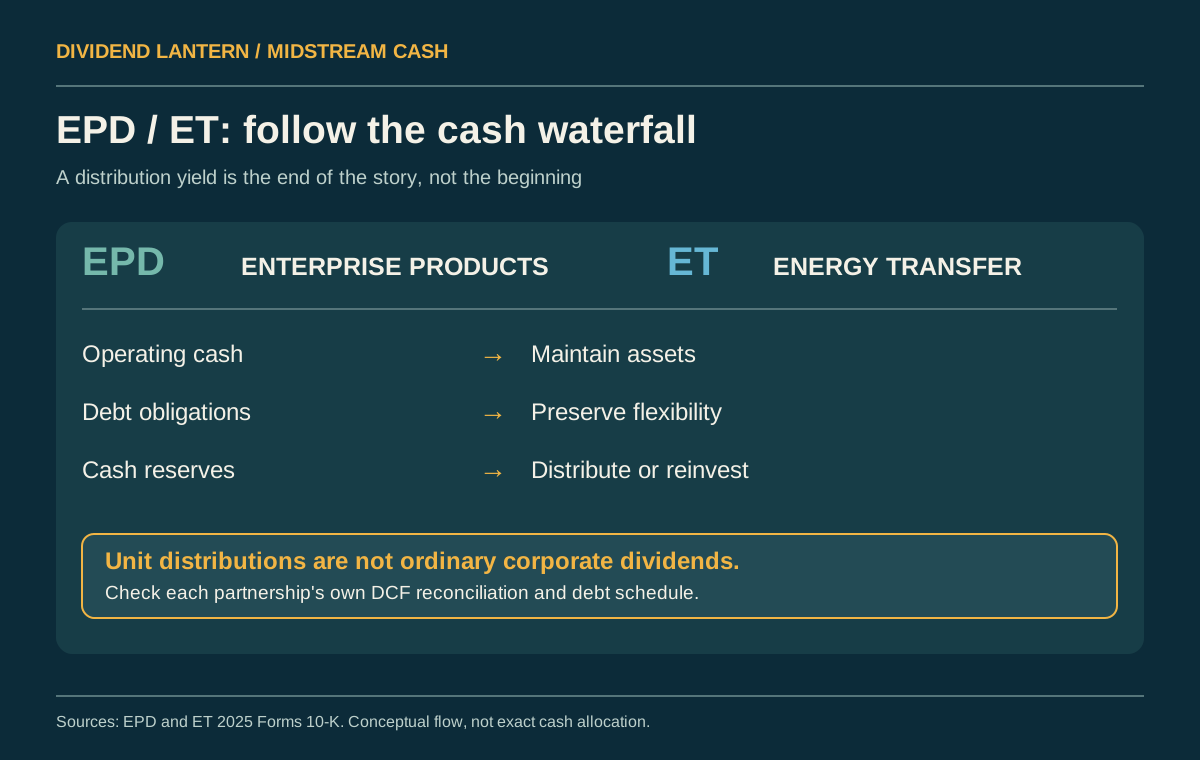
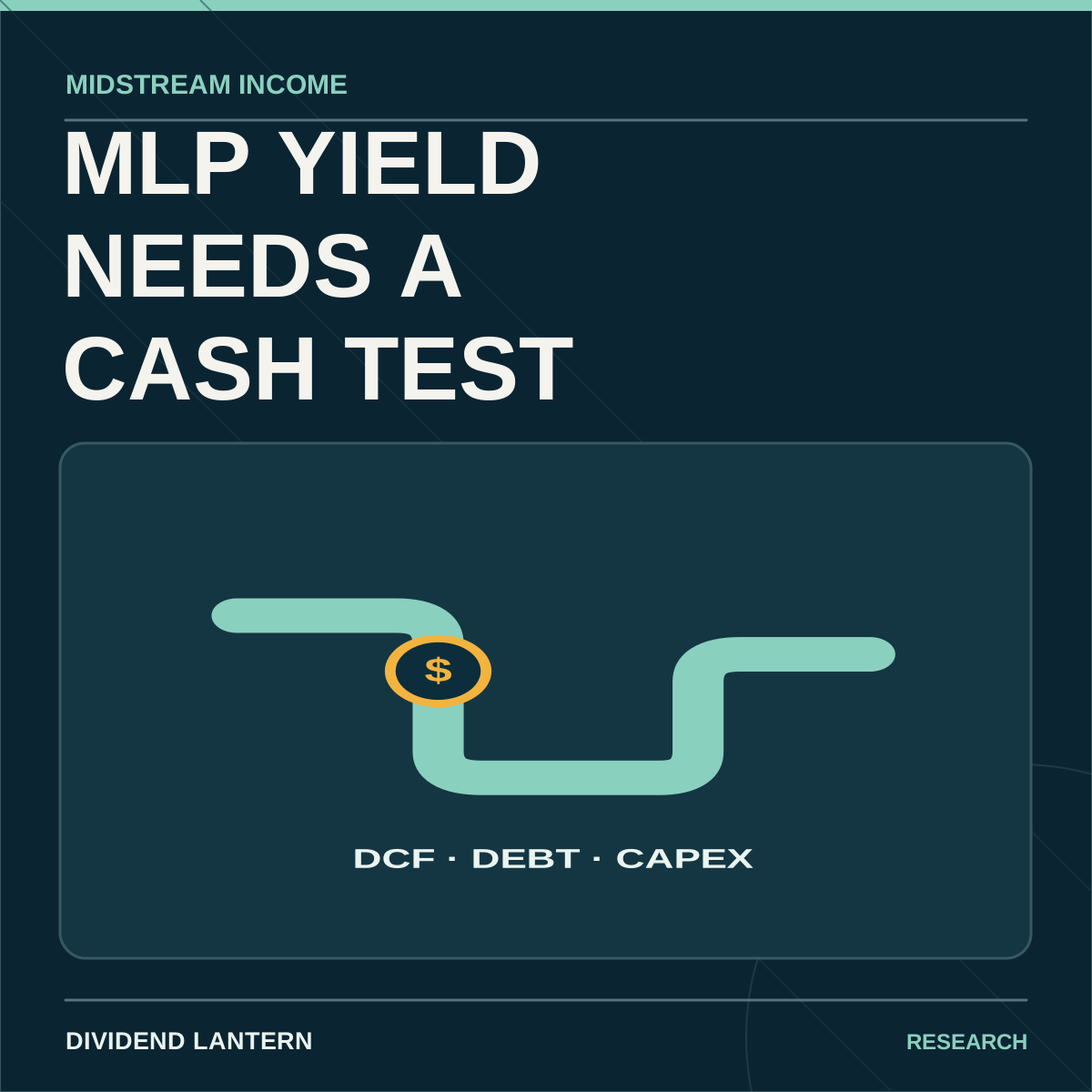
Diagram: original analytical framework, not a statement of either partnership's exact waterfall. Company descriptions of distributable cash and cash reserves: [EPD 2025 Form 10-K](https://www.sec.gov/Archives/edgar/data/1061219/000106121926000006/epd-20251231.htm) and [ET 2025 Form 10-K](https://www.sec.gov/Archives/edgar/data/1276187/000127618726000013/et-20251231.htm).
Why “distributable cash flow” deserves quotation marks
EPD's 2025 results reported $7.9 billion of operational distributable cash flow, 1.7 times coverage of that year's declared common-unit distributions and $3.2 billion retained for reinvestment. Its total net capital investment was $5.6 billion, including approximately $620 million of sustaining capital expenditure, growth projects and acquisitions, net of asset-sale proceeds. This separates two useful questions: was the distribution covered under management's definition, and how much funding did the entire capital program require? A coverage ratio above 1 does not mean all future expansion can be financed without debt or equity. EPD full-year 2025 release
The term is non-GAAP. EPD's 10-K says operational DCF excludes certain asset-sale proceeds and other items from DCF and is intended to capture cash from normal operations. It also says neither DCF measure substitutes for GAAP operating cash flow. ET similarly provides adjusted DCF measures with its own adjustments. Because definitions differ, stacking two “DCF coverage” ratios from a data website without reading both reconciliations can produce a false ranking. EPD 2025 Form 10-K, non-GAAP measures · ET Q4 2025 results
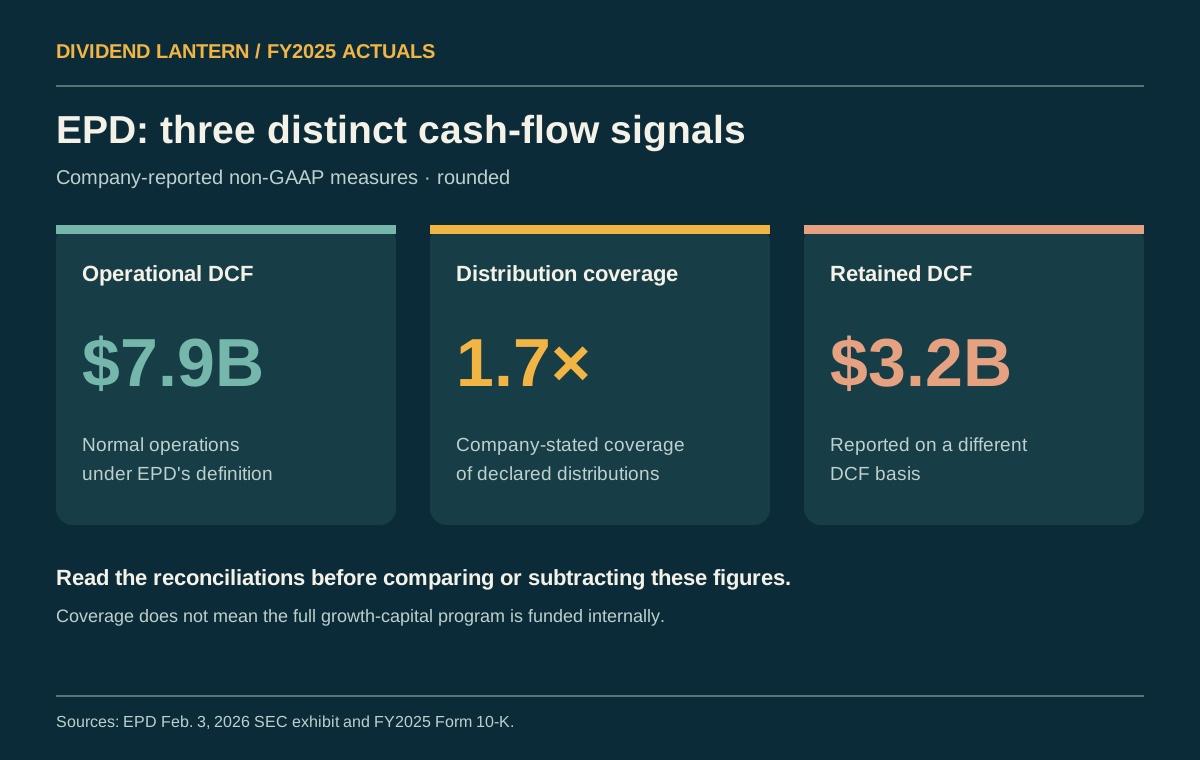
Chart: EPD fiscal 2025, USD billions rounded. The $7.9 billion operational DCF and the $3.2 billion retained DCF come from different company-defined measures, so the graphic presents them separately and does not subtract one from the other. The 1.7× coverage figure is company-reported. Sources and reconciliations: [EPD results](https://www.sec.gov/Archives/edgar/data/1061219/000106121926000002/epd-20260203xex991.htm), [EPD 10-K](https://www.sec.gov/Archives/edgar/data/1061219/000106121926000006/epd-20251231.htm).
A distribution policy is not the same as available cash
The partnerships' legal and financial language matters. EPD's 10-K says the partnership agreement calls for quarterly distributions of “available cash” after reserves established by its general partner for operations, investments, debt service, working capital and other commitments. ET's 10-K has its own definition of available cash and reserves; it identifies distributions, capital spending and debt service among its primary cash requirements. Neither document says every dollar entering a pipeline must immediately leave as a common-unit payment. EPD 2025 Form 10-K · ET 2025 Form 10-K
ET's 2025 Form 10-K reported $4.551 billion of distributions to limited partners declared and paid during that year. Its February 2026 results reported $2.04 billion of adjusted DCF attributable to partners for Q4 2025, along with $1.40 billion of growth capex and $355 million of maintenance capex in that quarter. These numbers belong to different lines and time scales. Do not divide one quarter's adjusted DCF by a whole year's distributions and call the result coverage. Instead, use the company's same-period reconciliation and check the actual cash flow statement, investment spending and financing cash flows. ET 2025 Form 10-K · ET Q4 2025 results
Maintenance, growth and debt are the moving parts
Maintenance capital is spending needed to keep existing assets operating and safe. Growth capital aims to add capacity or new services, sometimes under long-term contracts. The categories are useful but not perfect: deferred maintenance can make a payout look temporarily generous, while a strong growth project may justify financing today for cash later. Read what the partnership includes in each category and whether project economics depend on commodity volume, counterparties or timely completion. EPD and ET operate extensive midstream networks, but their segment mix and customer exposure differ. EPD 2025 Form 10-K · ET 2025 Form 10-K
Debt is the second test. Pipeline systems are capital-intensive. A partnership can cover today's distribution with operational cash yet face a costly refinancing, major project commitment or covenant constraint. Follow total debt, debt-to-earnings measures as actually defined in the filing, maturities, interest expense and unused credit capacity. Look for an ability to fund a reasonable part of growth internally, rather than relying on permanently friendly capital markets. EPD's retained 2025 DCF is relevant precisely because retained cash can reduce the need for outside financing; it cannot eliminate all financing risk by itself. EPD results · ET 2025 Form 10-K
Finally, payment history needs context. EPD said 2025 was its 27th consecutive year of distribution growth, while ET's distribution history shows quarterly per-unit rates and payment dates. A long record deserves attention, but history does not prove the next asset, rate or balance-sheet decision will work. A quoted annualized amount is simply a recent quarterly rate multiplied by four; it is not four future declarations. EPD 2025 release · ET distribution history
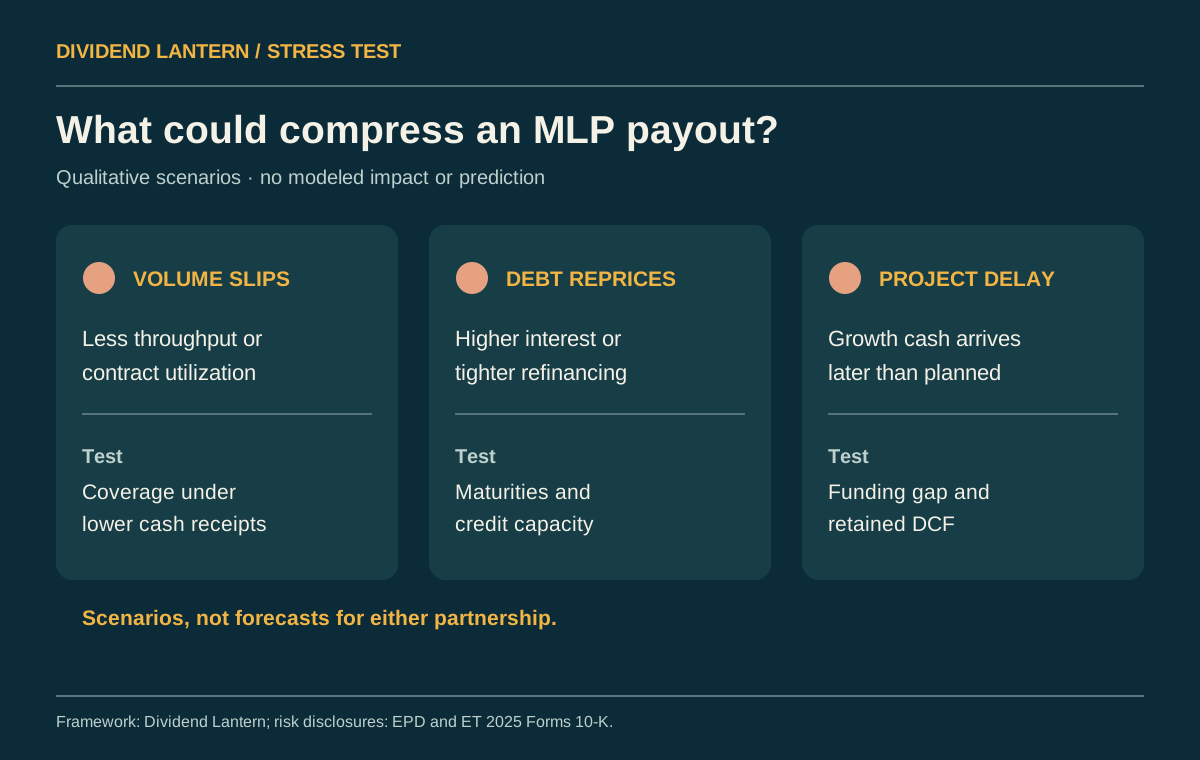
Graphic: qualitative scenarios, not forecasts for EPD or ET. Risks and funding needs drawn from [EPD's 10-K](https://www.sec.gov/Archives/edgar/data/1061219/000106121926000006/epd-20251231.htm) and [ET's 10-K](https://www.sec.gov/Archives/edgar/data/1276187/000127618726000013/et-20251231.htm).
Do not overlook the partnership form
An MLP unit is not the same legal and tax instrument as a corporate share. The IRS explains that partners may need to track their adjusted basis and use Schedule K-1 information, and that tax effects of distributions and a later sale depend on individual facts. Cross-border investors may face separate withholding and filing rules. This article cannot infer your tax treatment from the amount of cash deposited by a broker. Before using an MLP in any account, read the partnership's tax materials and obtain advice for your jurisdiction and account type. IRS Partner's Instructions for Schedule K-1 · IRS rules for publicly traded partnerships
The take: EPD's 2025 operational DCF showed a meaningful company-defined cushion above declared distributions, but that did not make its full capital program free. ET illustrates why an attractive quarterly rate must be read alongside its own cash reconciliation, construction spending and debt obligations. For either partnership, write down the exact period and definition of every coverage number, then ask how the distribution holds up when volumes, funding costs or project timing disappoint.
Educational analysis of public filings, not personalized investment or tax advice. Operational DCF and adjusted DCF are non-GAAP and company-specific. Distributions can change and have tax consequences unlike conventional corporate dividends.