

A retirement bill is paid with cash, whether that cash arrived as a dividend or came from selling a few shares. The source changes the mechanics and perhaps the tax result. It does not remove investment risk. A plan built around dividends should be compared with an intentional withdrawal plan using the same portfolio value, spending need and assumptions.

The SEC's retirement guidance asks investors to consider time horizon, risk tolerance and their broader financial situation when managing lifetime income. Those questions matter more than whether a brokerage account labels the cash line “dividend” or “sale proceeds.” Neither route promises a fixed paycheck.
Hold the spending target constant
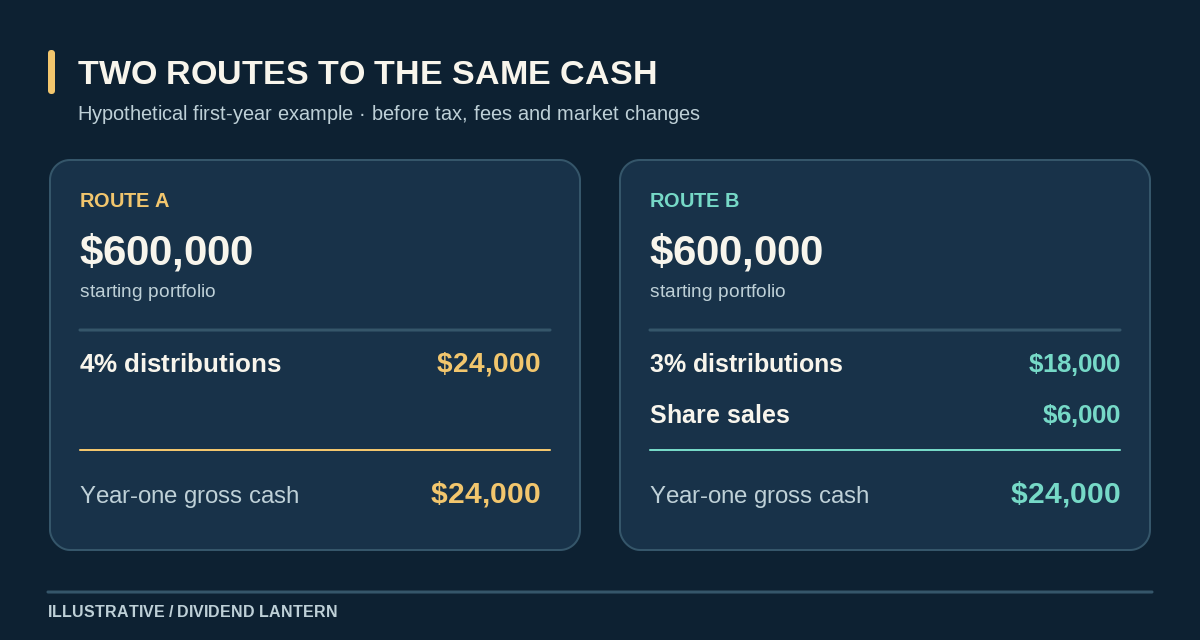
Imagine a hypothetical $600,000 portfolio and a $24,000 first-year gross cash need. The required cash equals 4% of the starting portfolio value. This is an arithmetic comparison, not a claim that 4% is a universally safe withdrawal rate.
In route A, the portfolio pays an assumed 4% in cash distributions: $600,000 × 4% = $24,000. In route B, it pays an assumed 3%: $18,000. The investor sells $6,000 worth of shares to make up the difference. Both routes provide $24,000 of gross cash in this first-year illustration. Neither calculation says what the holdings will be worth a year later. Prices may rise or fall; dividends may grow, stay flat or be cut.
The 4% figure in route A is an assumed starting cash yield, not a statement about the market or a recommendation to seek high-yield stocks. The SEC's diversification guidance explains why a collection of securities can still be concentrated, particularly when several funds share the same holdings or sector exposures. Reaching for a headline payout can increase concentration in businesses exposed to the same risks.
What a dividend actually changes
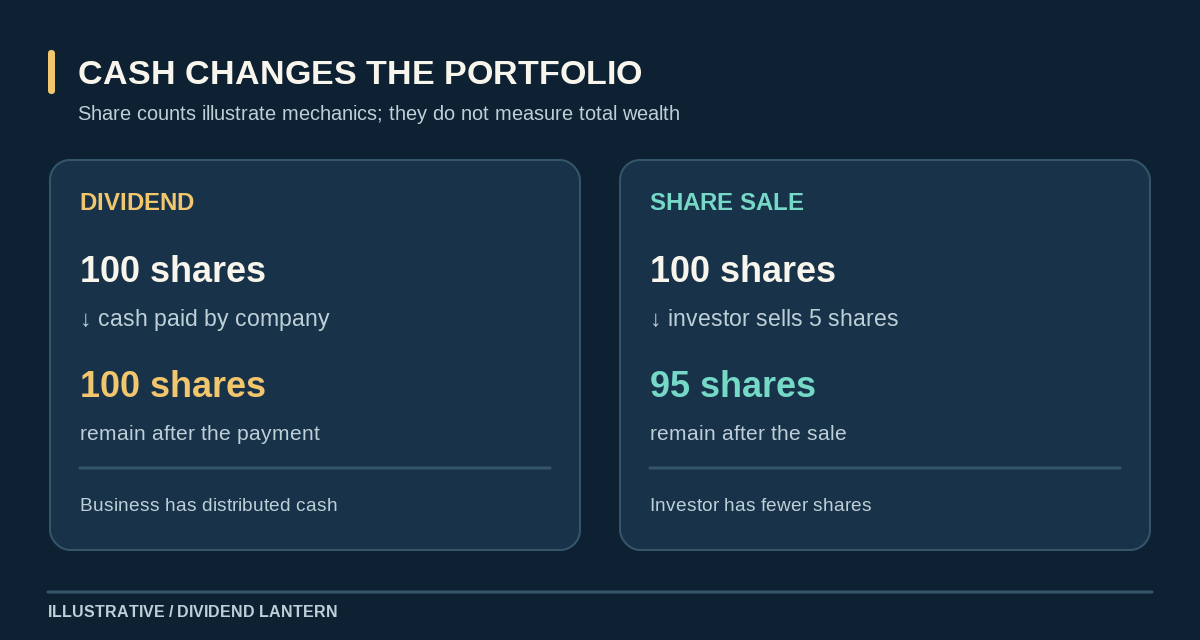
The dividend route is operationally simple: the company or fund decides to distribute cash, and eligible holders receive it on the payment date. The investor need not place a sell order for that payment. But management or the fund controls the payout. A company can cut or suspend a dividend; a fund distribution can vary with its investments and policy. A payment also does not create wealth by itself. Investor.gov's ex-dividend explanation notes that a stock's price may fall by approximately the dividend amount on the ex-date, although market movement can obscure the adjustment.
Selling shares gives the investor control over the timing and size of the sale. They can choose which asset and, in a taxable account, which eligible tax lot to sell. The trade reduces the number of shares owned. That share-count change is visible, which can feel uncomfortable even if the portfolio retains adequate value. Conversely, receiving a dividend leaves the share count unchanged, but each share represents a business that has sent cash out. Share count alone does not measure the assets remaining to support future income.
The difficult year test
Now imagine both portfolios fall 30% in market value before the next withdrawal decision. This is a stress-test assumption, not a forecast. The $600,000 starting balance would show $420,000 before considering distributions, sales or any subsequent price movement. A fixed $24,000 cash need would now equal about 5.7% of that value. A plan that looked effortless at the starting balance deserves a fresh review.
The dividend investor might hope to avoid selling depressed shares. That can help if the dividends remain intact and spending fits within them. But a price decline may accompany deteriorating earnings and a dividend cut. The investor cannot assume the payout will be insulated from the reason the price fell. The seller faces an obvious risk of disposing of more shares after a decline. A diversified liquid reserve can give either investor time to decide rather than forcing an immediate transaction. How much reserve to hold depends on circumstances; it carries its own inflation and opportunity costs.
The SEC's asset-allocation guidance emphasizes that allocation can change as the investment time horizon shortens, and that rebalancing may involve selling investments that have grown beyond their intended weight. That is a more useful framework than an absolute rule that retirement income must come only from one cash source.
Taxes can differ more than the labels suggest
A taxable account introduces another layer. A dividend may be qualified or nonqualified, and a fund payment might include capital-gain distributions or return of capital. A sale can create a capital gain or loss depending on the adjusted basis of the shares sold. IRS Publication 550 explains both dividend classifications and investment basis. The after-tax comparison requires the person's account type, tax year, share lots and other income. We do not insert an assumed tax rate into the $24,000 example.
In a tax-advantaged retirement account, distributions from the account follow account rules that differ from the tax treatment of an individual dividend inside a taxable brokerage account. It is a mistake to assume that a dividend automatically avoids tax or that every share sale immediately triggers tax. Likewise, commissions, bid–ask spreads and transaction timing can affect a sale, while fund expenses and portfolio turnover affect the holdings that generate distributions.
Our guides to qualified dividends and return of capital cover two tax labels that can change the answer.
Compare two plans on a common worksheet
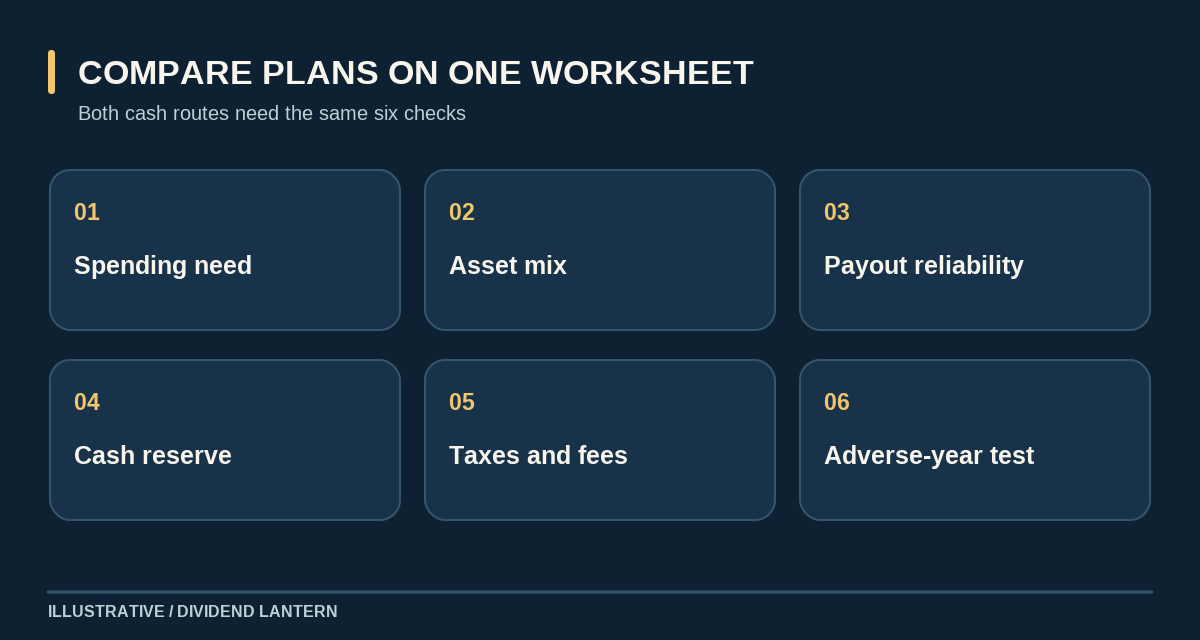
For a fair comparison, write down the same six items for both approaches: starting portfolio value; required spending after other income; expected gross distributions by security; cash reserve; taxes and fees; and an adverse-year scenario. Record the dividend rate as an assumption, not a promised income stream. Record the number of shares that would need to be sold at several hypothetical prices. If a plan depends on every payout staying unchanged, the assumption should be visible.
Then ask what would make each route fail. For the dividend-heavy version, look for concentration, weak cash coverage, debt and payouts that could be reduced. For the sale-based version, examine how much must be sold after a deep decline and whether holdings or reserves can fund spending without locking in an unsuitable trade. Both need an inflation assumption, because a flat $24,000 buys less over time if prices rise. Both need periodic review as health, expenses and market conditions change.
The decision is not a contest between “never sell a share” and “ignore dividends.” A diversified portfolio can receive distributions and make occasional sales. The useful question is whether the whole portfolio can support the desired cash flow through difficult years while preserving a risk level the investor can bear. The cash label is one input to that answer, not the answer itself.
Illustrative educational discussion for U.S. investors as of October 28, 2026. It is not an individualized retirement, tax or investment plan. All amounts, yields and market declines in the examples are hypothetical.

