The company announced a dividend. Your broker deposited less. Neither number must be wrong. A foreign share held through an American depositary receipt (ADR) can pass through a chain of currency conversion, foreign tax withholding and depositary charges before U.S. dollars reach the account. That chain makes a foreign company's headline dividend yield a poor estimate of cash you will actually see.

Start with the number of underlying shares
An ADR represents a specified number or fraction of ordinary shares in a non-U.S. company. The deposit agreement sets that ratio. One ADR does not necessarily represent exactly one ordinary share. The SEC's ADR bulletin advises reading the program's Form F-6 for the ratio and fees. Multiply the local-currency dividend per underlying share by the ratio before using the foreign-exchange conversion. Otherwise a per-share comparison can be off even when the market quotes are current.
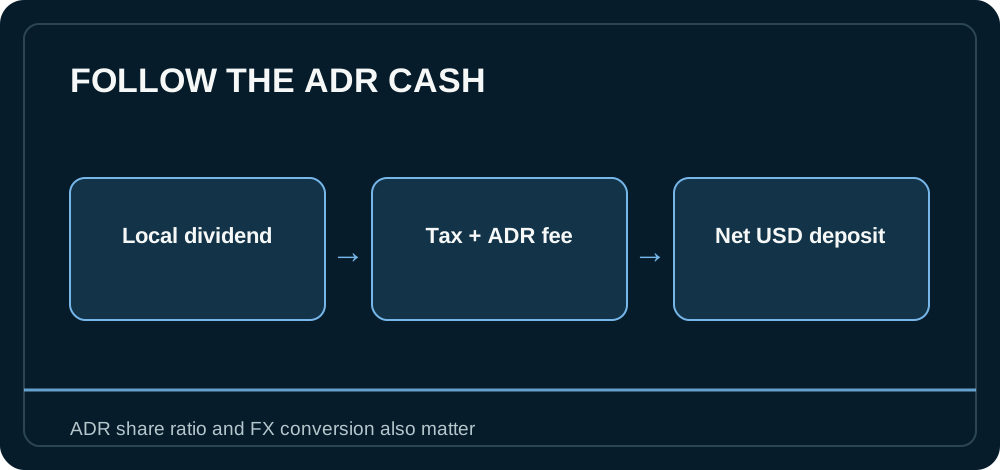
Next, the foreign jurisdiction may withhold tax at source. Its standard rate, treaty relief and reclaim process vary by country and investor eligibility. The depositary may then assess a custody or dividend-distribution fee. The SEC says depositaries often subtract such a fee from the gross dividend before the payment reaches ADR holders; fees and practices vary by program. The bank and broker can also use an exchange rate and timing that differ from a headline quote. SEC ADR bulletin.
A transparent, hypothetical cash bridge
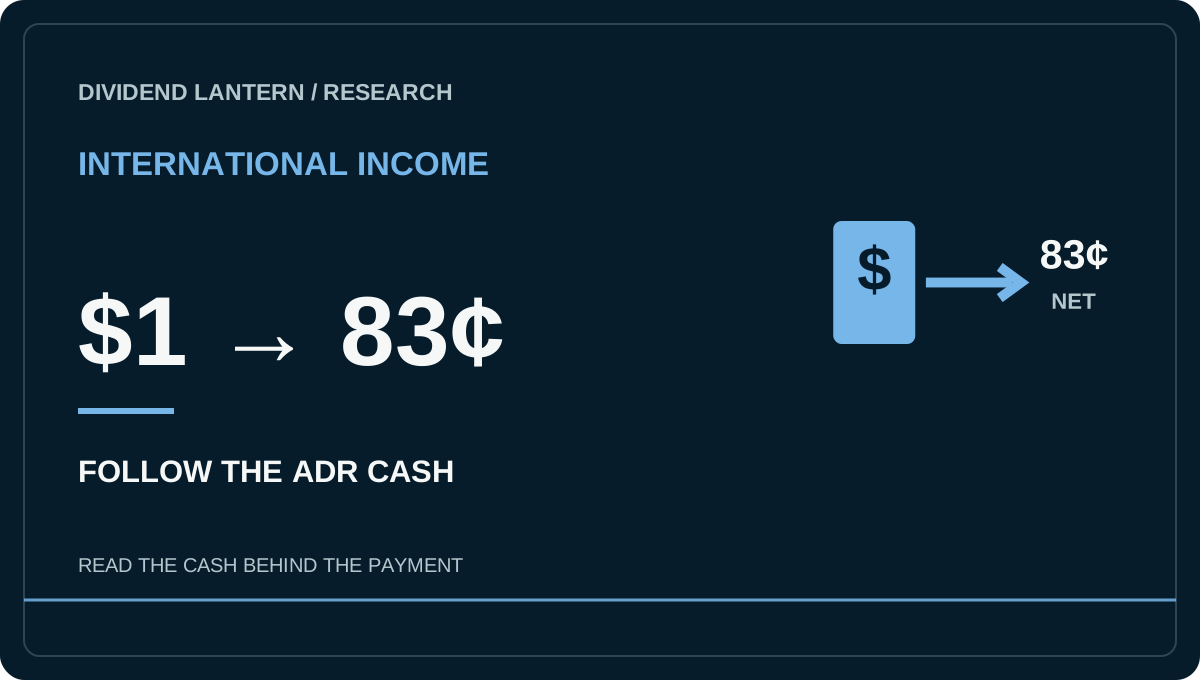
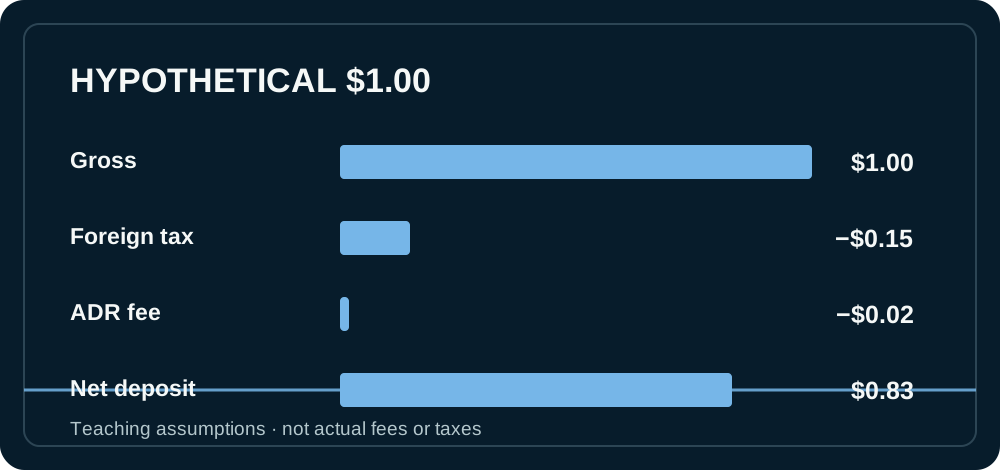
Suppose an ADR represents one underlying share and the foreign company announces a dividend worth $1.00 at an illustrative conversion rate. Suppose $0.15 is withheld abroad and the ADR fee is $0.02. The broker deposit would be $0.83, before any U.S. tax. These values are teaching assumptions, not the terms of a real country, treaty or ADR. A $1.00 gross dividend and a $0.83 deposit can both accurately describe the same corporate payment.
For a U.S. taxpayer, foreign tax withheld may be eligible for a foreign tax credit, subject to limits and special rules. It is not automatically refunded. IRS Publication 514 describes which taxes can qualify, limits and a separate holding-period rule for foreign dividend withholding taxes: for common stock, at least 16 days within a 31-day period around the ex-date in the circumstances it specifies. Do not confuse that test with the longer qualified-dividend holding period. Tax-advantaged account treatment and treaty relief can be different, so a universal “foreign dividend net yield” is misleading.
What to record in a tracker
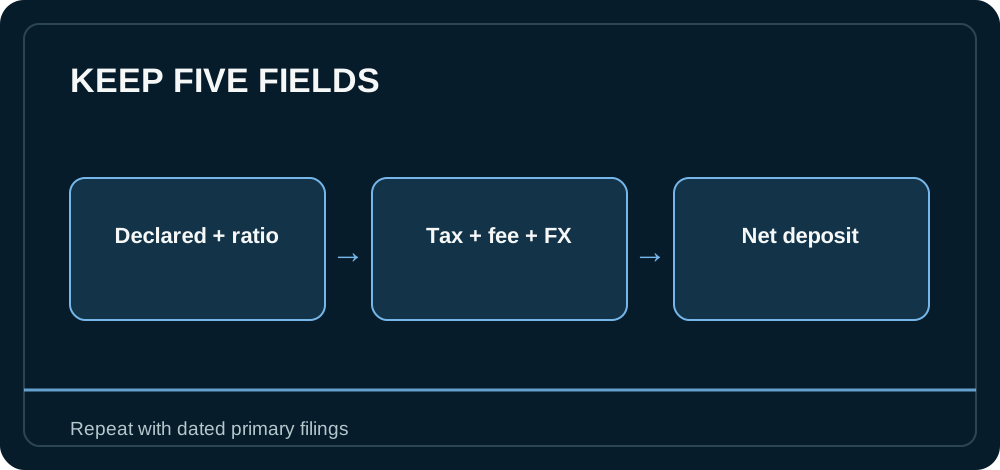
Keep five fields separate: issuer-declared dividend in local currency; ADR share ratio; gross USD amount credited by the depositary; foreign tax and fees; net cash received. Add the payment's date and conversion rate if the broker provides it. For analysis, compare companies using a consistent gross basis first. For household cash planning, use a cautious net estimate and reconcile it with actual deposits. A market-data site's trailing yield usually will not tell you exactly what your own broker or tax situation produces.
Before buying, read the issuer declaration, ADR deposit agreement or Form F-6, broker fee disclosure, and applicable tax guidance. The same ADR may look attractive on gross yield and less so after friction—but the reverse conclusion does not follow automatically. Cash return, price risk, currency exposure and the underlying business still matter.
Compare the same cash definition
Suppose two foreign stocks each advertise a 4% gross dividend yield. One uses an ADR with a depositary fee; another trades as an ordinary foreign share through a broker. Their gross company payouts may be comparable, but their account deposits can differ because of custody, foreign withholding, exchange rates and broker conversion practices. Comparing the first stock's net deposit with the second stock's gross issuer declaration would be an apples-to-oranges comparison. Record the source currency, share ratio and rate date so an apparent dividend change is not actually a currency move. Finally, remember that the foreign tax credit is a tax-return matter, not necessarily cash returned on the payment date. A household budget should start with the cash that actually arrives, while research should retain the gross amount and deductions for auditability.
A reconciliation that can explain a “missing” payment
Start with the issuer's dividend in its home currency and note whether it is quoted per ordinary share or per ADR. Obtain the ADR ratio from the deposit agreement. Then find the depositary's payment notice, which should describe the currency conversion and any program fee, and compare it with the broker's activity statement. These records may use different dates and rounding conventions. A mismatch is a question to investigate, not automatically proof that the company reduced its dividend. The SEC ADR bulletin explains ratios, fees and depositary arrangements.
In the hypothetical $1.00 example, record gross $1.00, foreign withholding $0.15, depositary fee $0.02, and net deposit $0.83 as separate columns. Do not simply replace the declared dividend with $0.83 in a corporate dividend-history chart. The company's decision was a $1.00 gross distribution under the assumptions. The $0.83 is the investor's account cash after particular frictions. Keeping both numbers allows the investor to ask whether a lower deposit came from a company action, a currency change, a tax-rate change, a ratio change or a fee. This distinction becomes even more useful when comparing years.
Gross yield, spendable yield and total return
A dividend-screening website typically divides a historical or indicated gross dividend by the current share price. That can be useful for comparing issuer policies, but it does not determine the dollars available for a household budget. For that task, estimate the net amount received, using the actual ADR program, account and tax jurisdiction. Keep any potential tax credit outside the cash-payment line until it is actually realized through the tax process. IRS Publication 514 describes foreign tax credit eligibility and limits; a credit is not automatically equal to all tax withheld.
Even a net yield is only a slice of the investment. An investor reporting in U.S. dollars owns a claim influenced by the underlying company's operations, the share price and the exchange rate. A strengthening dollar can reduce the translated dividend without any change to the local-currency payment. Conversely, a larger dollar deposit can result from currency moves rather than dividend growth. When comparing two international dividend stocks, make a small table with local-currency dividend growth, USD per-ADR cash, withholding and fees, and share-price change. The separate columns prevent currency translation from being misread as management policy.
There is no universal “ADR fee” or treaty percentage. One program may charge a dividend-service fee while another charges at a different time. Tax treatment can depend on ownership type and documentation supplied to the broker. The sound workflow is to read the particular issuer's declaration, its ADR documents and the investor's broker statement, then bring tax questions to a qualified adviser. A yield calculator that silently assumes one net rate for all foreign stocks offers false precision.
Educational U.S. investor framework, not tax or investment advice. Country withholding and treaty treatment vary. All numerical examples are hypothetical.