
A parent company can report profit while the cash supporting its shareholder dividend sits inside regulated insurance subsidiaries. That difference matters. An insurer's obligations to policyholders and statutory-capital rules can limit what the subsidiary sends upstream to the public holding company. A screen that divides parent EPS by its common dividend does not reveal the legal and financial path the cash must travel.

Three different dividends
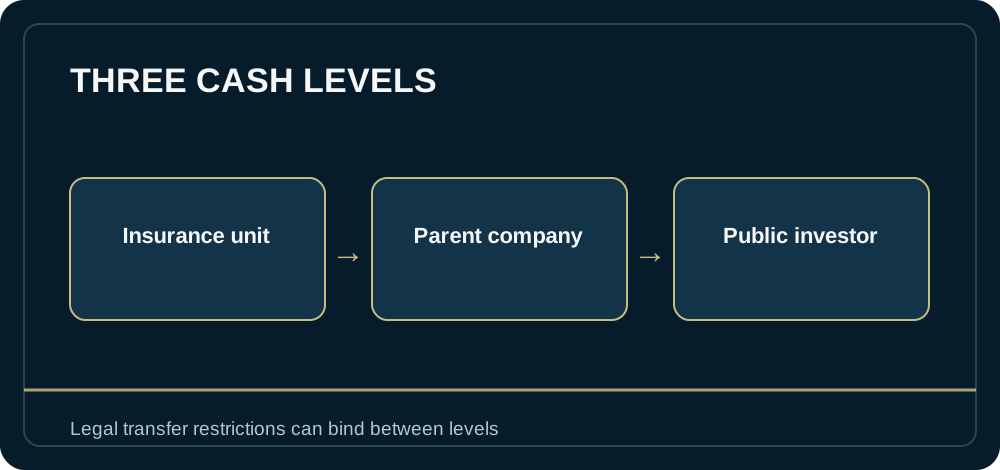
An insurance group can have (1) payments to policyholders under contracts, (2) dividends from operating insurance subsidiaries to their corporate parent, and (3) dividends from the parent to outside shareholders. Only the third is the public stockholder's cash income; the second often funds it. State insurance regulators supervise the operating subsidiaries and may restrict transfers to protect policyholders. The NAIC's U.S. solvency framework explains why extraordinary dividends can need approval and why risk-based capital is monitored.
Prudential Financial's 2025 Form 10-K makes the distinction visible. It reported receiving $900 million in 2025 dividends from its PICA domestic insurance subsidiary and $618 million from international insurance subsidiaries. It also states that insurance-company payments to the parent are restricted by applicable law and that market conditions can weaken subsidiary capital positions, further restricting transfers. These are 2025 flows, not a forecast of 2026 capacity. Other subsidiaries and capital-return mechanisms also matter.
Why GAAP earnings are not freely distributable cash
Consolidated GAAP reports combine the parent and subsidiaries for accounting purposes. Statutory accounting and risk-based capital measure insurance-company solvency under a different framework. Investment losses, reserves, claims and changing assumptions can affect statutory surplus even if parent-level adjusted operating earnings look stable. A subsidiary may be profitable yet need to keep capital to support its insurance promises. Conversely, the parent may have liquidity and borrowing capacity even during a temporarily low upstream-dividend quarter. Neither one headline ratio settles safety.
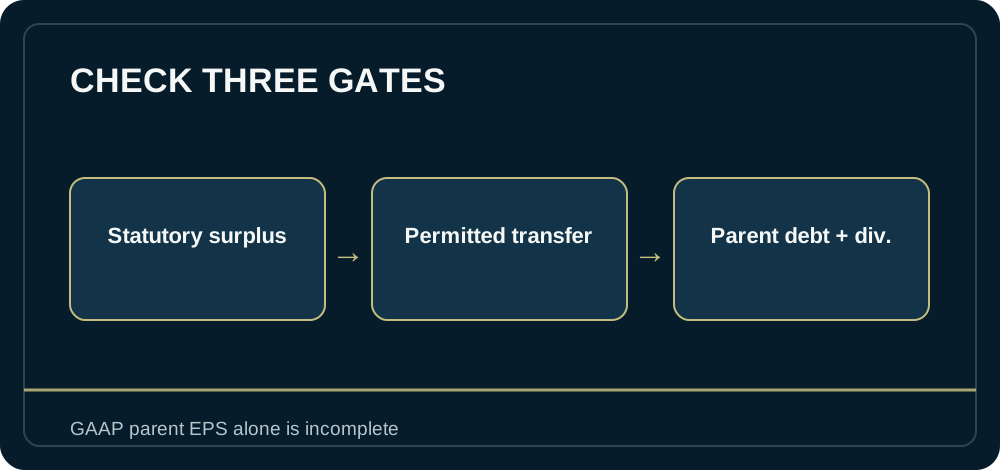
The NAIC Insurance Holding Company System Model Regulation outlines information required for extraordinary-dividend approval. The specific thresholds depend on the state and legal entity. An investor should therefore read the company's 10-K section on statutory capital and dividend restrictions, then inspect the insurer subsidiaries' statutory statements when available. If an insurer cites “ordinary dividend capacity,” check whether that is a ceiling before approval, how much is already used, and whether management intends to retain more capital. A ceiling is not a payment commitment.
A practical parent-company waterfall
Imagine a hypothetical parent begins a year with $2 billion of liquid resources, expects $1 billion of permitted subsidiary dividends and faces $0.4 billion of parent debt service and operating needs. It could have $2.6 billion before common dividends, acquisitions, repurchases and contingencies. But that arithmetic depends on the subsidiary payment actually being available. If a regulator or loss event limits the transfer to $0.3 billion, the parent has $0.7 billion less than assumed. These are illustrative values, not Prudential figures or forecasts. The exercise forces the analyst to put the legal transfer step in the cash model.
For a real insurer, track: (1) statutory surplus and RBC discussion; (2) reported dividends from each major insurance subsidiary; (3) permitted ordinary and approved extraordinary dividends; (4) parent liquidity, debt maturities and uses of cash; and (5) the public common dividend. Review claims, investment portfolio quality and reinsurance as possible changes to capital needs. A high dividend yield may reflect doubts about these constraints, not just the market overlooking a low payout ratio.
The essential insight is where cash resides and whether it may move. That question makes an insurer's dividend different from a manufacturer paying directly from its own operating cash flow.
Distinguish capacity from intent
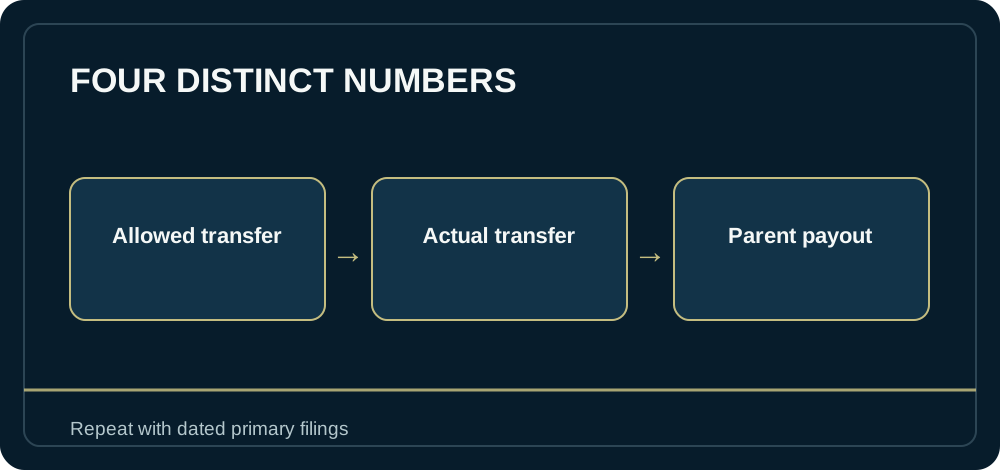
A filing may disclose the maximum dividend an insurance subsidiary can pay without prior approval in the next year. That is a regulatory ceiling, not a management commitment to transfer the maximum and not a measure of net income. The subsidiary may retain additional capital because claims, investment losses or growth require it. The parent may also draw on cash already held, sell assets or issue debt, which can support a dividend for a period while adding a different risk. A useful dashboard therefore places allowed, actually transferred, available at the parent and paid to public shareholders on separate lines. If any one number is missing, avoid constructing a precise “coverage ratio” from consolidated EPS alone.
An upstream cash bridge using actual disclosures
Prudential's reported $900 million received from PICA and $618 million received from international insurance subsidiaries in 2025 are two lines in a broader holding-company cash picture. They should not be added together and called “cash available for common dividends” without checking other parent inflows, parent expenses, debt service, repurchases and acquisitions. They should also not be confused with the subsidiaries' maximum permitted distributions. The actual transfers are historical facts; the ceiling is a legal constraint; the parent's final capital-allocation choice is a management and board decision. Prudential's 2025 Form 10-K discloses both the transfer restrictions and specific historical inflows.
Build the bridge from the parent's opening cash and liquid assets. Add actually received subsidiary dividends and other parent cash inflows. Deduct parent debt maturities, interest, operating obligations and announced commitments. Only then compare the remaining resources with the public dividend and any buybacks. Even that bridge needs a stress case: an investment-market decline, higher claims or a regulatory action can make a future subsidiary transfer smaller than the previous year's. The NAIC solvency framework explains the policyholder-protection purpose of insurance capital supervision.
A solvency ratio is not a cash account
Risk-based capital and statutory surplus help regulators assess whether an insurer can support its policy obligations. They are not a pile of unrestricted dollars that the holding company can simply wire out. They can change with asset valuations, liabilities, business growth and regulation. A strong ratio may give a firm flexibility, but the investor still needs to know what ordinary dividend capacity is allowed, whether extraordinary approval would be required and what management has actually transferred. Conversely, a single quarter of reduced upstream cash need not imply the public dividend is immediately at risk if the parent has ample liquidity and alternative sources.
The legal-entity map matters when comparing insurers. One listed group may have domestic life insurance subsidiaries, another property-casualty companies and another meaningful foreign operations. Different regulators and capital requirements apply. Consolidated EPS gives a useful profitability lens, yet it combines entities whose cash cannot be moved freely. This is why two stocks with identical EPS payout ratios may have different dividend resilience. Read the subsidiary and jurisdiction notes in each company's 10-K rather than importing a ratio from a peer.
For a repeatable review, keep four dated lines: allowed transfers, actual transfers, parent liquidity after obligations, and public dividend paid. Add a fifth line for management's announced capital-return plan, clearly labeled as forward-looking. Revisit the table after major claims, asset impairments or acquisitions. It makes the key question visible: can the regulated operating business continue supporting policyholders and still supply enough discretionary cash to the shareholder-facing parent?
Educational framework as of October 24, 2026, not an insurer solvency opinion or investment recommendation. Regulatory rules vary by jurisdiction; all hypothetical amounts are illustrative.