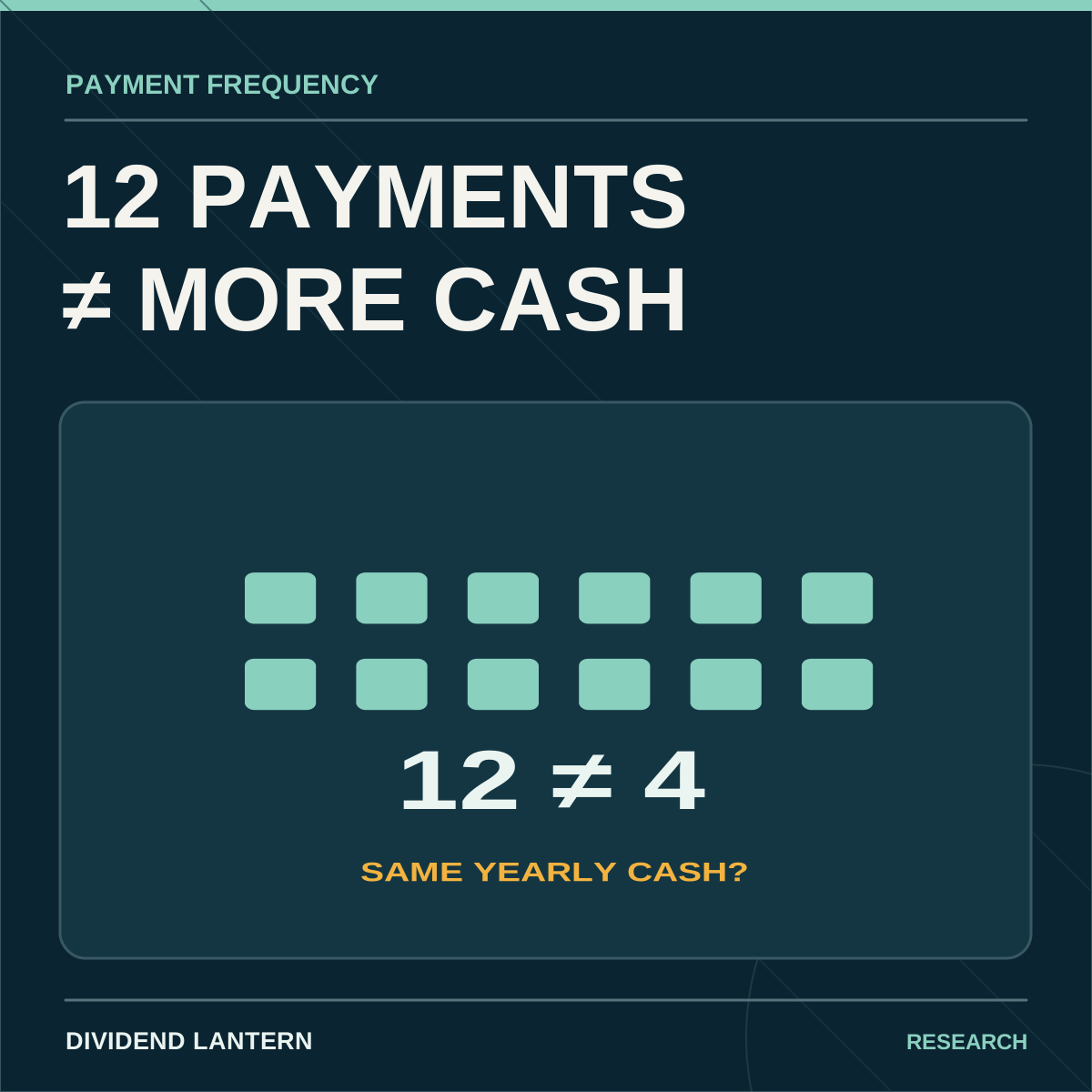
A monthly dividend can feel like income; a quarterly dividend can feel like waiting. That difference is real if you pay bills every month. It does not, by itself, make the monthly-paying stock more profitable or its dividend safer. Payment frequency determines when the company sends cash. The annual amount, the underlying business and the price you paid determine much more of the investment outcome.

There are real examples of both schedules. Realty Income announced another monthly common-stock dividend on October 13, 2026. Johnson & Johnson announced a quarterly dividend for the fourth quarter of 2026. Those examples establish payment cadence; they do not make the two businesses directly comparable. One is a real-estate investment trust; the other operates in healthcare. Their operating metrics, cash needs and risks require different analysis.
Equal annual cash, different arrival times
Consider two hypothetical investments, each expected to distribute $1,200 over the next 12 months on the investor's current share count. Investment M pays $100 on the last day of every month. Investment Q pays $300 at the end of March, June, September and December. Both pay $1,200 in this simplified year. Neither example assumes a rising share price or future dividend increases.
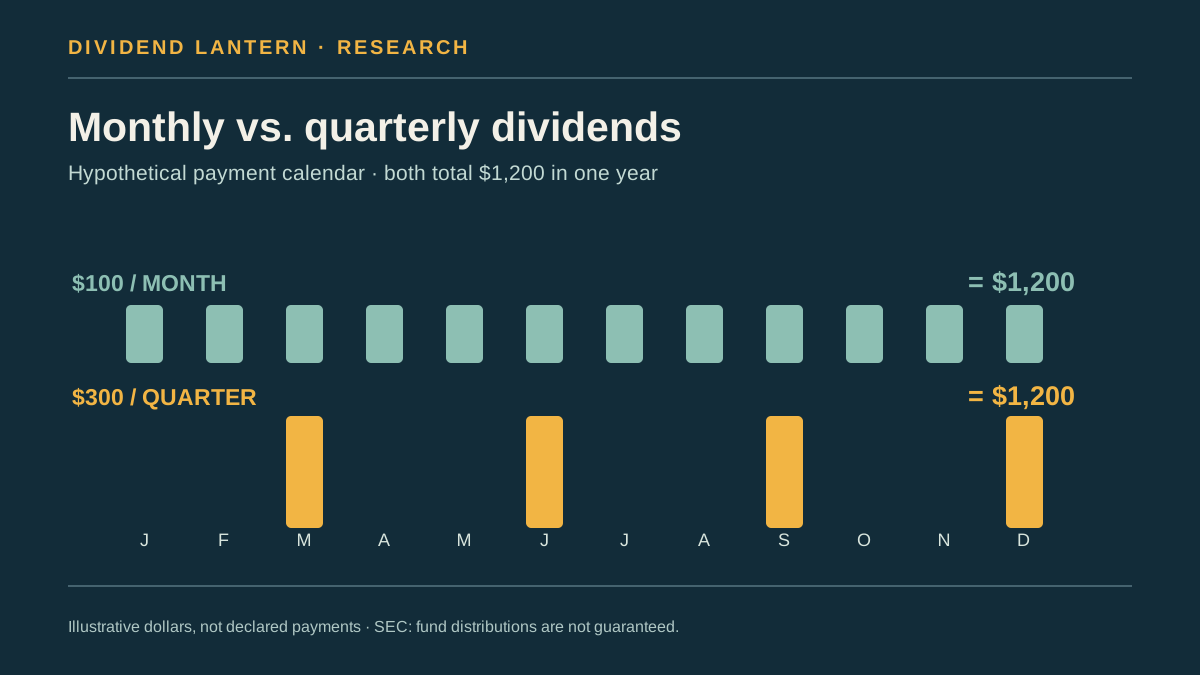
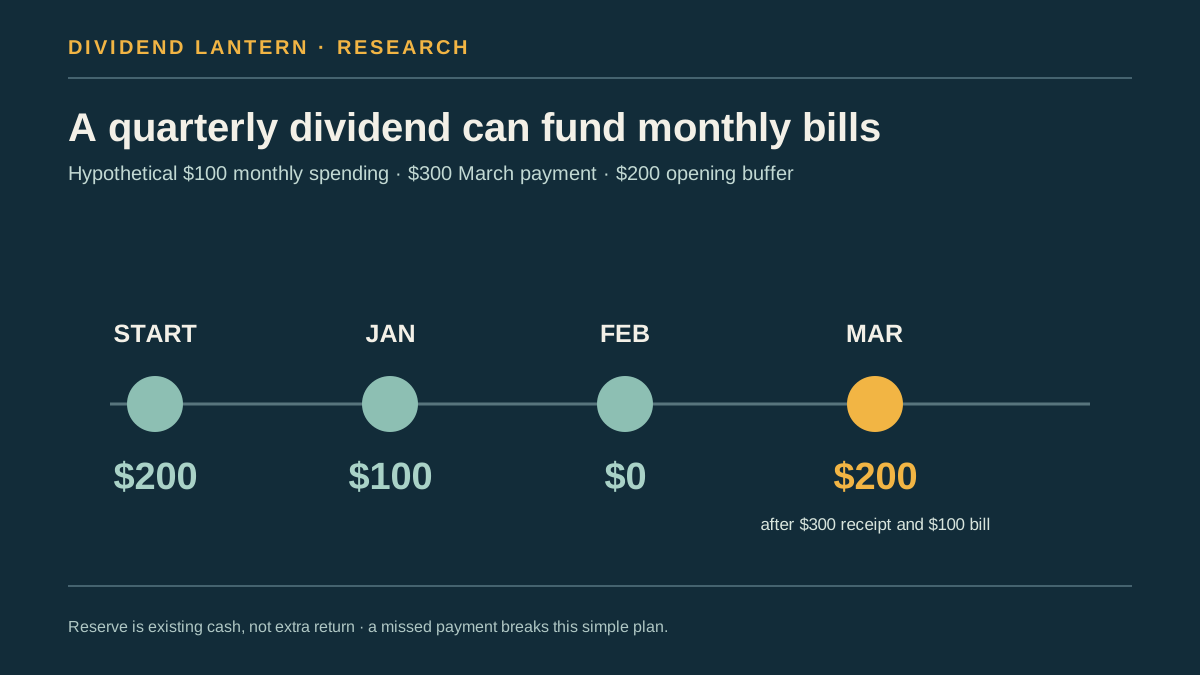
For someone spending $100 a month, M fits the bill calendar without much intervention. Q requires a cash buffer. Start the year with a hypothetical $200 reserve. Spend $100 in January and $100 in February. At the end of March, receive $300 and spend $100; the reserve returns to $200. Repeat each quarter. The investor did not earn an extra $200. The reserve simply bridges the months before a quarterly payment arrives.
That model assumes the payment is made on schedule, the amount does not change, and there are no other expenses. In a real income plan, a larger cash reserve may be prudent because a dividend can be delayed, reduced or omitted. The SEC says regular fund distributions can support predictable cash flow but are not guaranteed; the same broad caution applies when budgeting around company dividends. SEC fund distribution bulletin.
The compounding advantage is smaller than it looks
Monthly payers are sometimes presented as though more frequent reinvestment creates a dramatic return advantage. Hold everything else equal first. In a deliberately artificial model, put $10,000 into an investment with a fixed 4% annual distribution rate. Reinvest each payment immediately at a constant price, with no fees, taxes, share-price changes, dividend changes or record-date complications. If the payment and reinvestment happen twelve times a year, the annual cash-derived growth factor is `(1 + 0.04/12)^12`, or about 4.074%. Four equal quarterly payments produce `(1 + 0.04/4)^4 - 1`, or about 4.060%.
The difference is approximately $1.38 on $10,000 over one year. That tiny advantage is a property of the hypothetical compounding schedule, not an expected return forecast for any actual monthly stock or ETF. Real distribution amounts fluctuate, reinvestment prices move, eligibility dates matter, and a fund's payment can include sources other than ordinary portfolio dividends. A small fee or a modest difference in valuation could overwhelm the timing arithmetic.
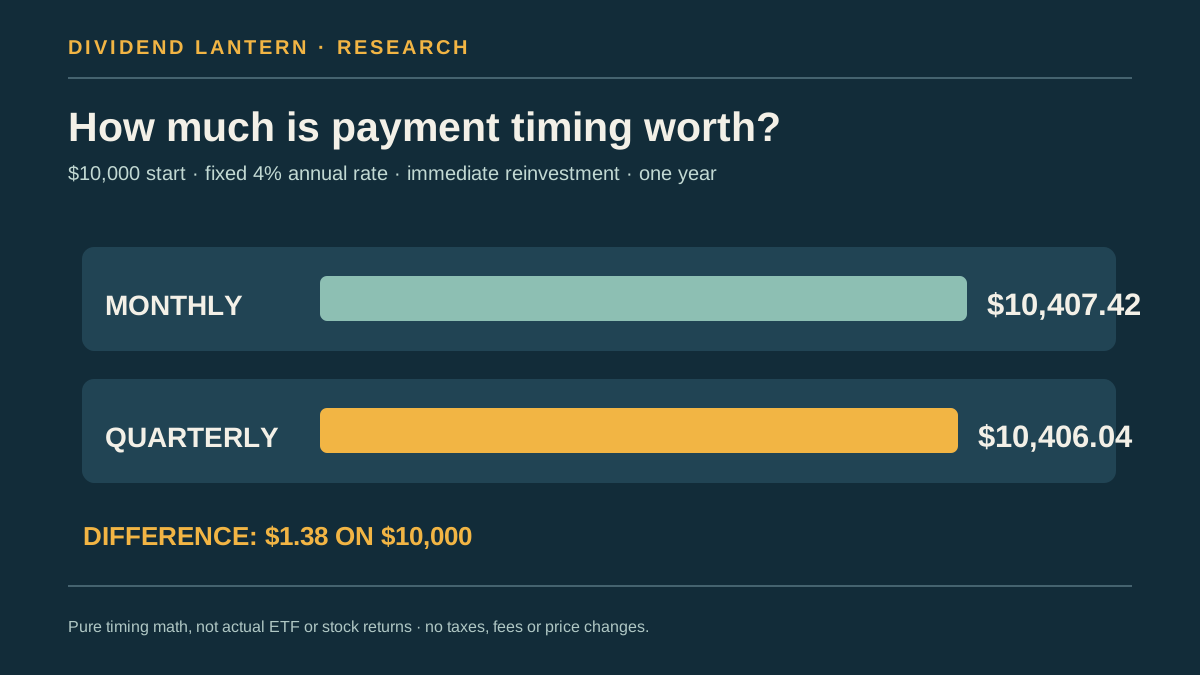
The calculation also assumes that reinvested units are eligible to earn the next fractional-period payment. Actual ex-dividend and record dates can change that. It is useful only to put the maximum-looking timing story in perspective. The distribution schedule is a planning convenience, not a substitute for researching the assets and liabilities that support payment.
Ask where the payment comes from
For an operating company, examine cash generated by operations, essential capital spending, debt maturities and the board's dividend policy. A stable monthly schedule does not fix a deteriorating balance sheet. For a REIT, compare distributions with appropriate measures such as adjusted funds from operations, then read the reconciliation and the assumptions behind it. Our REIT dividend-safety article explains why simple net income often misstates property cash economics.
Funds add another layer. The SEC distinguishes distributions sourced from portfolio dividends, interest, capital gains and return of capital. Return of capital gives an investor some principal back and changes tax basis; it should not be confused with earnings. The SEC also notes that a fund's net asset value declines when it distributes cash, all else equal. A high monthly distribution rate is therefore not free extra return. Read the fund's prospectus and distribution notices before comparing its cash yield with a company's ordinary dividend. SEC fund distribution bulletin.
The payment date can be especially misleading when a promotional “monthly income” figure is just the most recent distribution multiplied by twelve. For a variable-paying fund or company, that calculation shows a run rate, not a contractual annual income. Check several years of actual payments, any special distributions, and the most recent declared payment. If a share split or major portfolio change occurred, compare on a consistent per-share basis.
A better income calendar
Create one table for your holdings with declaration date, ex-dividend date, payable date, amount per share and expected cash at your current share count. Mark an item as declared only after the issuer announces it. Label future amounts as estimates based on the latest payment. Then aggregate by month and compare the timing with planned spending. This prevents a projected line in a tracker from looking like cash already promised.
If the portfolio is mostly quarterly payers, you can manage cash centrally rather than selecting a weaker asset only to fill a calendar gap. A short-term reserve lets you transfer a steady amount to a spending account while dividends arrive unevenly. Replenish the reserve after payments and review it if a dividend is cut. Keeping cash has an opportunity cost and its own risks, so the reserve size should fit the investor's needs rather than a generic rule.
Some people prefer monthly payers for the behavioral benefit: each payment makes progress visible. That is a valid personal preference. But the investment case should still survive a question that removes the calendar: Would I own this asset if it paid the same annual amount quarterly? If the answer is no, investigate whether the attraction is merely frequency or whether there is a durable cash-flow advantage you can actually document.
The decision in one sentence
Compare annual cash and total return, business quality, balance-sheet risk, tax treatment, valuation and diversification first. Then decide whether the schedule makes your cash management easier. Monthly income can be more convenient; quarterly income can be smoothed with a reserve. The one-year compounding difference under equal assumptions is small enough that the quality and price of the underlying investment should dominate the choice.
This is educational content, not personalized investment or tax advice. All $1,200 and $10,000 calculations are hypothetical; Realty Income and Johnson & Johnson are cited only as examples of payment frequency as of October 24, 2026. Actual dividends require board or fund action and can change.