A profitable utility can report negative free cash flow for years and still pay a dividend. That observation is neither a free pass nor proof of a dividend trap. Utilities build long-lived plants, transmission lines and distribution networks today, then seek to recover the costs from customers over many years. A one-year calculation of operating cash flow minus all capital expenditure can look ugly while the regulated business remains healthy. But growth projects still demand cash, and financing is not guaranteed on painless terms. NextEra Energy (NEE) and Duke Energy (DUK) make this tension unusually clear. NextEra's proposed all-stock combination with Dominion Energy adds a major prospective funding and regulatory question; it has not closed. NextEra-Dominion transaction announcement

This note uses full-year 2025 as a common reported cash baseline and company statements available by October 24, 2026. NextEra reported Q3 2026 on October 21; Duke plans to report Q3 on November 5. We discuss NextEra's update separately instead of matching it to a Duke quarter that has not yet been released. This is an analysis of funding mechanics, not a live-price comparison or a prediction that either board will declare a future dividend. NextEra combines Florida Power & Light with a large energy-development business; Duke is predominantly regulated electric and gas utilities. Their reported totals are not interchangeable measures of operating efficiency. NextEra cash-flow disclosure · Duke 2025 Form 10-K · Duke Q3 schedule
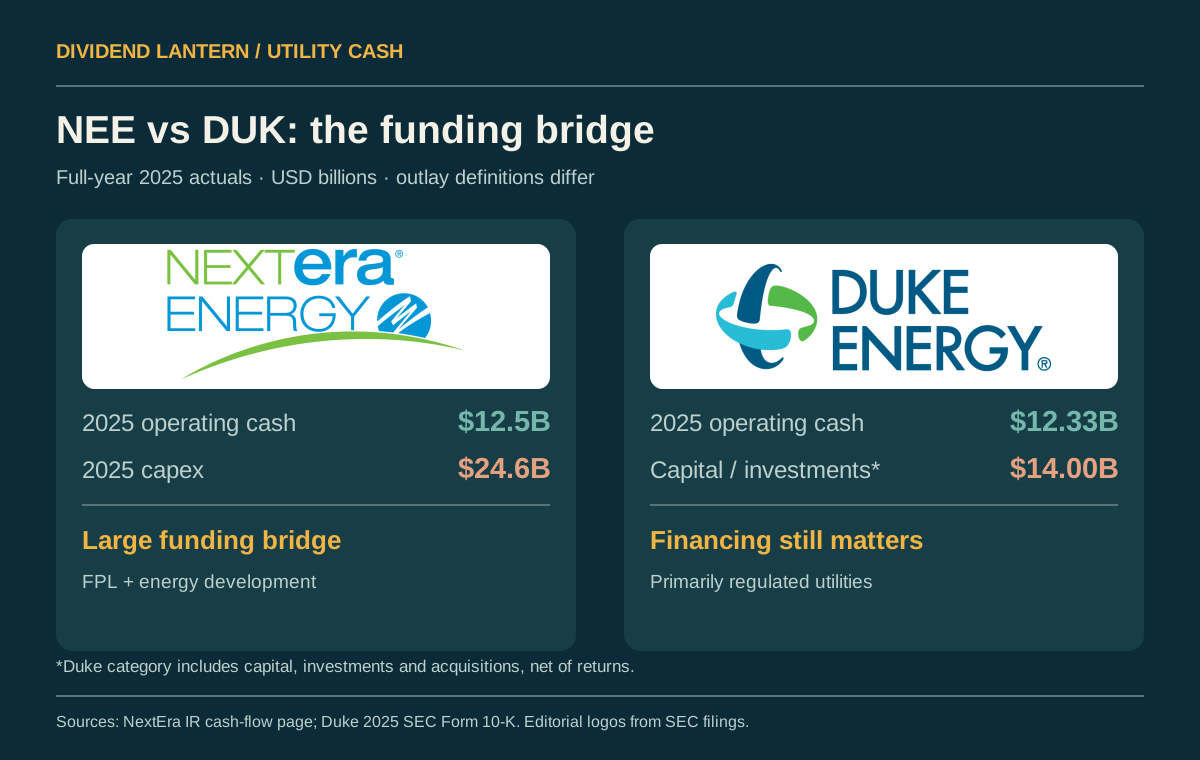
Diagram: analytical framework, not a forecast. Company marks are reproduced for editorial identification from [NextEra's SEC filing](https://www.sec.gov/Archives/edgar/data/753308/000075330825000039/nexteraenergy.jpg) and [Duke's SEC filing](https://www.sec.gov/Archives/edgar/data/17797/000132616026000014/duk-20251231_g1.jpg); neither company endorses Dividend Lantern. Business and financing context: [NextEra](https://www.investor.nexteraenergy.com/fixed-income-investors/cash-flow-quality-and-leverage) and [Duke](https://www.sec.gov/Archives/edgar/data/17797/000132616026000014/duk-20251231.htm).
The number that makes the story look alarming
NextEra's own cash-flow page lists $12.5 billion of 2025 consolidated operating cash flow, $24.6 billion of capital expenditure and about negative $11.4 billion of its defined free cash flow before dividends after other investing activities. Duke's 2025 filing reports $12.33 billion of operating cash flow, $14.002 billion of capital, investment and acquisition expenditures net of return of investment capital, and $3.30 billion of dividends paid. Duke also reports financing inflows, including net long-term debt issuance. These are historical cash flows; neither table says 2026 will repeat 2025. NextEra fixed-income disclosure · Duke 2025 Form 10-K, liquidity and financing
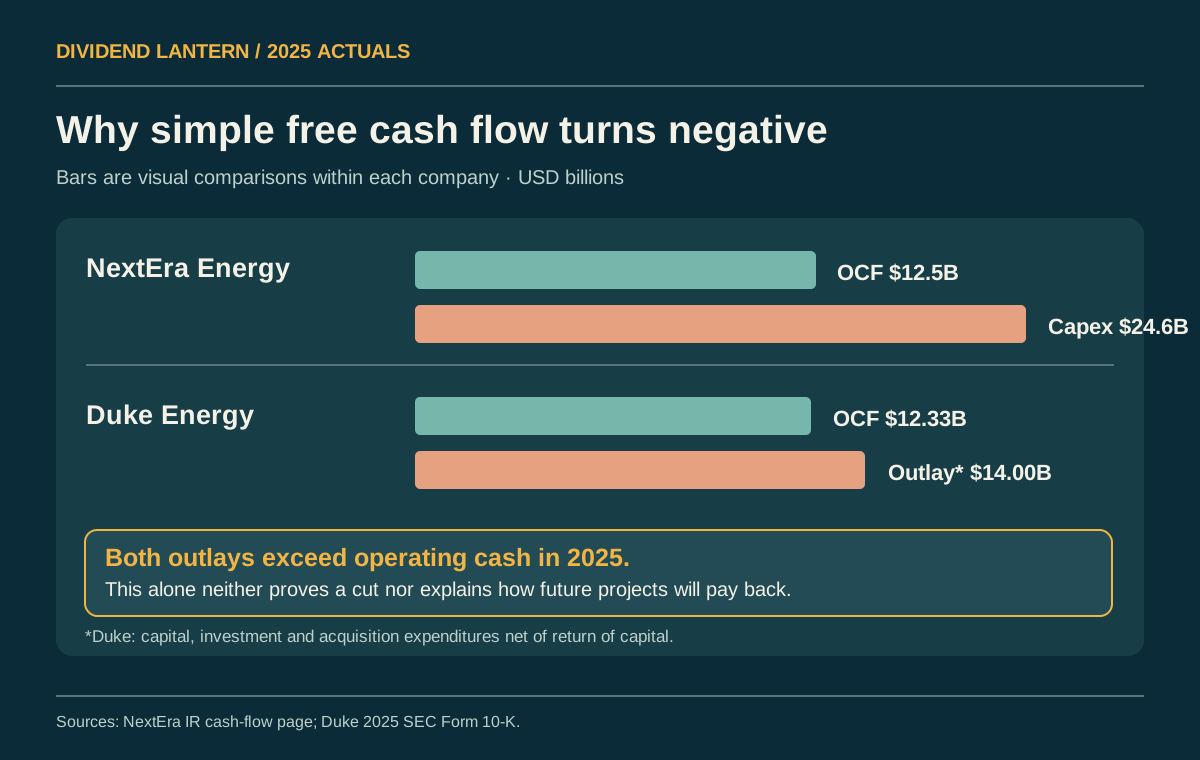
Chart: USD billions, fiscal 2025. NextEra capex is its company-published consolidated capital-expenditure series; Duke's $14.0 billion is its broader capital, investment and acquisition expenditures net of return of investment capital. The categories are not identical and the bars do not compare a normalized free-cash-flow margin. Sources: [NextEra](https://www.investor.nexteraenergy.com/fixed-income-investors/cash-flow-quality-and-leverage), [Duke](https://www.sec.gov/Archives/edgar/data/17797/000132616026000014/duk-20251231.htm).
It would be a mistake to call this “the dividend was funded entirely by debt.” Money in a corporate treasury is fungible. A utility can finance new regulated assets while operating receipts support expenses and distributions; one cannot assign an individual borrowed dollar to one use without the financing documents. It is equally mistaken to say that financing does not matter because investments will eventually earn a return. Capital markets, interest rates, approvals and construction schedules determine how expensive that bridge becomes.
Why regulated capital spending is different—and where it can go wrong
The appealing utility story is a sequence: invest in prudent infrastructure, obtain regulatory approval to include it in rate base, earn an allowed return, collect cash, and repeat. The time between spending and recovery is a real financing requirement. Rate cases can delay or limit recovery. Project costs can rise. Demand growth may require assets before customer revenues arrive. Storm damage, fuel costs and working-capital swings can also move cash independently of the long-term investment case. Duke's 10-K explicitly connects its 2025 earnings improvement with recovery of infrastructure investment, while also describing rising interest expense and a multiyear funding plan. Duke 2025 Form 10-K
NextEra's profile adds a further layer: Florida Power & Light is regulated, while NextEra Energy Resources develops assets with long-term contracts and other commercial arrangements. NextEra says its capital investment is expected to drive later cash-flow growth. That is a company expectation, not cash already collected. Its September 2026 statement expected roughly 10% annual dividend-per-share growth through 2026 off a 2024 base, and then 6% annually from year-end 2026 through 2028, subject to board discretion. A dividend policy is useful evidence of management's intention; it is not a contract with shareholders. NextEra September 2026 investor update
The October 21 Q3 release adds a useful but incomplete checkpoint. NextEra reported $1.24 adjusted EPS for the quarter, compared with $1.13 a year earlier, while Energy Resources added 3.7 GW of renewables and storage to a backlog of roughly 36.7 GW. Backlog is potential future work, not 36.7 GW of projects already producing dividend cash. On October 22 the board declared another $0.6232 quarterly common dividend, payable December 15. That is a real declared payment; it does not demonstrate that the entire expansion plan is internally financed. NextEra Q3 2026 release · NextEra October dividend declaration
Duke's July 2026 board declaration raised its quarterly common dividend from $1.065 to $1.085 per share. That is a declared payment, unlike a multiyear target. Duke's history of quarterly cash dividends is long, but a century of payments cannot eliminate the economic test for the next decade. Its filing projected $17.75 billion of capital and investment expenditure for 2026, a forward-looking amount greater than 2025 actual spending. Investors should separate that plan from past cash flows and watch how it is financed. Duke dividend declaration · Duke 2025 Form 10-K
The funding bridge is the dividend test
Three questions reveal more than a yield screen. First, does cash from established assets grow as earlier projects enter service? A widening gap between operating cash and capital needs is less troubling when completed projects show an observable recovery path. Second, what is the cost and maturity profile of financing? Replacing debt at higher rates can absorb cash that would otherwise support dividend growth. Third, does management have financial flexibility—cash, credit, asset sales, prudent equity issuance or the ability to defer discretionary projects—without weakening the operating franchise?
These are not interchangeable tools. Issuing equity can protect credit metrics but dilute each existing share's claim on future earnings. Debt can avoid immediate dilution but raises fixed claims. Selling a minority interest in a subsidiary can raise cash without disposing of the entire operation, but it gives another investor a claim on part of the future economics. Duke's 2025 filing described an agreement for a minority investment in Florida Progress intended to help fund its capital plan; the expected closings and proceeds were forward-looking when disclosed. Do not count an unclosed financing transaction as cash already in the bank. Duke 2025 Form 10-K
The proposed NextEra-Dominion combination adds a different kind of financing bridge. The companies announced an all-stock transaction in May, so the consideration is not a simple cash purchase price; issuing shares would change the per-share claim on the combined utility. They expect closing in the second half of 2027, subject to state and federal regulatory approvals and other conditions. The Q3 update said shareholder approvals had been obtained, while regulatory reviews continued. Until closing, treat projected merger benefits and combined-company earnings growth as management expectations, not cash available for today's dividend. Watch any new capital commitments, customer credits, approval conditions and changes to the combined share count. Original transaction terms · NextEra Q3 update
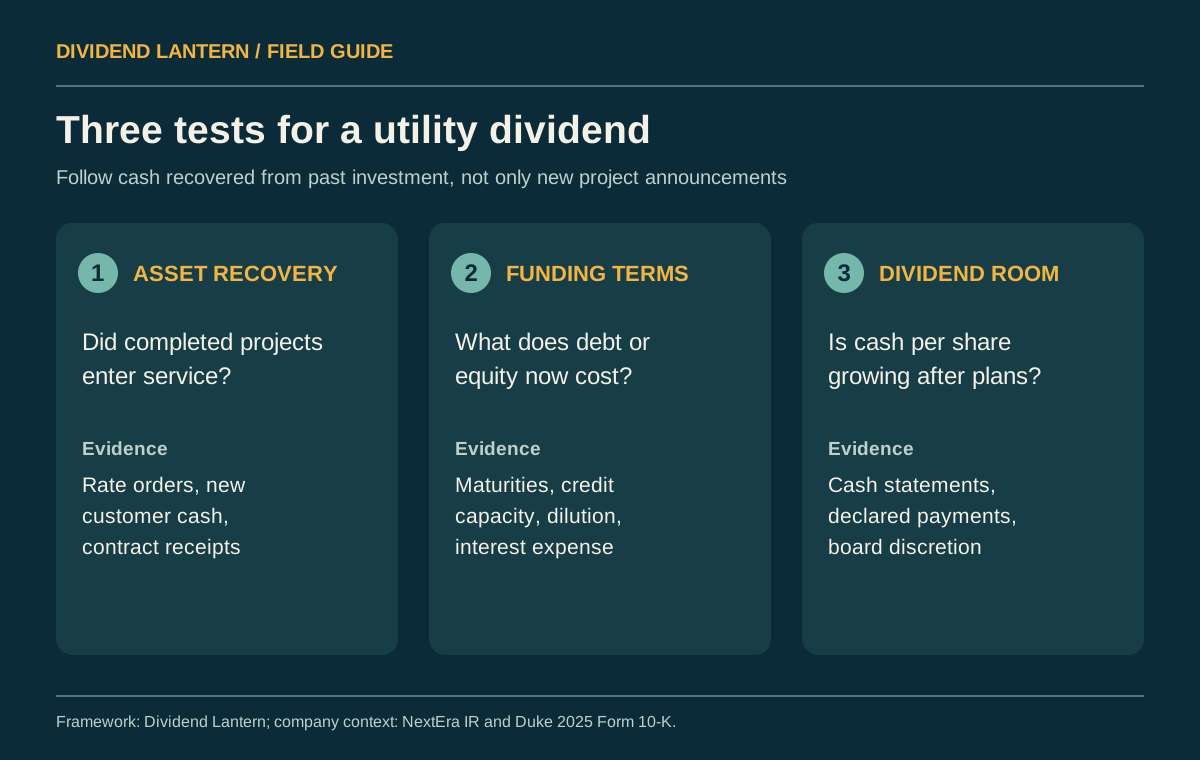
Diagram: Dividend Lantern analytical checklist, based on the companies' [NextEra capital and cash disclosure](https://www.investor.nexteraenergy.com/fixed-income-investors/cash-flow-quality-and-leverage) and [Duke liquidity discussion](https://www.sec.gov/Archives/edgar/data/17797/000132616026000014/duk-20251231.htm). It is not a credit rating.
A practical comparison without declaring a permanent winner
For NextEra, follow Florida Power & Light's rate-base and customer cash generation separately from Energy Resources' development spending. Compare the actual cash yielded by completed projects with the capital still committed to the pipeline. Revisit the stated dividend-growth policy if financing costs or project timing changes. NextEra's company-published series makes it clear that large capital demands are not a one-off exception; that is precisely why access to long-term capital deserves regular attention. NextEra fixed-income disclosure
For Duke, track approved rate recovery, the cash effects of its growing investment program, debt maturities and any actual proceeds from announced funding transactions. Compare dividends paid with the cash available after necessary reinvestment, but do not assume all capex is maintenance that must be funded from this year's operations. Duke's own 2025 report provides the historical baseline and its 2026 plan; its scheduled November 5 quarterly report should show how the plan is unfolding. Duke 2025 Form 10-K · Duke Q3 schedule
Finally, valuation matters. A faster dividend-growth policy can disappoint at a price that already assumes flawless execution. A slower-growing utility can disappoint if debt costs outrun regulated returns. Compare the dividend yield available at the price on the day you invest, the likely growth of cash per share, financing needs and a Treasury alternative. This article does not freeze a live yield into an evergreen conclusion.
The take: Both companies are funding substantial infrastructure beyond a single year's operating cash flow. NextEra's latest quarter showed earnings progress and an expanding project backlog, yet its proposed Dominion combination adds a substantial execution and approval test. The question is not whether a 2025 free-cash-flow figure was negative; it is whether future regulated and contracted cash arrives on schedule, and whether the financing bridge preserves enough capacity for the dividend. That answer must be updated as projects, rate cases and financing terms change.
Educational analysis of public disclosures available October 24, 2026, not personalized investment advice. Reported 2025 figures, 2026 declarations, a proposed merger and future targets are deliberately distinguished. All future common dividends remain subject to the relevant board's approval.