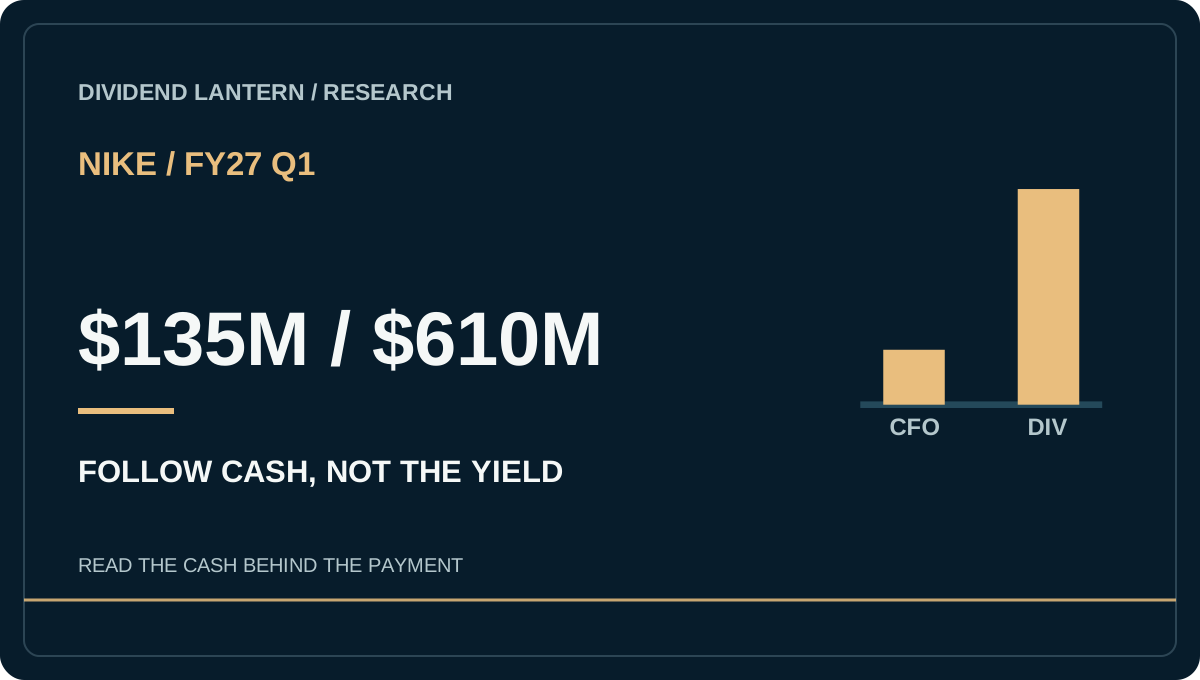
Nike declared a $0.41 quarterly dividend, but the latest reported quarter produced only $135 million of operating cash flow against $610 million of cash dividends paid. That contrast deserves investigation. It does not, on its own, prove the dividend is unsustainable: cash moves unevenly through an apparel business, Nike held substantial liquidity, and one quarter cannot stand in for a year. The more useful question is what the next several quarters must deliver to support the payment without eroding the cash buffer. Nike's fiscal Q1 2027 ended August 31, 2026; the 10-Q was filed October 2. Nike Q1 2027 Form 10-Q.

The headline business trend is mixed
Nike reported $11.2 billion of Q1 revenue, down 4% from the year-earlier quarter on a reported basis. Gross margin increased 60 basis points to 42.8%, helped by lower warehousing and logistics costs. Nike Direct revenue fell 8% on a reported basis; Nike Brand Digital sales declined 13%. Demand can differ across channels and regions, so a margin improvement is not the same as a demand recovery. A durable dividend requires future profits to convert into cash, not merely a favorable quarter of accounting margin. Nike Q1 2027 earnings release.
The company's August 2026 declaration set $0.41 per common share for its October 1 payment. That is an actual declaration, not an annual dividend guarantee. Four identical future quarters would mathematically equal $1.64 per share, but no board has committed to all four by making one declaration.
Reconcile profit with cash
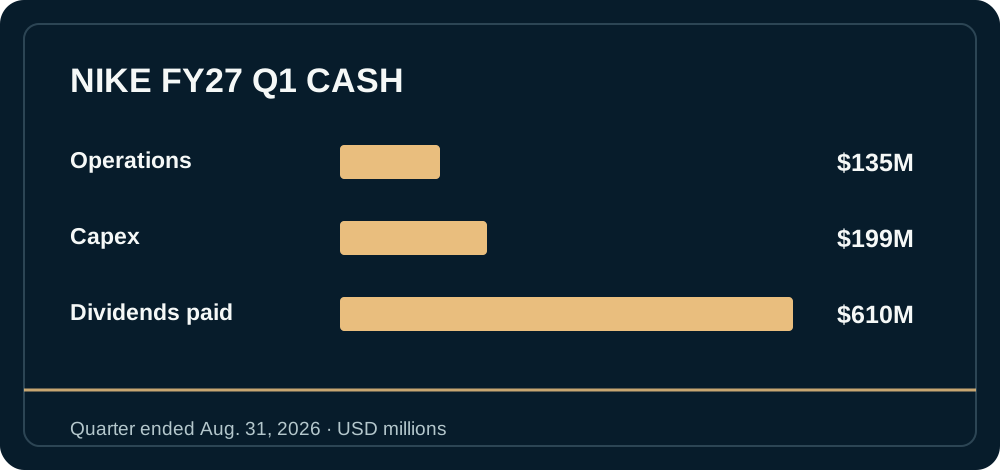
Q1 net income was $712 million. Operating cash flow was much lower at $135 million. Nike's 10-Q attributes $846 million of cash outflow to changes in working-capital components and other assets and liabilities, notably lower accrued liabilities and higher inventories, partly offset by lower receivables. It reported $199 million of property, plant and equipment additions and $610 million of dividends paid. A simple cash-flow-minus-capex measure is therefore negative $64 million for the quarter: $135m − $199m. This is our calculation from the filing, not Nike's full-year guidance. It excludes other investing cash flows. Nike Q1 2027 Form 10-Q.
The year before, Q1 operating cash flow was $222 million and capex $207 million; one-quarter cash conversion was also slim. Quarter-to-quarter working capital has timing effects, and fiscal-year seasonality matters. Declaring the dividend “uncovered forever” from Q1 alone would be an analytical error. But dismissing the gap as “just timing” without checking later recovery would be equally weak.
The full year offers a second lens
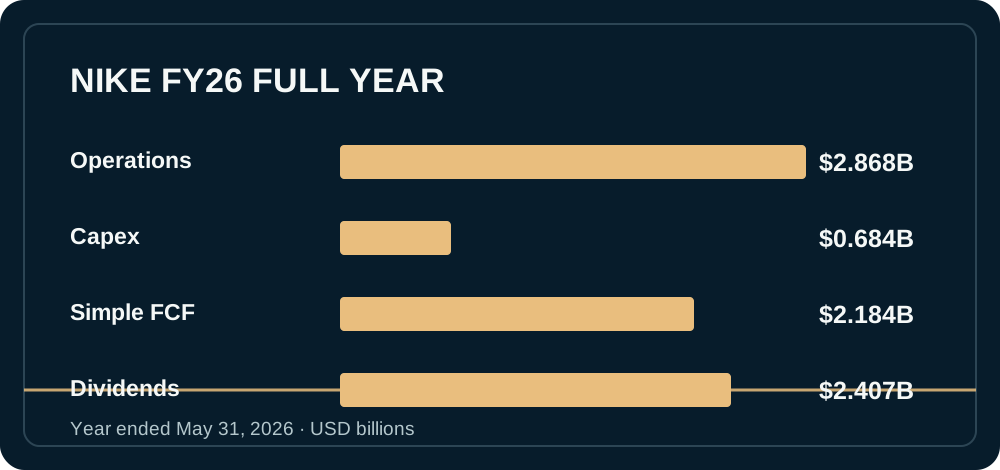
For fiscal 2026, Nike reported $2.868 billion of operating cash flow, $684 million of property and equipment additions and $2.407 billion of dividends paid. On the same simple definition, free cash flow was $2.184 billion, about 0.91× cash dividends. The cash gap was approximately $223 million before other uses and sources. The company finished May 2026 with $7.563 billion of cash and equivalents. These figures show that Nike had resources to pay the dividend, while the latest completed year's internally generated cash after capex did not fully cover it on this measure. Nike fiscal 2026 Form 10-K.
By August 31, 2026, Nike reported $8.4 billion of cash and short-term investments. Liquidity is a cushion, not a permanent substitute for a recovering operating business. Nike paused repurchases under its existing authorization during fiscal Q1 2027. That gives more flexibility to preserve cash for other uses, although it cannot by itself create stronger product demand. Nike Q1 2027 10-Q.
The next report has three decisive questions
- Does operating cash flow recover as working-capital outflows reverse? Track inventory, accruals and receivables, not only net income.
- Does direct-to-consumer demand stabilize? Nike's Q1 digital and store declines make channel recovery part of the cash story.
- How much of restructuring becomes actual cash spending? Nike announced the Pace operating-model transformation and estimated pre-tax charges and future savings. These are management projections, not realized cash, and need updates in subsequent filings. Nike Q1 release.
Our assessment: There is no basis here to announce a dividend cut. There is also no basis to call the payout effortlessly covered by current cash generation. Nike's strong liquidity buys time; the next few reports must show whether the cash engine improves. A stock's fallen price and higher yield do not change that requirement. The relevant comparison is cash after reinvestment, the balance sheet and what investors pay for the risk.
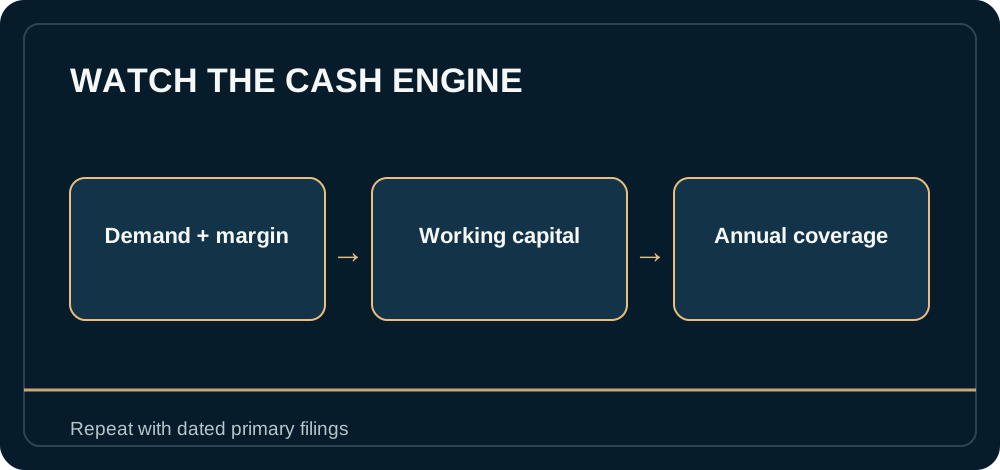
A cash gap has more than one possible cause
Nike's $135 million of fiscal Q1 operating cash flow is not interchangeable with its $712 million of net income. The cash-flow statement reconciles them: accrual accounting recognizes some revenue and expenses at different times from their cash settlement, while inventories, receivables and accrued liabilities absorb or release cash. Nike reports a substantial working-capital outflow in the period. Nike's fiscal Q1 2027 10-Q provides the actual line items. If a temporary inventory build later unwinds, cash may improve without a matching surge in earnings. If inventory reflects persistently weak demand or requires markdowns, the balance can pressure future margins and cash instead. The next filings distinguish those paths.
This is why a dividend review should not label every quarterly cash deficit a cut signal. An apparel business has a selling cycle, product launches and wholesale collection timing. Yet the reverse shortcut—assuming every weak quarter is temporary—has no evidentiary basis either. Record the same quarter a year earlier, the full fiscal year and the subsequent quarters on a consistent cash-flow definition. The fiscal 2026 comparison in this article is not an annualization of the weak fiscal Q1; it is a separate completed-year check. It showed simple free cash flow of about $2.184 billion against $2.407 billion of dividends paid. Nike fiscal 2026 10-K.
What would count as improvement?
First, operating cash needs to recover enough to fund ordinary reinvestment and the dividend over a meaningful period, not just one favorable quarter. Second, the inventory and digital-sales trend should support that cash recovery rather than forcing higher discounts. Third, repurchase discipline matters. Nike's pause in buybacks during fiscal Q1 preserved flexibility: a company can reduce optional repurchases before changing a regular dividend. But stopping buybacks is not a perpetual solution if business cash remains inadequate. The earnings release and 10-Q are the dated baseline for each check.
Apply a simple hypothetical test rather than a share-price prediction. If future annual operating cash remained $2.868 billion and annual capex remained $684 million, matching fiscal 2026, there would be $2.184 billion before dividends and other uses. A hypothetical $2.407 billion cash dividend bill would exceed that by $223 million. If operating cash rose by $300 million with capex and dividends unchanged, the simple surplus would become about $77 million. If capex rose by the same $300 million instead, the gap would widen to $523 million. These are arithmetic scenarios, not Nike guidance. They show how sensitive the coverage story is to operating recovery and investment needs.
Nike's liquidity provides time to manage the transition, and the latest dividend was actually declared. Neither fact makes its future dividend automatically safe. The disciplined question for each new earnings release is whether the business is creating enough repeatable cash after reinvestment to support both the payment and a healthy balance sheet. Until that improves, a higher stock yield caused by a lower price is a risk signal to investigate rather than a conclusion.
Educational analysis using information available October 24, 2026, not personalized investment advice. Fiscal Q1 2027 and fiscal 2026 are different periods. Simple free cash flow is our calculation; subsequent Nike results may change the assessment.