
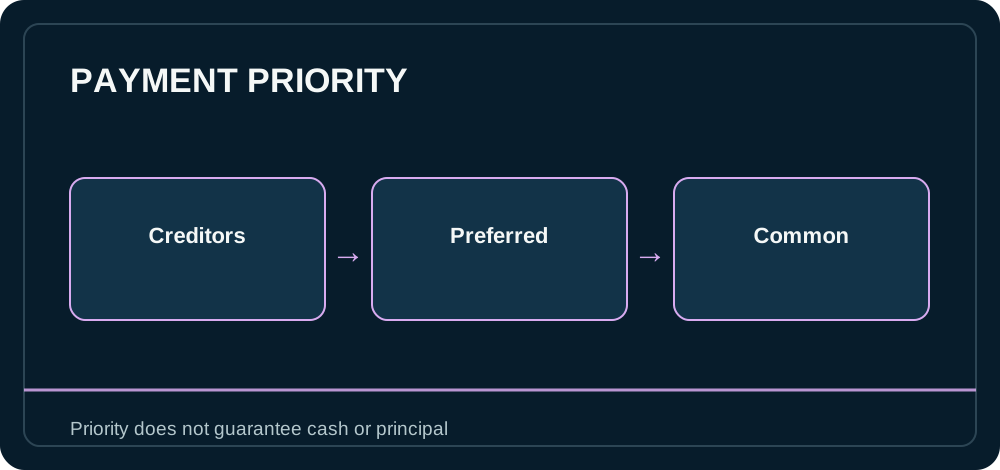
“Preferred” describes a place in the capital stack—not a guarantee of income. Preferred shareholders generally receive dividends ahead of common shareholders and rank ahead of them if assets are distributed in liquidation. They still stand behind creditors. The board can suspend preferred dividends under the issue's terms, and a quoted yield can rise sharply when the market price falls. A preferred share is neither a Treasury security nor simply a high-paying common stock.

What is actually preferred?
The SEC's stock guide says preferred holders usually lack ordinary voting rights but receive dividends before common shareholders and have priority over common in a liquidation. That is relative priority. It does not mean the company must have sufficient cash, that the share is insured, or that the preferred dividend grows. Bondholders and other creditors usually have claims above preferred equity.
Read whether the series is cumulative. If a cumulative dividend is skipped, arrears ordinarily must be resolved before common dividends resume, subject to exact terms. A noncumulative series can miss a payment without building the same arrears claim. The precise rights, restrictions and redemption conditions are in the issuer's prospectus supplement, not in the ticker suffix. Bank preferreds can have additional regulatory constraints. Never infer cumulative status from the company name or last payment alone.
Four sources of risk behind a seemingly fixed payment
Credit risk: The preferred dividend depends on the issuer's financial strength and ability to access capital. Unlike debt interest, it may be discretionary. If the business weakens, a preferred investor can suffer both a skipped dividend and a steep share-price decline.
Interest-rate risk: A preferred issue with a relatively fixed payment can fall in price when newly available income investments offer higher rates. The SEC's fixed-income bulletin explains the general inverse relationship between market rates and fixed-payment security prices. Preferreds have their own features, but the comparison is useful.
Call risk: The issuer may be entitled to redeem after a stated date at a stated price. If the investor paid above that call price, a redemption can erase part of the income collected. The date is often the first permissible call date, not a promise of redemption. The SEC describes why calls can force reinvestment when comparable yields are lower. SEC call-risk guide.
Growth and liquidity risk: A conventional fixed-rate preferred dividend has little of a growing common dividend's upside. Some issues trade thinly, adding a wide bid–ask spread when an investor wants to exit. Floating-rate and convertible issues behave differently, so read the actual formula.
Compare yield to the right denominator
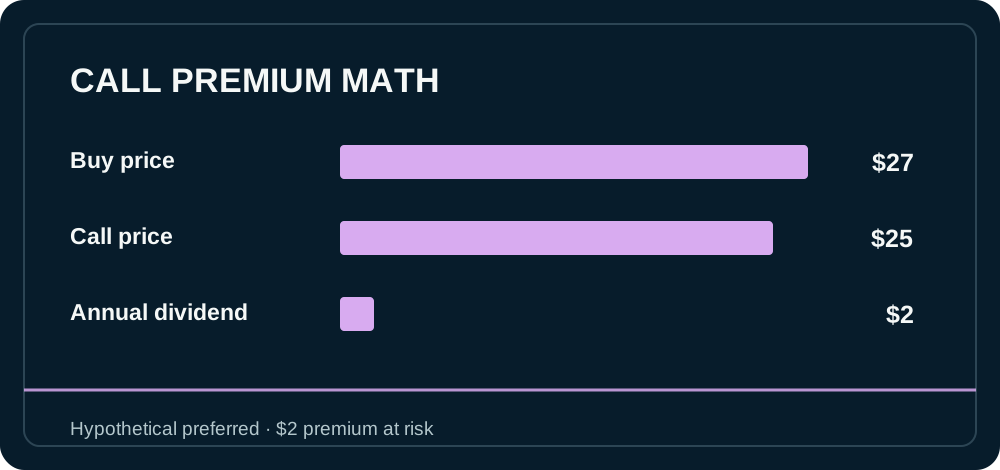
Consider a purely hypothetical preferred with a $25 call price, a $2 annual dividend and a market price of $27. Its current dividend yield is about 7.4% ($2 ÷ $27), but redemption at $25 would also create a $2 capital loss per share for an investor who bought at $27, ignoring fees and taxes. The date and probability of a call determine how that loss affects annualized return. If the security cannot be called for years, the math differs. A single “current yield” number misses both possibilities.
Use a five-line worksheet: issue price; current market price; dividend formula and cumulative status; first call date and call price; issuer coverage and balance sheet. Calculate yield to a plausible call date as well as current yield. Then stress-test a rate increase and a suspended payment. If the prospectus terms are unclear, a bigger number on a screen is not a reason to guess.
The document that matters more than the ticker
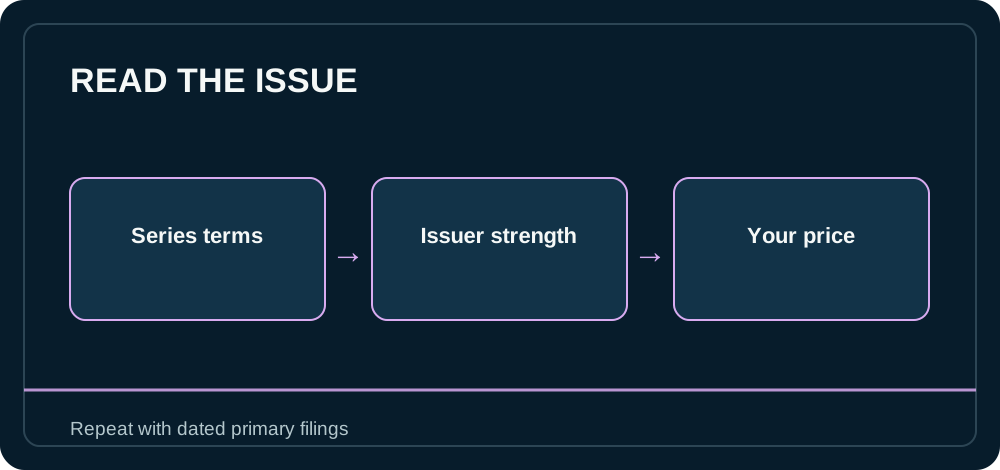
Two preferred series from the same company can have different payment rates, call dates, cumulative rights and floating-rate formulas. Their market yields therefore cannot be ranked without reading the series-specific prospectus supplement. Check whether the quoted dividend rate is a percentage of a $25 or $1,000 liquidation preference, whether the security changes from fixed to floating, and what reference rate and spread apply after the reset date. Verify whether the preferred is directly issued by the operating company or by a financing vehicle with a guarantee. A company-level dividend history is useful background, but it does not establish the contractual priority or tax character of a particular series. The prospectus should be paired with the latest issuer filing and the current market price.
One security, three possible paths
The hypothetical $27 purchase, $25 call price and $2 yearly payment can lead to very different investor experiences. If the issuer redeems soon, the $2 price premium may consume much of the near-term dividend income. If it does not call and market rates rise, the investor might collect the contractual payments while facing a lower resale price. If the issuer's balance sheet weakens, the concern shifts from call timing to whether payments continue and what recovery value remains. These are scenarios, not probabilities or a forecast for any named issue. They show why the quoted current yield is an incomplete comparison.
For a rough call-date check, list the purchase price, every scheduled payment expected before the first permissible call date, and the redemption amount. Calculate the cash left if the issuer calls at that first opportunity. Repeat for a later call and for no call, using a plausible sale price rather than assuming par. Actual yield-to-call calculations also account for payment dates and compounding, and can be distorted if a call is not economically likely. The exercise is useful because the risk is asymmetric: an issuer may redeem an expensive preferred when it can refinance cheaply, while an investor cannot force redemption at par when rates move against them. The SEC's callable-security explainer describes that reinvestment problem.
Where the income claim sits in a stress event
“Ahead of common” matters only after senior claims are considered. A business may be able to pay common dividends in a healthy year and later suspend them to protect lenders. Preferred holders generally have a stronger claim on dividends than common holders, but they do not move ahead of secured or unsecured creditors in a liquidation. The SEC's stock primer explains that hierarchy. Therefore assess issuer debt maturities, liquidity, regulatory capital where relevant and the cash demands of the operating business. A preferred's contractual coupon cannot create cash the issuer does not have.
The series-specific documents should answer whether skipped dividends accumulate, whether the issuer may redeem at its option, how a floating rate is set, and whether special conversion or change-of-control provisions apply. A broker label such as “6% preferred” is only a pointer to those terms. It might describe a percentage of liquidation preference rather than the yield at today's market price. An investor buying at $27 for a $25 liquidation preference is paying a premium; one buying at $22 may face a different capital risk even though both own the same series.
Preferred shares can serve an income role when their terms and issuer risk are understood, but ranking them by distribution rate alone selects for the biggest visible number. Compare cash return plus plausible capital outcome over an investment horizon. Also compare with the issuer's common and debt: each claim has a different combination of priority, flexibility, growth and downside. This is an issue-level research problem, not a sector-wide shortcut.
Educational content, not personalized investment advice. Rights vary by preferred series and can change through corporate actions. All dollar figures in the example are hypothetical.