A dividend can arrive in full while losing the tax treatment you expected. For a U.S. taxable investor, receiving a company's cash payment and qualifying for the preferential qualified-dividend rate are separate tests. The company, the type of payment and the number of days you held each share all matter. A distribution displayed as “qualified” on a brokerage statement can require an investor-level adjustment if the holding period was too short.

The two gates
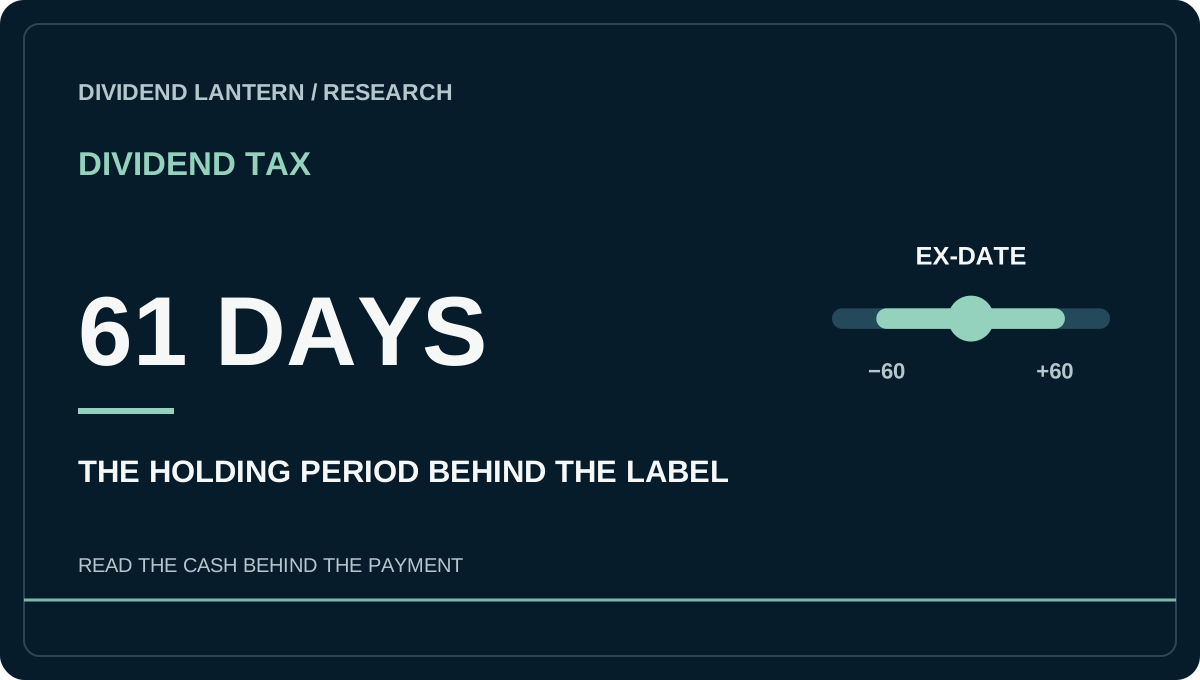
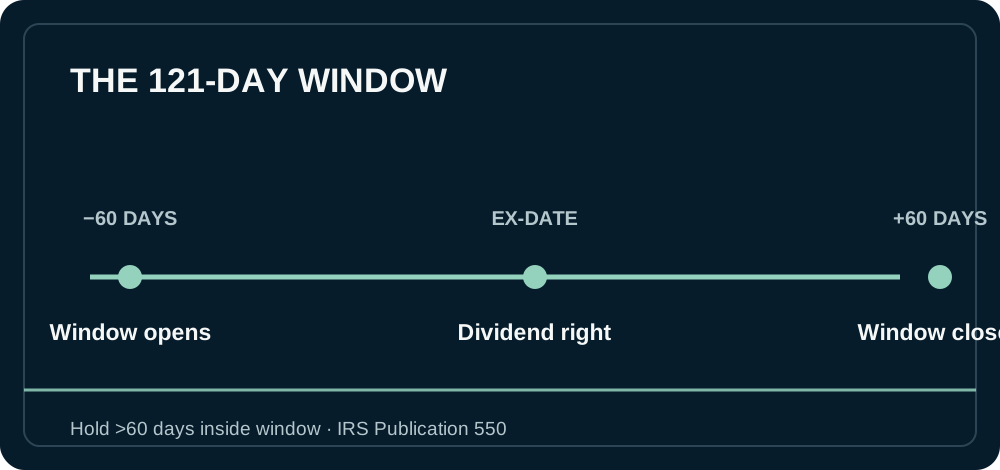
The IRS Publication 550 describes qualified dividends as ordinary dividends potentially eligible for the long-term capital-gain tax rates, subject to conditions. First, the payer must be a U.S. corporation or a qualified foreign corporation and the payment must not be an excluded type. Second, for most common shares, you must have held the stock more than 60 days during the 121-day period beginning 60 days before the ex-dividend date. That means at least 61 counted days, not merely “own it on the ex-date.” Count the sale date, but not the acquisition date. Days during which you are protected from risk of loss may not count.
For certain preferred dividends covering more than 366 days, the IRS uses a more than 90 days within a 181-day window rule. These details are why a one-line “all U.S. dividends are qualified” claim fails. Also, REIT distributions, substitute payments in lieu of dividends and some other payments may not be qualified regardless of a familiar ticker. The year-end Form 1099-DIV distinguishes total ordinary dividends in box 1a from the amount shown as qualified in box 1b; box 1b is included within box 1a, not added to it. IRS Publication 550.
A trade calendar can change the answer
Assume, purely for illustration, a common stock goes ex-dividend on July 15. An investor buying immediately before that date and selling three weeks later receives the dividend, but generally does not pass the 61-day test. If they continue holding long enough within the prescribed window, they may pass. The precise day count depends on actual acquisition and sale dates, settlement, share lots and risk-reducing positions. This is a calendar illustration, not a recommendation to hold a stock for a tax outcome.
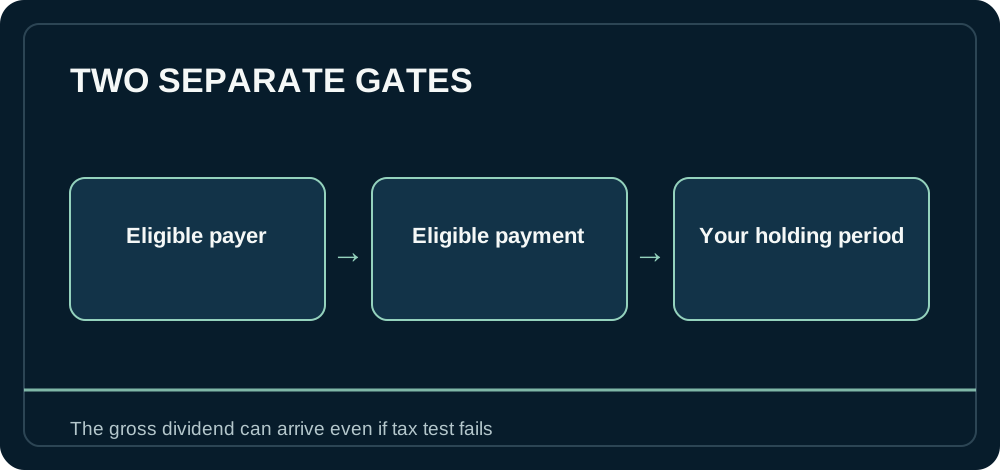
Imagine a hypothetical $1,000 gross dividend. Its gross amount is $1,000 whether or not it qualifies. The after-tax result can differ because qualified dividends may receive a different federal rate from ordinary income; state treatment and investor circumstances can change the final result again. We intentionally avoid a fixed “you save $X” number. Current tax brackets, investment-income surtaxes and account type must be applied to the actual tax year, not to a recycled social-media example.
Build a tax-aware research record
For each taxable dividend lot, retain the purchase date, sale date, ex-date, number of shares and any hedging transactions. Compare your record with the issuer's declaration and Form 1099-DIV. If your own holding period fails the requirement despite a qualified amount in box 1b, the IRS says not to report that payment as a qualified dividend on Form 1040 line 3a. IRS Publication 550. A qualified tax preparer can resolve complicated share-lot or hedging situations.
There is a bigger portfolio point. An investor should not keep a deteriorating business merely to meet a tax clock. A few tax percentage points cannot protect against a large loss in the share price or a dividend cut. The research order is: determine whether the business and price make sense, then understand the after-tax cash. The tax label is a characteristic of a payment under a particular investor's facts, not a substitute for dividend-safety analysis.
Three easy ways to misread the tax form
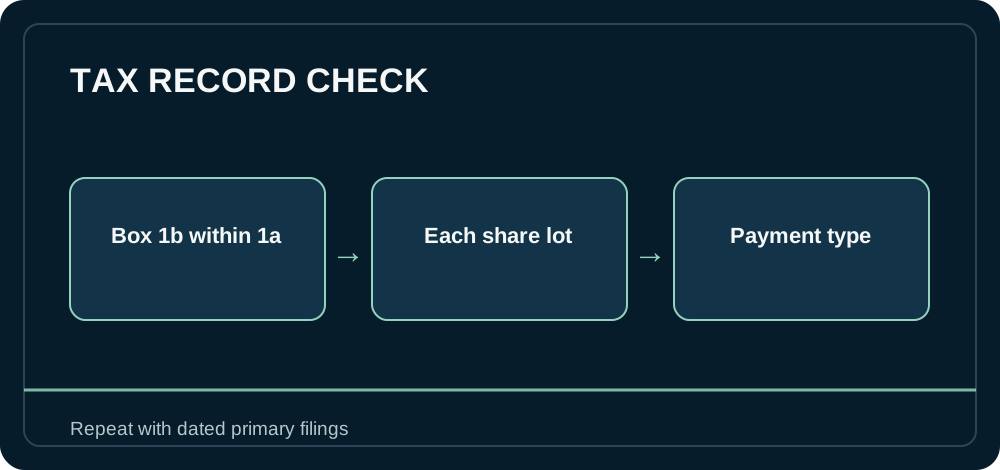
First, box 1b is a subset of box 1a. Adding both boxes together overstates dividend income. Second, the broker may report the issuer's potentially qualified payment without knowing whether a particular investor held every lot long enough; a short-held lot can require correction on the return. Third, a payment in lieu arising from securities lending or a short sale is not automatically the same tax item as the issuing company's dividend. The IRS separately discusses substitute payments in Publication 550. In a retirement account, tax reporting follows different account rules, so this worksheet is principally for a U.S. taxable brokerage account. Keep the underlying trade confirmations; a screenshot of a yield screen cannot establish the holding period.
Why the test belongs to a share lot
Suppose an investor bought 100 shares months ago and another 100 shares just before an ex-date. The issuer pays the same cash amount on each share, yet the investor's holding-period result may differ between the older and newer lots. A brokerage screen showing one 200-share position can conceal that distinction. The acquisition and sale dates of each lot are what make the day count reproducible. If the investor later sells only part of the position, the lot-identification method becomes relevant; an average holding date invented for the whole ticker is not an adequate substitute. IRS Publication 550 gives the holding-period and risk-of-loss rules.
The window also prevents a common misconception about the ex-date. Owning the stock at the close just before ex-date determines whether the investor receives the corporate payment through the normal market process. It does not automatically determine preferential tax treatment. The two systems ask different questions: who gets the dividend, and for how many qualifying days did the taxpayer bear the investment risk? A covered call or other position that substantially reduces risk can affect the latter test. Investors using options or securities lending need the full IRS rule, not a simple date calculator.
A worksheet before and after Form 1099-DIV
Before the year-end form arrives, record the issuer name, account, share lot, purchase date, any sale date, ex-date, gross payment and whether the issuer's distribution may be qualified. Leave tax status provisional until the holding period and payment type are known. At tax time, compare the broker's Form 1099-DIV with that worksheet. Box 1b is the broker-reported potentially qualified portion of box 1a, but a taxpayer's own short holding period can require reporting less as qualified. The IRS's 1099-DIV instructions explain the boxes; Publication 550 covers the investor-level adjustment.
Do not reduce this process to “hold for 61 calendar days after buying.” The statutory window begins before the ex-date and ends after it; days outside that window do not count toward this particular requirement. Count using actual trade records, not a screenshot of current holdings. When a payment comes from a REIT, a foreign issuer, an ETF or a securities-lending arrangement, first verify what kind of payment it is. The ticker's familiar brand does not establish the tax box. If a broker later issues a corrected 1099-DIV, use the correction rather than preserving the first estimate.
The financial decision remains separate. A holding period can change a federal tax rate, but it cannot make a weak dividend safe or turn an overvalued share into a bargain. Work out expected total return and loss capacity before optimizing tax treatment. A tax-efficient bad investment is still a bad investment. This framework is most useful when comparing two otherwise sound choices or checking a completed tax year, not as an instruction to delay a necessary sale.
Educational U.S. federal tax information as of October 24, 2026, not individualized tax advice. Tax rules and rates can change. Consult the current IRS instructions or a tax professional for a return.