Imagine seeing a special dividend in your account, selling the shares, and learning that the cash belongs to your buyer. That can happen when a distribution is unusually large. The ordinary shorthand—“own it before the record date”—is insufficient. The exchange or FINRA determines the ex-dividend date, and the entitlement can follow the shares after the record date through a due bill. This is a market-mechanics lesson, not a way to collect free money.

Why the ordinary calendar can mislead
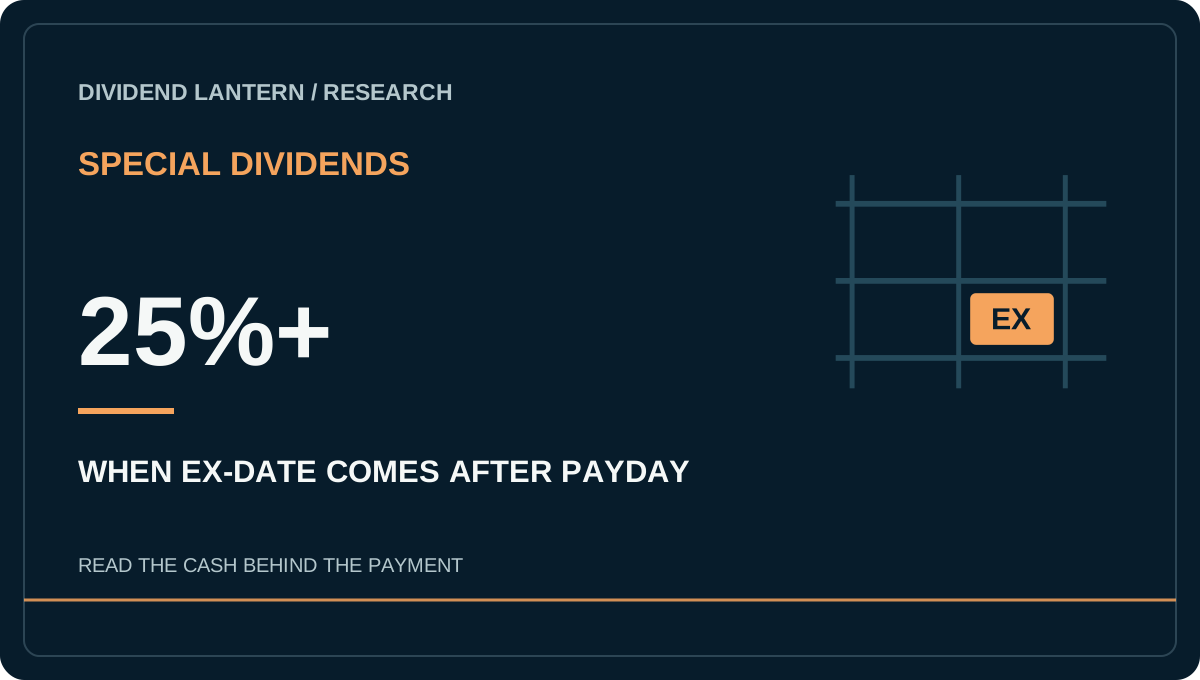
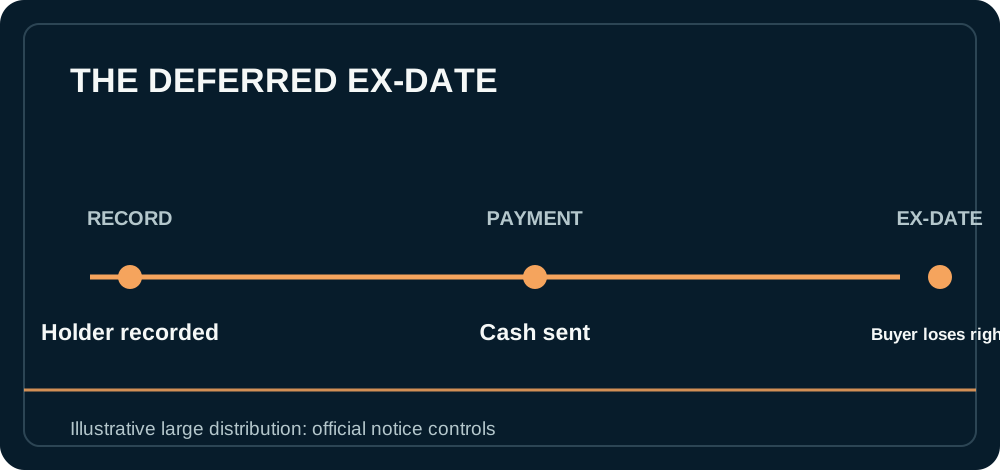
For a routine cash dividend, the ex-date is usually on or before the record date under the current U.S. settlement framework. A buyer on or after that ex-date is not entitled to the payment. The SEC's Investor.gov ex-dividend guide explains the difference between declaration, record, ex and payment dates. A large dividend can reverse the familiar ordering: if the distribution equals 25% or more of the stock's value, its ex-date is generally deferred until the first business day after payment. Check the actual notice for the security rather than applying a memorized rule to every corporate action.
In that special case, a shareholder of record can receive the payment and still be obligated to pass its economic benefit to the buyer if they sold before the deferred ex-date. The intermediary handles that obligation through a due bill. FINRA's Rule 11140 governs the ex-date designation. Investor.gov explains that selling before the ex-date also transfers the right to certain stock distributions even if the seller is the holder of record. Corporate-action details and broker processing matter.
A simple example, deliberately hypothetical
Suppose a stock trades at $40 and declares a $12 special dividend—30% of that pre-distribution price. The company sets a Tuesday payment date. A hypothetical deferred ex-date would be Wednesday if both are business days and the official notice uses the standard large-distribution treatment. A person who sells on Tuesday cannot assume the $12 deposited into their account is an extra gain on top of the sale price. The due-bill obligation may route that payment to the buyer. This example ignores taxes, price changes unrelated to the distribution and broker fees; it is not a schedule for any real stock.
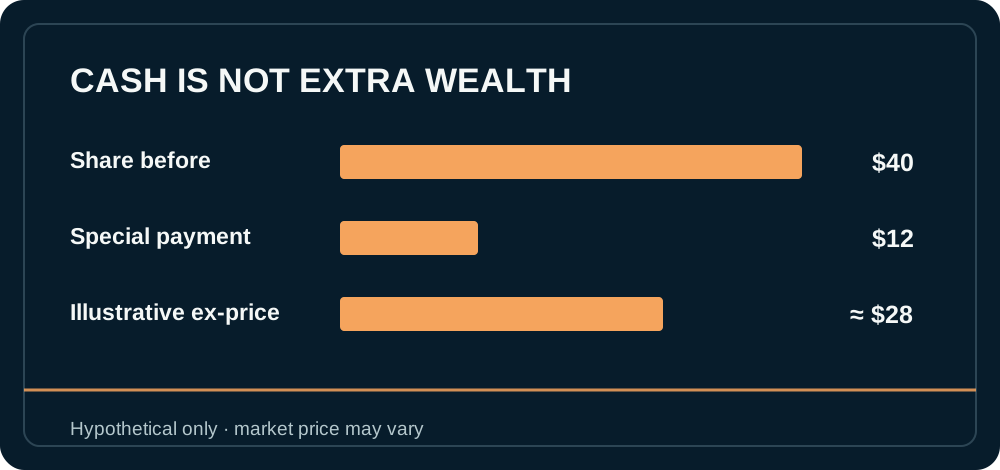
The share price commonly adjusts around the ex-date because the company has paid out cash. The adjustment is not mechanically guaranteed to equal the dividend in live trading: other news, the market and taxes can move the price. A high quoted yield calculated from one exceptional payment is particularly deceptive. Annualizing a $12 special dividend as if it will recur quarterly would invent $48 of yearly income where the board declared only a one-time $12.
What an investor should actually verify
- Read the issuer's declaration for the amount and whether it is regular, special, cash, stock or part of a spin-off.
- Confirm the security's official ex-date in the exchange or FINRA corporate-action record, including any due-bill period. Do not infer it from the record date alone.
- Ask the broker how the entitlement is processed if a purchase or sale falls between record, payment and deferred ex dates.
- Separate recurring dividend capacity from asset monetization. In the next filing, look for the cash source: ongoing operations, asset sale, borrowing or a transaction. A one-time return of capital cannot be assumed in next year's budget.
- Model the whole trade. Include likely price adjustment, spread, taxes and the opportunity cost of the capital. A dividend capture strategy cannot create the payout twice.
The useful mental model is ownership of the economic entitlement, not just the name on the record-date list. For ordinary dividends the two often align intuitively; for an unusually large distribution they may not. Treat every exceptional payout as its own corporate action.
The final check before trading
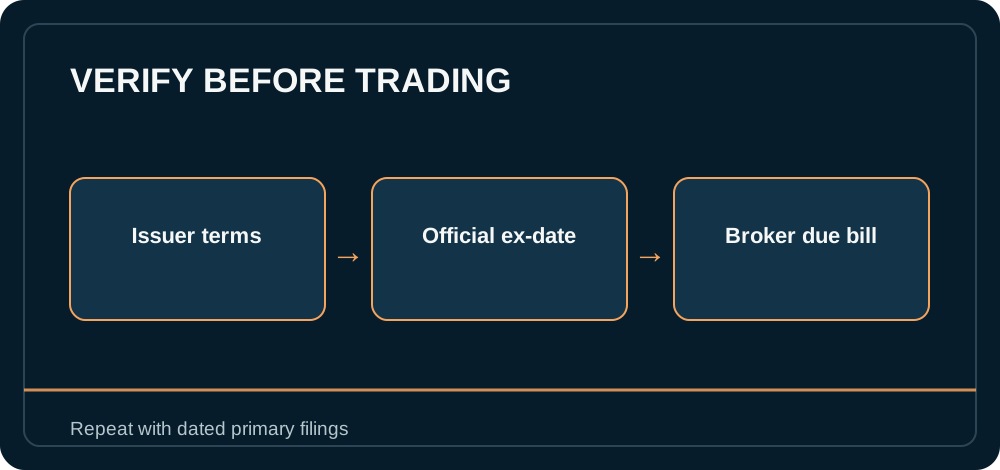
The issuer's announcement often emphasizes the record and payable dates because those matter to its transfer agent. A trading decision also needs the market's ex-date. If a broker's app displays only the record date, look for the exchange corporate-action notice or ask the broker to confirm the due-bill window. The spread between the payment and deferred ex-date is precisely where an intuitive “sell after I got paid” rule can fail. Keep the announcement and broker confirmation in the trade record. This is particularly important when a distribution includes shares in another company or a complicated recapitalization: the owed asset may be stock rather than a simple cash transfer. A one-time special payout can also have distinct tax consequences, which is another reason to avoid using the broker's estimated yield as a net-return calculation.
Two ledgers for one distribution
A practical way to prevent a due-bill mistake is to keep two ledgers. The cash ledger records who initially receives money from the paying agent and when. The entitlement ledger records which investor is economically entitled to that money under the official ex-date. In an ordinary dividend these may seem identical. In a large special distribution, they can temporarily point to different people. The broker's subsequent adjustment reconciles them. This is why an account balance viewed on payment morning is not proof that every dollar is available to spend. The SEC's explanation is explicit that selling during the due-bill period can pass the right to the buyer.
Apply that distinction to the hypothetical $40 share. If a shareholder sells for a price reflecting the still-attached $12 entitlement and also keeps the $12 payment, they would receive the economic benefit twice. The due bill prevents that result. The actual market price may be above or below $40 because businesses and markets continue to change. A trader should therefore model sale proceeds plus dividend entitlement plus any due-bill adjustment, rather than treating the deposit as a separate profit. The date of the sale matters more than the date on which a brokerage app posts the cash.
The same research discipline helps with other unusual distributions. A company may distribute shares, rights or cash from a divestiture. That changes the security a buyer receives economically, and a display of trailing dividend yield may not reflect it. The issuer's declaration says what is being distributed; the official market notice determines how trades transfer the entitlement. FINRA Rule 11140 is the governing ex-date rule, but the specific corporate-action notice is the operational document to save.
Test the investment without the special payment
Remove the one-time $12 from a projected income calendar and ask whether the remaining company still meets the investment thesis. A special dividend may be financed by accumulated cash, an asset sale, a spin-off transaction or borrowing. These have different implications for the assets and future cash generation left behind. A company that distributed proceeds from selling a business may have less future revenue; one returning surplus cash could have the same operating assets with a smaller balance-sheet cushion. Only the transaction announcement and subsequent filings can establish which case applies. The trailing yield is a historical ratio, not evidence that the board can repeat the payment.
Finally, separate the dividend decision from the trading decision. A special payment can be economically neutral before tax in a frictionless illustration, but real shareholders face taxes, spreads, market movements and uncertain valuation. “Buy just before the record date” is not a strategy until the actual ex-date, due-bill treatment and expected post-distribution security are understood. The investor's advantage, if any, must come from an informed view of value, not from reading only half a calendar.
Educational information, not investment or tax advice. This article describes U.S. market conventions as of October 24, 2026; the official notice controls each security. All dollar examples are hypothetical.