
An established dividend can look steady right up to the year a large bond comes due. A company may cover today's payout from current cash flow but still need to refinance debt, pay more interest or preserve cash for lenders. Those decisions affect what remains for shareholders.
Debt does not automatically make a dividend unsafe. Its amount, timing, interest rate, contractual terms and available liquidity matter more than a single debt-to-equity ratio. The SEC's guide to reading a 10-K points investors to Management's Discussion and Analysis for liquidity and capital resources, and to the financial statements and notes for the underlying detail.
Put every maturity on a calendar
Begin with the latest 10-K and update it with subsequent 10-Qs, debt offerings and earnings releases. Look for short-term borrowings, the debt note's maturity table, lease and other material obligations, and the section titled Liquidity and Capital Resources. Separate debt due in the next 12 months from debt due later. Note which borrowing has a fixed coupon and which reprices with a floating benchmark.
Do not treat a maturity as an annual operating expense. It is the date principal must be repaid or replaced. The funding could come from cash on the balance sheet, operating cash flow, a new bond, a bank facility, an asset sale or an equity issue. Each route has a different consequence for future owners. A credit line is a potential source of liquidity, not cash already earned; check its availability and conditions.
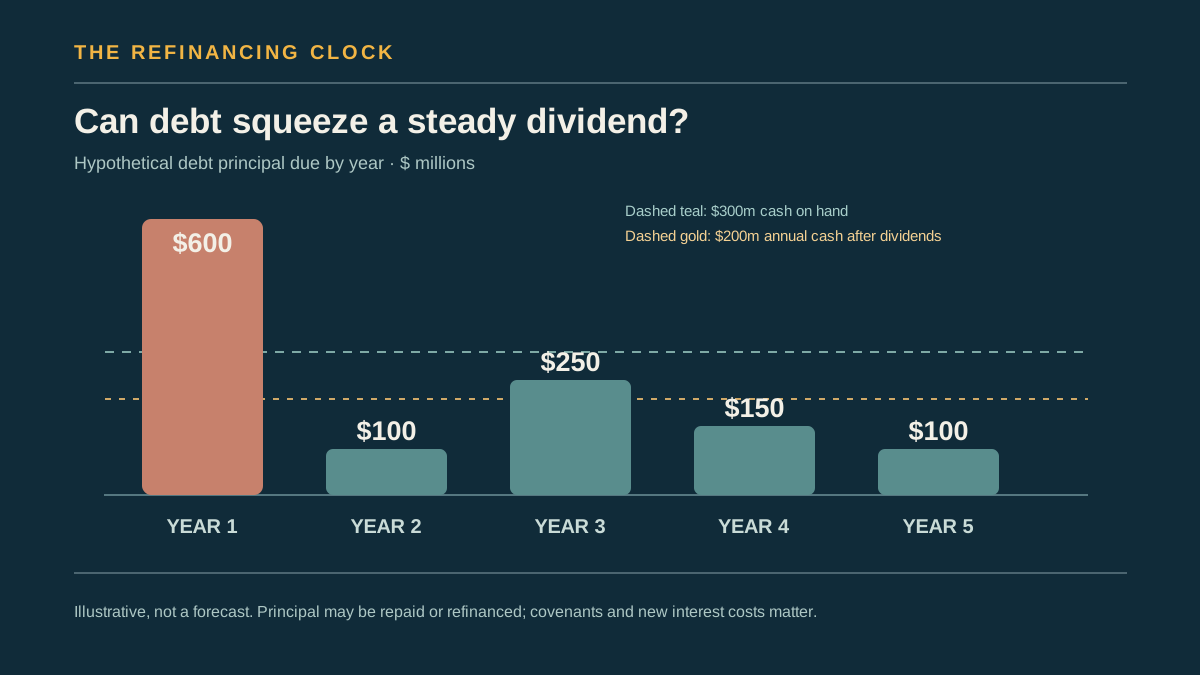
Model the cost of replacing debt
Consider a hypothetical company with $720 million of annual operating cash after capital spending and after the interest already paid in that year. It pays $520 million in common dividends, leaving $200 million before other cash uses. A $600 million fixed-rate note carrying 2.5% matures next year. If it must refinance the entire principal at 6.5%, the incremental annual interest would be $24 million: $600m × (6.5% − 2.5%). Holding everything else equal, its $200 million cushion would shrink to about $176 million before tax effects or changes in operations.
The $600 million refinancing is not another $600 million expense in that annual interest calculation. The company replaces old principal with new principal. If instead it repays the debt with cash, the interest cost may disappear, but $600 million of liquidity must be found. These are different scenarios; adding both as if they occurred together double-counts the burden.
| Hypothetical annual view | Existing note | Refinanced note |
|---|---|---|
| Cash after capital spending, including interest already paid | $720m | $720m |
| Common dividends | $520m | $520m |
| Extra annual interest from refinancing | $0m | $24m |
| Illustrative cash cushion before other uses | $200m | $176m |
This simple sensitivity is not a forecast. The actual refinancing rate, maturity timing, taxes, changing borrowings and operating results could alter it. A stronger business might absorb the higher interest easily. A weaker business with a thin starting cushion could face pressure even from a smaller rate change.
Read the fine print, not only the headline debt total
The debt note and credit agreement may describe covenants: requirements or limits that can restrict additional borrowing, asset sales or dividends. A covenant can matter before the company runs out of cash. In Monro's fiscal 2026 Form 10-K, for example, the company describes periods of covenant relief and liquidity conditions for declaring dividends. That is an illustration of why the contract matters; it is not a view on Monro's shares or its current dividend prospects.
Ask four concrete questions when reading those notes:
- How much is due soon? Compare maturities and other committed payments with cash, near-term cash generation and genuinely available borrowing capacity.
- What resets? Identify variable-rate debt and fixed-rate notes that would likely need replacement at a different cost.
- What limits the board? Look for dividend restrictions, required liquidity, leverage tests and conditions attached to revolving facilities.
- Who needs the cash? A subsidiary may generate it while a parent pays the common dividend. Check any restriction on transferring cash between them.
The SEC's corporate-bond explainer makes the underlying hierarchy clear: the issuer has a legal commitment to pay bond interest and principal, while a common dividend depends on a declaration. In financial distress, that difference becomes practical, not merely technical.
Link the debt calendar to the dividend decision
A debt schedule by itself is not a verdict. Put it next to cash generated after necessary investment, current cash holdings, and management's plans for buybacks, acquisitions and capital spending. The company may have years to prepare for a maturity, or a near-term wall that makes future dividend growth less flexible. Read the most recent 10-Q as well: an old 10-K may predate a refinancing, acquisition or credit-facility amendment.
For an income investor, a useful one-page note has the next three years of principal maturities, fixed versus floating exposure, cash and available facilities, the interest-cost sensitivity and any dividend covenant. Update it after every material financing event. It is more actionable than repeating that the company has always paid a dividend.
The strongest conclusion is conditional: “At current cash generation and refinancing terms, the dividend has a cushion; a decline in operating cash flow or a larger financing cost would narrow it.” That sentence tells you what to monitor. A bare “safe dividend” label does not.