

“The payout ratio is 70%” sounds precise. It is incomplete until we know what the 70% divides. Dividend per share divided by earnings per share, cash dividends divided by free cash flow, and distributions divided by adjusted funds from operations are different measurements. Even within one company, they can point in different directions. Across an industrial business, a property REIT, a bank, an insurer and a BDC, one universal threshold is unlikely to answer whether the dividend is durable.

The useful sequence is: identify the business model, choose a relevant recurring resource, compare the payout with that resource, and then test what remains for debt, investment and bad years. A low ratio in one quarter does not guarantee safety. A high ratio in a sector with accounting charges that differ from recurring cash needs does not automatically prove danger.
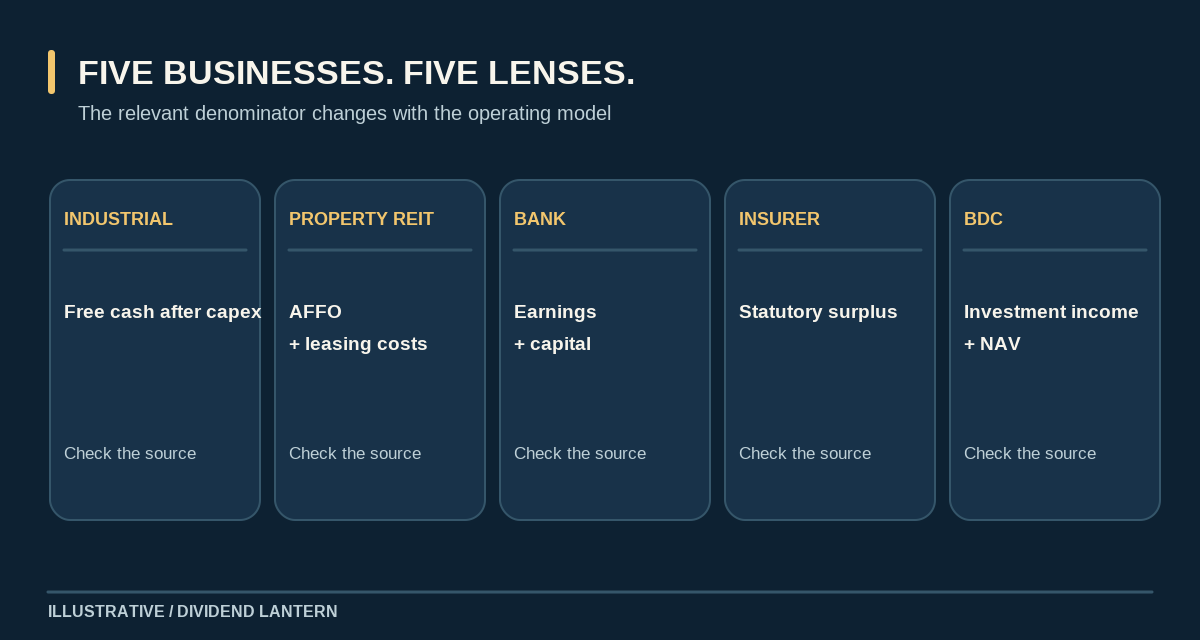
First define the numerator and denominator
In a conventional earnings payout ratio, the numerator is common dividends and the denominator is net income available to common shareholders, often expressed per share. For a hypothetical company paying $3 per share against $5 earnings per share, the ratio is 60%. A share count change, a one-time gain, an accounting loss or a major capital project can make that single figure less informative. Comparing a quarterly dividend with annual earnings would be a unit error. Comparing a preferred distribution with income only available to common shareholders can also distort the result.
Free cash flow offers another view: operating cash flow minus capital expenditure under a stated definition. Suppose a hypothetical industrial company reports $800 million of operating cash flow, spends $300 million on capital projects and pays $350 million of common dividends. A simple free-cash-flow estimate is $500 million, and the cash payout is $350 million ÷ $500 million = 70%. This says the dividend was covered by that year's simplified cash estimate. It does not tell us whether the $300 million capex was enough to maintain competitiveness, whether working capital temporarily flattered cash flow or whether debt maturities are near. Our free-cash-flow guide walks through the follow-up questions.
A property REIT: read the bridge to recurring property cash
Depreciation of buildings can make GAAP earnings a poor one-line proxy for recurring property cash. The REIT industry uses funds from operations (FFO) as a supplemental measure; analysts and issuers often use adjusted FFO (AFFO) with additional adjustments. Nareit defines FFO and explains its role. Its AFFO glossary cautions that AFFO has no standardized definition, so investors must inspect each company's reconciliation and recurring capital needs.
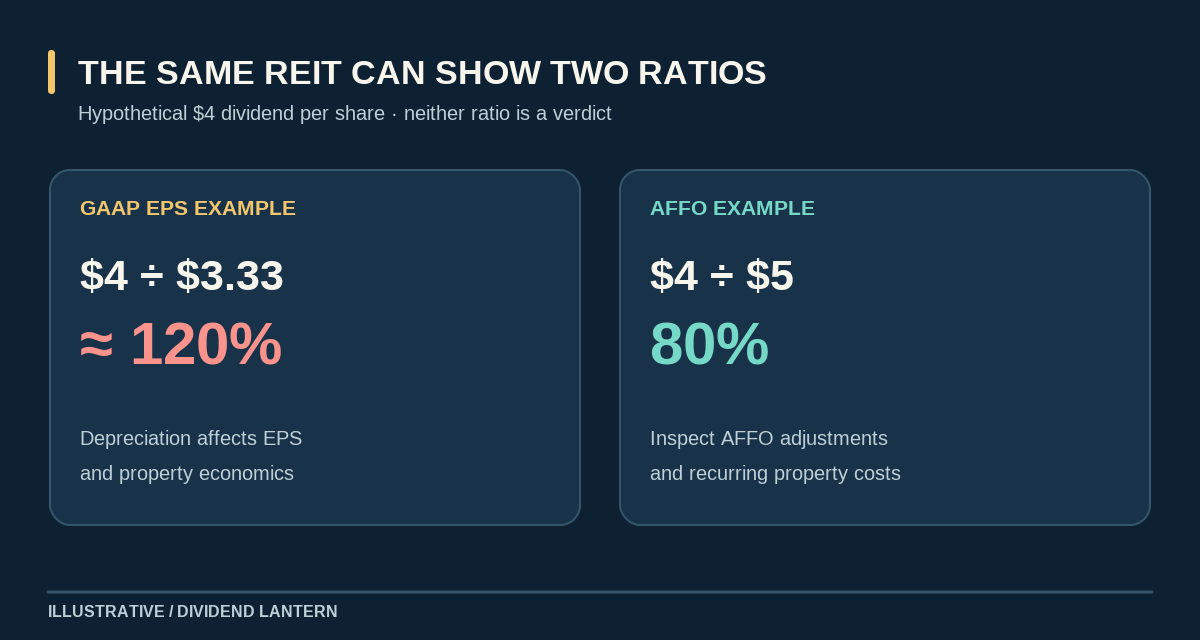
Imagine a hypothetical REIT paying $4 per share and reporting $5 per share of AFFO. The apparent 80% AFFO payout may be a more relevant first lens than a 120% GAAP EPS payout. Still, ask which leasing commissions, tenant improvements and maintenance work are excluded or included in its definition. A well-covered payment today can be pressured by vacancies, refinancing costs or property-level capital spending tomorrow. Our REIT dividend-safety guide and lease-expiration guide treat those risks in detail.
A bank: earnings and regulatory capital both matter
Banks transform deposits and other funding into loans and securities. A dividend policy must coexist with credit losses, liquidity needs and regulatory capital requirements. The Federal Reserve's policy statement says a bank's dividends should generally be funded by net income available to common shareholders and be consistent with its capital needs, asset quality and overall condition. Federal Reserve Regulation 208.5 also sets limits on dividends for covered member banks under specified conditions.
A hypothetical 30% earnings payout may look conservative, yet it does not reveal whether credit losses are rising or capital has become thin relative to risk-weighted assets. Review common equity tier 1 capital where relevant, stress-test results, credit quality, deposit costs and the difference between bank subsidiary cash and holding-company cash. Our JPMorgan vs. Bank of America research gives an issuer-specific example. Do not treat an industrial company's “free cash flow ÷ dividend” shortcut as the bank's complete capital test.
An insurer: the operating subsidiary has its own capital rules
An insurance holding company may report consolidated profit while cash intended for a parent-level dividend is held in regulated insurance subsidiaries. The ability of those subsidiaries to pay the parent depends in part on statutory surplus and applicable state rules. The NAIC's insurance holding-company model regulation describes information and approval requirements for extraordinary dividends, including the effect on surplus. State implementation can vary; the model is a research starting point, not a claim that every insurer faces identical limits.
Ask how much capital the insurance operation needs against its obligations, whether catastrophe or claim experience changed, and how much ordinary cash can reach the parent. An insurer's low consolidated earnings payout may still leave a parent with little unrestricted cash in a stressed year. Our insurer dividend guide goes deeper into statutory capital and the movement of cash between entities.
A BDC: base income, supplemental payouts and asset quality
A business development company earns income from an investment portfolio, often including loans to smaller businesses. A regular distribution and a supplemental distribution are different commitments. A BDC may report net investment income per share, realized gains, losses and changes in net asset value. Its distribution can also include return of capital. The SEC's BDC investor bulletin describes these components and the risks of a distribution that returns investor principal.
Suppose a hypothetical BDC earns $1.20 of annual net investment income per share and declares a $1.00 regular distribution plus a $0.40 supplemental distribution. The regular payout seems covered on that measure; the $1.40 total exceeds it. That is a prompt to investigate the source and repeatability of the supplemental amount, rather than classifying the entire payment as a permanent $1.40 base. Also inspect nonaccrual loans, borrowing, net asset value and portfolio concentration. Our BDC regular-versus-supplemental guide provides the full checklist.
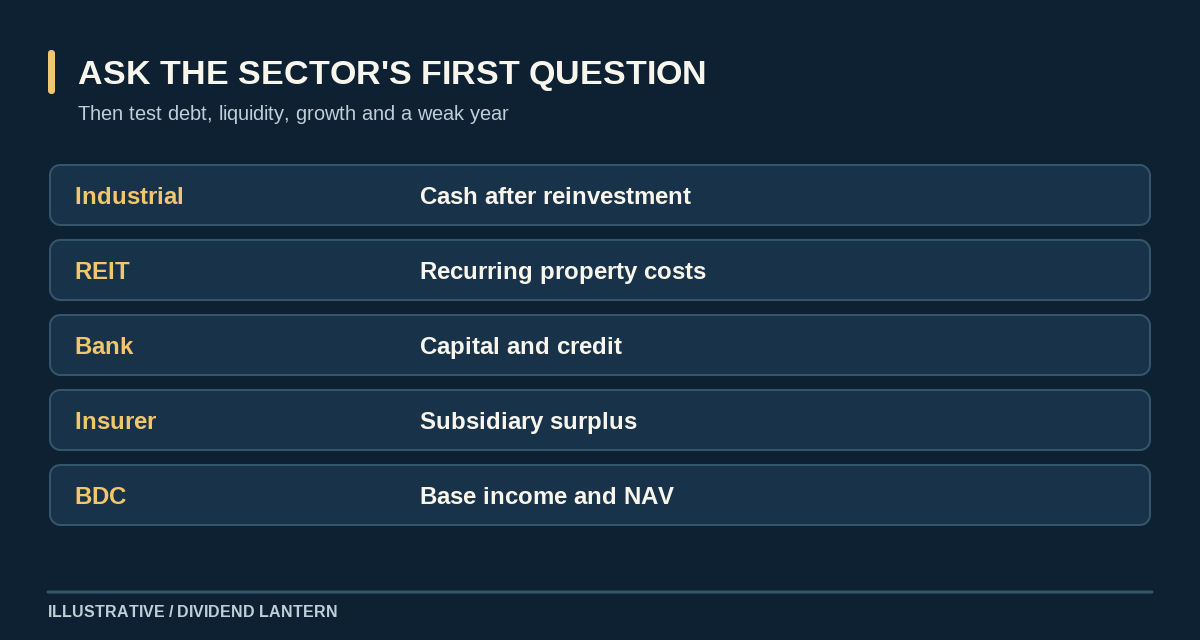
A better comparison table for a watchlist
Create one row per holding with six columns: entity type; regular dividend per share; the period-matched denominator and its source; cash retained after the payout; financing or regulatory constraint; and the event that could weaken next year's coverage. Put a footnote beside any non-GAAP measure explaining the issuer's definition. For a fund, distinguish distribution policy from earnings of individual portfolio companies. For a bank or insurer, include the relevant capital information alongside earnings. For a REIT, retain both the AFFO reconciliation and actual capital-spending discussion.
Do not rank a hypothetical 50% GAAP payout at a REIT against a 60% payout at a bank and declare the first one safer. The percentages do not share the same economic base. Compare each entity with its own history, peers using comparable definitions, and the resources it needs to stay healthy. Then ask how the dividend behaves under a plausible bad year. Our dividend stress-test guide provides a way to make that final step explicit.
This sector map is intended to improve the first question, not to produce a mechanical buy or sell signal. A durable dividend depends on a durable business, a suitable balance sheet, and a payout that leaves room for obligations and reinvestment. The right denominator makes that analysis possible; it cannot replace it.
Educational U.S. investor research as of October 28, 2026. All numerical examples are hypothetical. Rules, company definitions and capital requirements should be checked against current filings and regulators before use.
Primary sources
- Federal Reserve: Cash Dividends Not Fully Covered by Earnings
- Federal Reserve: Regulation 208.5, Dividends and Other Distributions
- SEC Investor.gov: Publicly Traded BDCs Investor Bulletin
- NAIC: Insurance Holding Company System Model Regulation
- Nareit: Funds from Operations
- Nareit: Adjusted Funds from Operations

